

 Login
Login

 January 20, 2026
|
Voiced by Amazon Polly |
Introduction
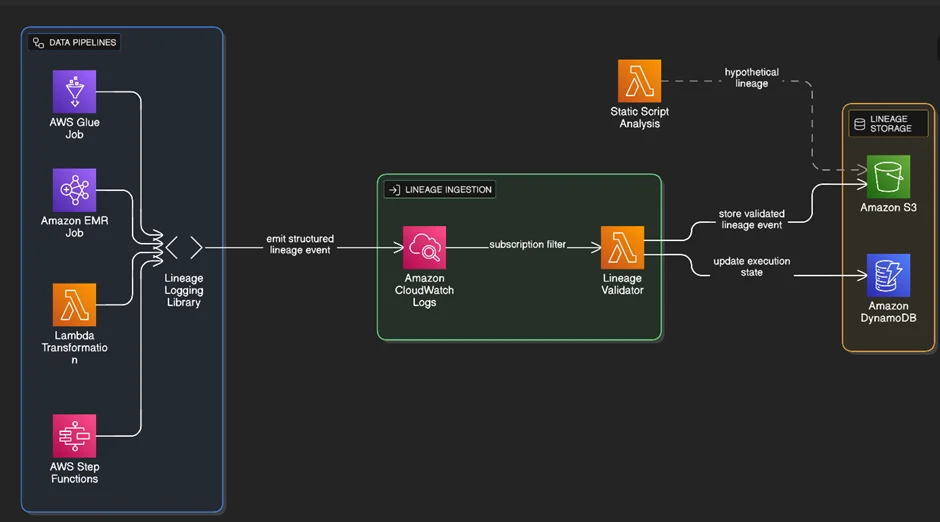
In the first two blogs of this series, we established the technical foundation of a production-grade data lineage platform on Amazon Web Services:
- Part 1 demonstrated how lineage must be captured deterministically at execution time using structured logging embedded directly in pipeline scripts.
- Part 2 showed how those execution-grade lineage events are structured into a time-aware graph model using Amazon Neptune, with carefully controlled GenAI enrichment via Amazon Bedrock.
At this stage, many organizations stop. They have a lineage graph, some visualizations, and perhaps a few ad-hoc queries. However, lineage that exists only as documentation or diagrams does not justify the operational cost of building it.
The real value of lineage emerges only when it is operationalized, when it becomes an active system used daily by support teams, platform engineers, and governance stakeholders. This third blog focuses on that final step: transforming lineage from a passive graph into a shared operational and analytical product that directly improves reliability, reduces incident resolution time, and enables advanced analytics across the data platform.
Pioneers in Cloud Consulting & Migration Services
- Reduced infrastructural costs
- Accelerated application deployment
Problem Context: Why Lineage Often Fails to Deliver Business Value
Even organizations with technically sound lineage implementations struggle to extract value due to three common gaps.
- Lineage Is Not Integrated into Operational Workflows
Support engineers rarely have time to explore graph visualizations during incidents. If lineage is not queryable through APIs and automation, it is effectively unused during critical events.
- Lineage Is Disconnected from Time, Cost, and SLA Data
Static lineage answers what depends on what, but not when, how often, or at what cost. Without these dimensions, lineage cannot inform prioritization or optimization decisions.
- Different Teams Build Their Own Views
Support, analytics, and governance teams often maintain separate interpretations of lineage, leading to inconsistency and eroding trust.
The objective of this phase is to ensure that all consumers operate on a single lineage truth, while enabling purpose-specific views and analytics.
High-Level Architecture Overview
- Script-centric data lineage through logging
- Data lineage using GenAI and graph modeling
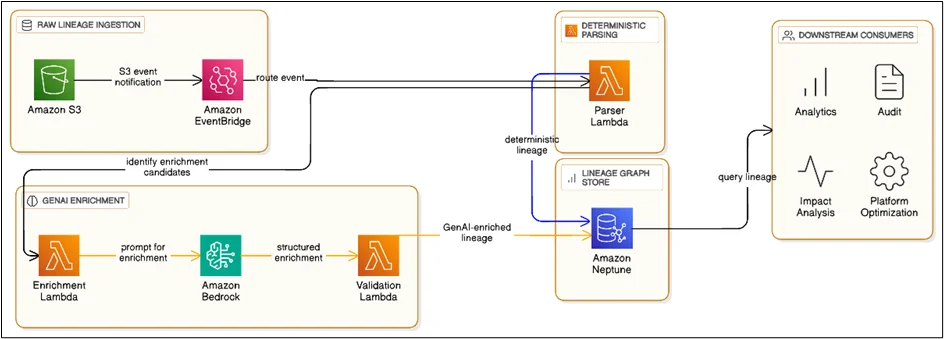
This phase introduces the lineage consumption plane, which sits on top of the lineage graph built in earlier stages.
AWS Services Used
- Amazon Neptune – Authoritative lineage graph
- AWS Lambda – Lineage query and traversal APIs
- Amazon API Gateway – Controlled lineage access
- Amazon Athena – Analytical queries over lineage snapshots
- Amazon QuickSight – Operational and analytical dashboards
- Amazon S3 – Lineage snapshots and historical exports
- Amazon OpenSearch Service – Search-driven lineage exploration
No additional processing systems or external BI tools are required.
Lineage as a Support and Incident-Response System
Embedding Lineage into Support Workflows
When a data issue occurs, such as a broken dashboard, missing data, or anomalous metrics, the first question support teams ask is:
“Where did this data come from, and what changed?”
Instead of manually tracing pipelines, support systems invoke lineage APIs backed by Neptune.
Example: Metric Regression Incident
- Monitoring detects a KPI deviation.
- The alert payload includes the affected dataset or metric ID.
- AWS Lambda-based support API:
- Queries Neptune for upstream DERIVES_FROM paths
- Filters executions by timestamp
- Identifies the last successful lineage path
- The API returns:
- Upstream datasets
- Pipeline executions
- Schema changes or failed steps
This process reduces incident diagnosis from hours to minutes.
Time-Aware and Comparative Lineage Views
Why Time Matters in Lineage
Lineage without temporal context is misleading. Dependencies change over time due to:
- Code deployments
- Schema evolution
- Data source migrations
The Neptune data model introduced earlier supports valid_from and valid_to attributes, enabling time-sliced lineage queries.
Comparative Lineage Analysis
Using time-aware traversal, teams can compare:
- Lineage before and after a deployment
- Dependency changes across environments
- Historical vs current data flows
This is particularly valuable during post-incident reviews and audits.
Lineage-Driven Analytics Using Amazon Athena and Amazon QuickSight
Lineage Snapshots for Analytics
While Amazon Neptune excels at traversal, large-scale aggregation is better handled by analytical engines. Periodic lineage snapshots are exported from Amazon Neptune into Amazon S3 in a flattened format.
These snapshots are queried using Amazon Athena to compute metrics such as:
- Number of downstream dependencies per dataset
- Pipeline criticality scores
- Change frequency across lineage paths
- Failure correlation across dependency chains
Operational Dashboards
Amazon QuickSight consumes Amazon Athena results to present:
- High-risk datasets with a large blast radius
- Pipelines with frequent downstream failures
- Most critical lineage paths by business impact
- Lineage freshness and execution health
Platform leads use these dashboards for prioritization and capacity planning.
Cost and SLA Attribution Through Lineage
Why Lineage Enables Cost Intelligence
Traditional cost reporting shows where money is spent, but not why. Lineage provides the missing context by linking compute and storage costs to downstream consumers.
By joining:
- Lineage execution data
- AWS Cost and Usage Reports (CUR)
- SLA definitions
The platform can answer questions such as:
- Which datasets are the most expensive per consumer?
- Which pipelines drive the highest downstream SLA risk?
- Where can optimizations yield maximum impact?
This transforms lineage into a decision-support system rather than just a diagnostic tool.
Unified Lineage Views for Multiple Consumers
A key design requirement is that all consumers operate on the same lineage graph, even though their views differ.
Consumer-Specific Views
- Support teams – Time-filtered, execution-focused views
- Analytics teams – Aggregated and trend-based views
- Governance teams – Full provenance and audit trails
- Platform engineers – Structural and dependency-focused views
Each view is derived from Amazon Neptune, ensuring consistency and trust.
Failure Scenarios and Resilience

The lineage platform never blocks data processing; it degrades independently.
Security and Access Control
- AWS IAM policies enforce read/write separation
- Amazon API Gateway provides fine-grained access
- Sensitive metadata is masked at the API layer
- AWS CloudTrail records all lineage access
This ensures lineage itself does not become a compliance risk.
Conclusion
Operationalizing data lineage is the point at which lineage justifies its engineering investment. By integrating lineage directly into support workflows, analytical systems, and cost intelligence pipelines, organizations transform lineage from static documentation into a living operational asset.
On AWS, this is achieved by combining:
- Execution-grade lineage capture
- Graph-based modeling with Amazon Neptune
- Analytical processing with Amazon Athena and Amazon QuickSight
- API-driven consumption across teams
Drop a query if you have any questions regarding Data Lineage and we will get back to you quickly.
Empowering organizations to become ‘data driven’ enterprises with our Cloud experts.
- Reduced infrastructure costs
- Timely data-driven decisions
About CloudThat
FAQs
1. Why not let each team maintain its own lineage view?
ANS: – Multiple lineage sources inevitably diverge. A single authoritative graph ensures consistency and trust across the organization.
2. Does querying lineage impact production performance?
ANS: – No. Lineage operates on metadata and logs, completely isolated from production data paths.
3. Can this lineage platform support compliance audits?
ANS: – Yes. Time-aware, execution-grade lineage provides full data provenance with immutable historical records.


WRITTEN BY Bineet Singh Kushwah
Bineet Singh Kushwah works as an Associate Architect at CloudThat. His work revolves around data engineering, analytics, and machine learning projects. He is passionate about providing analytical solutions for business problems and deriving insights to enhance productivity. In his quest to learn and work with recent technologies, he spends most of his time exploring upcoming data science trends and cloud platform services, staying up to date with the latest advancements.


 PREV
PREV



Comments