

 Login
Login

 August 25, 2026
|
Voiced by Amazon Polly |
Introduction
DevOps and SRE have evolved rapidly, from manually managed servers to Infrastructure as Code, CI/CD, containers, and Kubernetes.
Now, we’re entering the next phase: AI-driven operations.
This goes beyond using AI to write Terraform or troubleshoot a Kubernetes pod. AI agents can interact with tools, gather context, investigate incidents, and even take controlled actions.
For DevOps and SRE teams, this could fundamentally change how we operate production systems.
The Shift: From Rigid Automation to AI Agents
Traditional DevOps automation is fantastic when you know exactly what needs to happen. It thrives on predictability.
Think about your standard deployment flow:
- Developer pushes code
- CI pipeline kicks off
- Code builds, and tests run
- Container image is baked
- Deployed to Kubernetes
- Application is monitored
Everything is neatly predefined. But as anyone who has ever been on call knows, production incidents are rarely predictable.
Imagine getting paged with a generic alert: “Checkout service error rate is above 10%.”
Right now, an engineer’s next 20 minutes look like a chaotic scramble. You’re checking Grafana dashboards, tailing application logs, looking at Kubernetes events, hunting down recent Git commits, and querying database metrics to piece together what actually broke.
This is exactly where AI agents shine.
Instead of just asking an LLM a single question, you can give an agent access to your tooling and tell it to investigate. It can dynamically jump from your logs to your deployment history, check metrics, compare patterns, and build a hypothesis. It’s not just generating text, it’s actively collecting evidence before jumping to a conclusion.
Pioneers in Cloud Consulting & Migration Services
- Reduced infrastructural costs
- Accelerated application deployment
A Real-World Kubernetes Example
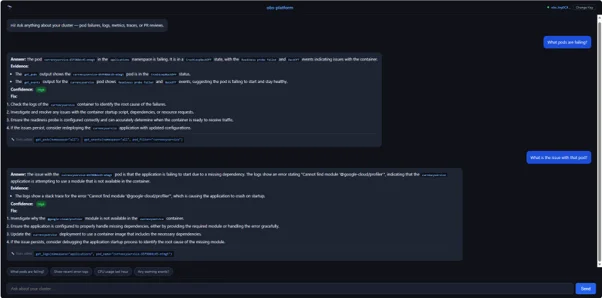
Let’s say you’ve got a production app running on Kubernetes, and suddenly, users are getting slapped with HTTP 500 errors. Your monitoring system fires off an alert.
Today, a human SRE has to run through a mental checklist manually:
- What changed recently?
- Did someone just deploy a new version?
- Are pods restarting?
An AI agent can instantly perform this initial triage. It notices a new version was deployed 10 minutes ago. It checks the logs and spots database connection timeouts. It cross-references the Git commit and sees that the connection pool size was tweaked in the latest release.
Instead of waking you up with a vague “Error rate high” message, the agent hands you this:
“The recent spike in checkout failures is likely tied to deployment v2.4.1 (deployed 10 mins ago). This release altered the database connection-pool size, resulting in connection timeouts in the app logs and a spike in active connections on the database.”
That isn’t just an alert. That’s actionable intelligence.
From Investigation to Remediation (and Bounded Autonomy)
Finding the root cause is only half the battle. The next question is: what do we do about it?
This is where AI agents become powerful, and risky. If an agent identifies a faulty deployment, it could potentially roll it back. But should AI have direct control over production?
The goal isn’t to give an AI unrestricted access to production, but to use bounded autonomy—enough access to be useful, with strict guardrails to prevent major incidents.
A practical model looks like this:
- Low Risk: AI executes automatically.
- Medium Risk: AI recommends → Human approves.
- High Risk: Human decision required.
We Need to Monitor the Monitors
There’s an interesting side effect of letting AI operate our infrastructure: who watches the AI?
Traditional observability focuses on our applications, are requests failing, is latency increasing, and are pods healthy? With AI agents, we also need to know what the agent investigated, which tools it used, what data it relied on, and whether its action actually fixed the problem.
In short, the operator itself becomes a system we need to observe. AI observability will become an important part of future SRE platforms.
AI and the Future of Platform Engineering
AI agents fit naturally with Platform Engineering. Internal Developer Platforms (IDPs) already provide developers with self-service infrastructure without requiring them to become Kubernetes experts.
Imagine a developer typing into Slack: “Deploy my reporting service to production with 3 replicas, autoscaling, and standard monitoring.”
Instead of dealing with YAML, pipelines, or Jira tickets, an AI agent could understand the request and use the organization’s existing, approved platform modules to deploy it. The platform still provides the secure and compliant building blocks, the AI simply becomes a natural-language interface.
So, What Happens to SREs?
Will AI agents replace DevOps and SRE engineers? No, but they will change the job.
A lot of on-call work involves searching through logs, dashboards, and documentation to understand what happened. If AI can handle this repetitive investigation, engineers can focus on higher-value work, such as:
- Designing reliable architectures
- Capacity planning
- Security and governance
- Resilience and disaster recovery
- Building the platforms AI operates on
The role shifts from manually operating systems to designing systems that can operate safely on their own.
How DevOps Engineers Should Adapt
DevOps engineers don’t need to abandon Kubernetes or Terraform and become ML researchers. The most valuable engineers will be those who combine strong infrastructure skills with AI knowledge.
Along with Cloud, Kubernetes, Networking, CI/CD, and Go/Python, engineers should learn:
- LLM basics and prompt engineering
- AI agents and tool calling
- AI security and governance
The real advantage will come from understanding both how infrastructure works and how AI can be used to operate it safely.
Conclusion
AI-driven DevOps is still evolving, and not every AI agent is ready for production yet. But the direction is clear. DevOps has always been about better automation, and AI is taking that a step further by making automation more adaptive and intelligent. The future isn’t about AI replacing DevOps engineers, but about helping them manage larger, more complex environments while handling repetitive operational work. The real challenge isn’t making AI powerful enough to run production, it’s making it safe enough to trust.
Drop a query if you have any questions regarding DevOps, and we will get back to you quickly.
Empowering organizations to become ‘data driven’ enterprises with our Cloud experts.
- Reduced infrastructure costs
- Timely data-driven decisions
About CloudThat
FAQs
1. What is AI-driven DevOps?
ANS: – AI-driven DevOps uses AI and AI agents to automate tasks such as incident investigation, root-cause analysis, deployment assistance, and infrastructure operations.
2. What is an AI agent in DevOps?
ANS: – An AI agent is a system that can use tools and APIs, collect information from different sources, investigate problems, and recommend or perform actions based on its findings.
3. Will AI agents replace DevOps or SRE engineers?
ANS: – No. AI is more likely to reduce repetitive operational work and allow DevOps and SRE engineers to focus on architecture, reliability, security, and complex problem-solving.


WRITTEN BY Gokulraj G
Gokulraj G works as a Research Associate at CloudThat, with hands-on experience in automating infrastructure, managing cloud environments, and optimizing deployment pipelines. He is certified as an AWS Solutions Architect – Associate and a Terraform Associate, which supports his ability to design scalable cloud systems and manage infrastructure as code effectively. His day-to-day work involves tools like Kubernetes, Docker, and CI/CD platforms, all focused on building reliable and efficient systems.


 PREV
PREV












Comments