

 Login
Login

 May 22, 2026
|
Voiced by Amazon Polly |
Overview
Modernization projects often stall after lift-and-shift because teams lack the bandwidth to continuously assess dependencies, refactor applications, modernize infrastructure, and validate changes at scale. Agentic AI changes that model by introducing autonomous agents that can analyze environments, generate modernization recommendations, execute repetitive transformation tasks, and accelerate cloud adoption workflows. This article covers how AWS DevOps Agent, MCP Server, and Amazon Bedrock AgentCore can be combined to reduce modernization timelines, lower post-migration defects, and enable a more scalable approach to cloud transformation.
Pioneers in Cloud Consulting & Migration Services
- Reduced infrastructural costs
- Accelerated application deployment
Introduction
Lift-and-shift was supposed to be phase one. For 72% of enterprises, it became the final destination.
Flexera’s 2025 State of the Cloud report confirms what most architects already know: organizations moved workloads to the cloud but never modernized them. They’re paying cloud prices for on-premises architecture, no auto-scaling, no managed services, no resilience patterns. The reason modernization stalls isn’t technical capability. It’s operational bandwidth. In 2026, AI agents change that equation entirely.
Agentic AI Changes the Modernization Equation
That number comes from Flexera’s 2025 State of the Cloud report. Nearly three-quarters of organizations lifted and shifted their on-premises applications to the cloud and stopped there. They’re paying cloud prices for on-premises architecture. No auto-scaling. No managed services. No resilience patterns.
The reason modernization stalls isn’t technical. It’s operational. Teams know they should refactor. They know containers and serverless would save money. But the effort of analyzing dependencies, rewriting code, testing for regressions, and migrating data while keeping production running is overwhelming.
Agentic AI Changes the Modernization Equation
In 2026, AWS released three capabilities that fundamentally shift how modernization projects execute:
- AWS DevOps Agent — Investigates infrastructure, identifies issues, and executes operational tasks autonomously.
- AWS MCP Server (GA) — Gives AI agents authenticated access to all AWS services via the Model Context Protocol.
- Amazon Bedrock AgentCore — Framework for building custom agents that reason, plan, and act across multi-step workflows.
Together, these tools enable a modernization approach in which agents handle repetitive analysis and execution, while architects focus on decision-making.
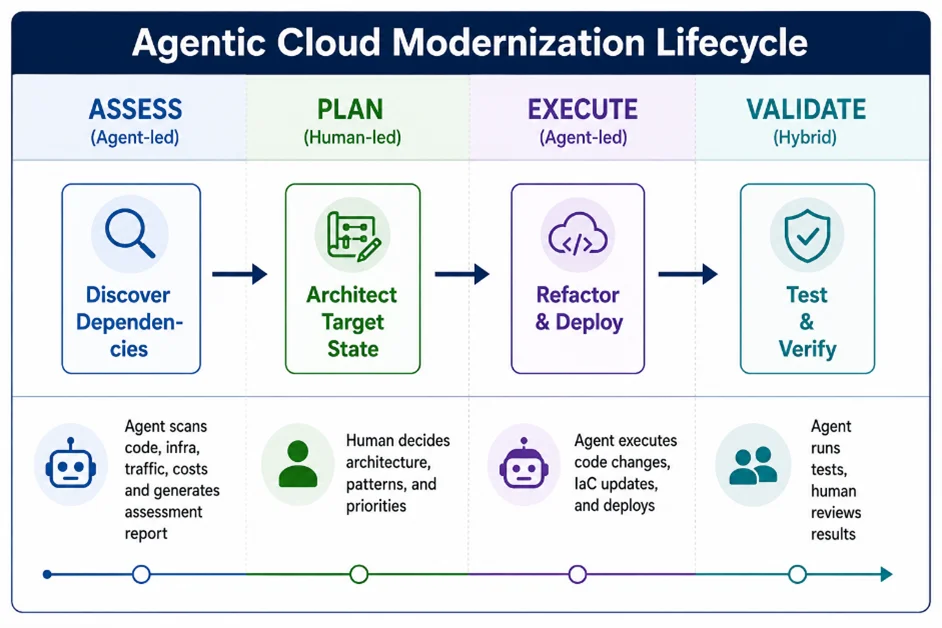
The Agentic Modernization Framework
Notice the pattern: agents handle the labor-intensive phases (Assess and Execute), humans handle the judgment-intensive phase (Plan). Validation is shared.
Phase 1: Agent-Driven Assessment
This is where most modernization projects waste months. Manually cataloging applications, mapping dependencies, and estimating effort. An agent can do this in hours.
What the agent analyzes:
- Amazon CloudWatch metrics → identifies underutilized resources
- AWS CloudTrail logs → maps service-to-service communication patterns
- Code repositories → detects framework versions, deprecated APIs, and tight coupling
- Cost and Usage Reports → flags expensive anti-patterns (oversized instances, idle resources)
Output: A prioritized modernization backlog ranked by business impact, technical risk, and estimated effort.
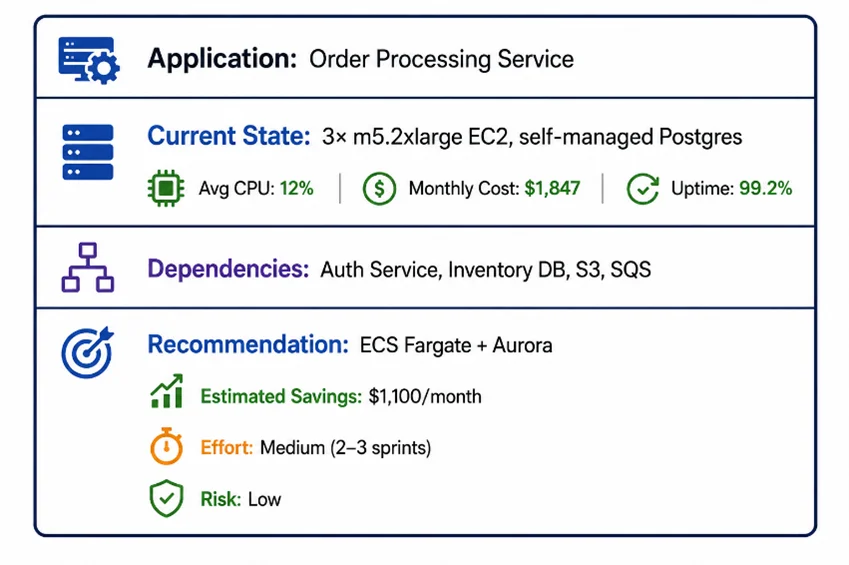
Phase 2: Human-Led Architecture Decisions
Agents assess. Humans decide. This phase is where architects earn their value:
- Which applications modernize first? (Business priority)
- Replatform or refactor? (Risk tolerance)
- Which managed services replace custom code? (Team capability)
- What’s the rollback strategy? (Operational maturity)
The agent provides data. The architect provides judgment.
Phase 3: Agent-Executed Modernization
Once the target architecture is defined, agents execute the mechanical work:
Code Refactoring — Using Kiro or Amazon Q Developer, agents can:
- Convert monolithic code into service boundaries
- Replace deprecated SDK calls with current versions
- Generate Dockerfiles and Amazon ECS task definitions from existing deployment scripts
- Create Infrastructure as Code (CDK/Terraform) from manually provisioned resources
Infrastructure Deployment — Using AWS MCP Server, agents can:
- Provision target infrastructure through authenticated API calls
- Configure networking, security groups, and AWS IAM roles
- Set up CI/CD pipelines for the modernized application
- Execute blue/green deployments with automated rollback triggers
Data Migration — Agents orchestrate:
- Schema comparison between source and target databases
- AWS DMS task configuration for live replication
- Cutover coordination with application deployment
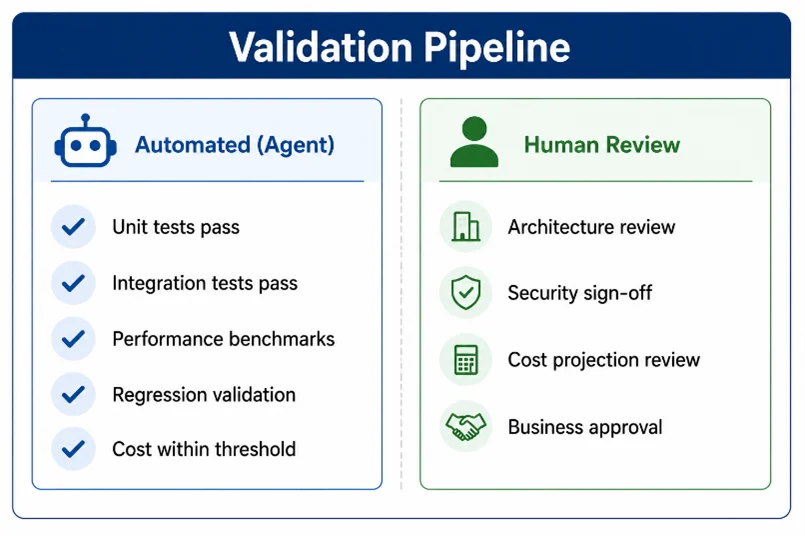
Phase 4: Continuous Validation
A Practical Starting Point
You don’t need to modernize everything at once. Here’s a 30-day pilot that proves the approach:
- Week 1: Deploy an assessment agent that scans one AWS account. Use Amazon Bedrock with tool access to Cost Explorer, CloudWatch, and AWS Config. Generate the prioritized backlog.
- Week 2: Pick the lowest-risk, highest-savings application from the backlog. Define the target architecture (human decision).
- Week 3: Use Kiro to refactor the application. Let the agent generate the container configuration, IaC, and deployment pipeline.
- Week 4: Deploy to a staging environment. Run the validation pipeline. Measure cost and performance against the baseline.
One application modernized in 30 days, with 60% less manual effort than traditional approaches. That’s your proof point for scaling the program.
The Economics
McKinsey’s 2025 research on cloud modernization found that organizations using AI-assisted modernization tools completed migrations 40% faster and with 35% fewer post-migration defects compared to manual approaches. The cost of the AI tooling (Bedrock invocations, agent compute) typically represents less than 3% of the total modernization budget, while reducing the largest cost component (engineering labor) by a third.
The math works. The tooling is ready. The only question is whether your organization starts now or waits for competitors to finish first.
Conclusion
Drop a query if you have any questions regarding Agentic modernization and we will get back to you quickly.
Empowering organizations to become ‘data driven’ enterprises with our Cloud experts.
- Reduced infrastructure costs
- Timely data-driven decisions
About CloudThat
FAQs
1. Can agents handle legacy languages like COBOL or older Java versions?
ANS: – Amazon Q Developer supports migrating Java 8/11 applications to Java 17+. For COBOL, the AWS Mainframe Modernization service handles the conversion. Agents orchestrate these tools — they don’t need to understand COBOL directly, they need to invoke the right transformation service and validate the output.
2. How do I ensure the agent doesn't break production during modernization?
ANS: – Agents operate in isolated environments by default. All changes go through CI/CD pipelines with automated testing gates. Blue/green deployments ensure the old version continues to run until the new version passes all validation checks. The agent never modifies production directly, it creates and deploys through controlled pipelines.
3. What's the minimum team size needed for agentic modernization?
ANS: – A pilot can run with 2-3 people: one cloud architect (decisions), one platform engineer (agent configuration and pipeline setup), and one application developer (validation and domain knowledge). The agents handle the work that would traditionally require 5-8 additional engineers.
4. Does this approach work for regulated industries with strict change management?
ANS: – Yes. Every agent action is logged with full audit trails. The human-in-the-loop architecture decision phase satisfies change advisory board requirements. Automated validation provides evidence for compliance documentation. Several financial services organizations are using this pattern with their existing ITIL change management processes intact.


WRITTEN BY Vignesh J
Vignesh Jagadeesan is the Head of Presales at CloudThat with 12+ years of experience driving digital transformation for Public Sector, SMB, and Enterprise customers across India and the USA. He specializes in Cloud Consulting, Data Management, MDM, Analytics, and enterprise modernization. Vignesh has led transformation engagements spanning cloud adoption, analytics, managed services, and enterprise solutioning across government, BFSI, healthcare, retail, manufacturing, and energy sectors, partnering with business stakeholders and cloud partners to deliver scalable, outcome-driven solutions.


 PREV
PREV










Comments