

 Login
Login


 May 22, 2026
|
Voiced by Amazon Polly |
Overview
Serverless architectures deliver exceptional agility, scalability, and operational simplicity, but they are not universally optimal for every workload. Certain application patterns introduce cost inefficiencies, latency challenges, execution limits, and operational complexity that can make containers or traditional compute models a better fit. This article examines where serverless architectures begin to break down, highlights the trade-offs involved, and provides a practical decision framework for selecting the right compute model based on workload characteristics rather than architectural trends.
Pioneers in Cloud Consulting & Migration Services
- Reduced infrastructural costs
- Accelerated application deployment
Introduction
Serverless deserves its reputation. AWS Lambda processes trillions of invocations monthly, and it has genuinely transformed how teams build event-driven systems. But somewhere along the way, “serverless-first” became “serverless-only”, and that’s where the architecture decisions start costing more than they save.
This isn’t a criticism. It’s a boundary map. Every compute model has a sweet spot and a breaking point. Recognizing where serverless breaks down is what separates a senior architect from someone following a trend.
Where Serverless Genuinely Wins?
Before discussing limitations, let’s ground ourselves in what serverless does exceptionally well:
- Event-driven processing — Reacting to Amazon S3 uploads, Amazon SQS messages, Amazon DynamoDB streams, or IoT events
- Unpredictable traffic patterns — APIs that spike from 10 requests/minute to 10,000 and back
- Operational simplicity — No patching, no capacity planning, no cluster management
- Cost at low scale — Pay-per-invocation means idle workloads cost nothing
- Rapid prototyping — From idea to production endpoint in hours, not weeks
The pattern where serverless shines: short-lived, stateless, event-triggered, bursty workloads with unpredictable demand.
Five Scenarios Where Serverless Works Against You
- Sustained High-Throughput Processing
Lambda’s per-invocation pricing model is economical at low volume. At sustained high volume, the math reverses.
Consider a workload processing 50 million requests per month with 500ms average duration at 512MB memory:
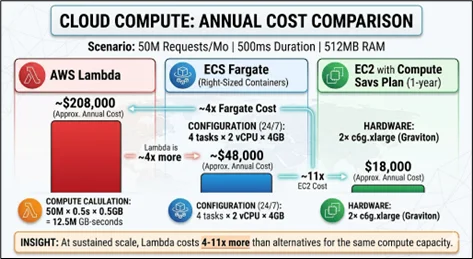
The premium you pay with AWS Lambda is for elasticity, the ability to scale to zero and burst to thousands. If your workload never scales to zero and rarely bursts beyond a predictable baseline, you’re paying for flexibility you don’t use.
- Latency-Sensitive Applications
Cold starts remain a real consideration. While AWS has significantly improved cold start times, they still range from 100ms (Python, small package) to several seconds (Java, large dependencies, VPC-attached).
Provisioned Concurrency eliminates cold starts, but at that point, you’re paying for always-warm compute at AWS Lambda pricing, which is more expensive than equivalent Amazon Fargate or Amazon EC2 capacity.
If your application requires consistent sub-50ms response times, such as real-time bidding, payment authorization, gaming backends, or interactive APIs where every millisecond affects user experience, containers provide predictable, consistent latency without the cold-start variable.
- Long-Running Processes
AWS Lambda’s 15-minute execution limit is a hard boundary. Workloads that exceed this require architectural workarounds:
- Video transcoding of large files
- ML model training or batch inference
- Complex ETL jobs processing millions of records
- WebSocket connections are maintained for extended sessions
- Report generation involving a large dataset aggregation
You can architect around this limit using Step Functions for orchestration or Amazon SQS for chunked processing. Still, the added complexity often outweighs the operational simplicity that motivated the decision to choose serverless in the first place.
- Complex Stateful Systems at Scale
Each AWS Lambda function is an independent unit requiring its own: IAM permissions, environment configuration, deployment package, monitoring setup, and inter-function communication logic.
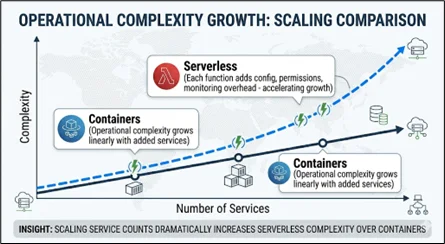
At 10-15 functions, serverless is manageable. At 50+, the operational overhead of managing the distributed function mesh often exceeds what a container orchestrator like Amazon ECS or Amazon EKS would require.
- Heavy Dependencies and Persistent Resources
AWS Lambda’s ephemeral execution model works against workloads that need:
- Large ML models in memory — Reloading a 2GB model on every cold start is wasteful
- Database connection pools — AWS Lambda creates new connections per invocation; connection pooling requires external solutions like Amazon RDS Proxy
- In-memory caches — No shared state between invocations without external services
- Custom system libraries — Constrained by deployment package limits and runtime environments
A Decision Framework
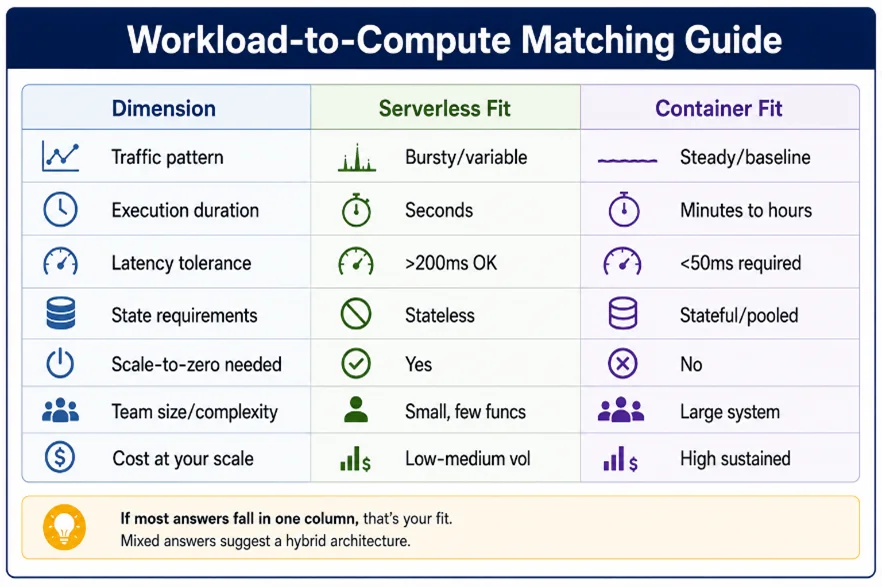
Rather than defaulting to serverless or containers, evaluate your workload against these dimensions:
The Hybrid Approach: Best of Both
The most effective production architectures in 2026 aren’t based on a single model. They’re intentionally hybrid:
- Serverless at the edges — AWS Lambda for webhook ingestion, Amazon S3 event processing, authentication flows, and scheduled automation
- Containers for the core — Amazon ECS Fargate or Amazon EKS for the main application logic, APIs with strict latency requirements, and stateful services
- Managed services as connective tissue — AWS EventBridge, Amazon SQS, and AWS Step Functions, bridging the two models
This isn’t a compromise, it’s using each compute model where it’s strongest.
Conclusion
Drop a query if you have any questions regarding Serverless and we will get back to you quickly.
Empowering organizations to become ‘data driven’ enterprises with our Cloud experts.
- Reduced infrastructure costs
- Timely data-driven decisions
About CloudThat
FAQs
1. At what request volume does AWS Lambda become more expensive than containers?
ANS: – There’s no universal crossover point, it depends on duration, memory, and concurrency. However, a useful rule of thumb: if your Lambda function runs at consistent high concurrency (50+ concurrent executions) for more than 14 hours per day, AWS Fargate is likely cheaper. Use the AWS Pricing Calculator to model your specific workload before deciding.
2. Can Provisioned Concurrency fully solve the cold start problem?
ANS: – It eliminates cold starts for the provisioned capacity, yes. But you pay for that capacity whether invocations arrive or not. If you need Provisioned Concurrency running 24/7 at high levels, compare that cost against equivalent Fargate tasks, AWS Fargate will typically be 30-50% cheaper for the same always-on compute capacity.
3. Is serverless still the right default for new projects and startups?
ANS: – For most early-stage products, yes. The operational simplicity, zero idle cost, and fast iteration speed are genuinely valuable when you don’t yet know your traffic patterns. The key is to plan your evolution path and identify which components you’ll migrate to containers, if and when you hit the scale thresholds described above.
4. How do I monitor whether my serverless architecture is becoming a cost or complexity problem?
ANS: – Track three metrics monthly: (1) AWS Lambda cost per transaction compared to equivalent Fargate cost, (2) P99 latency including cold starts, and (3) mean time to debug production issues. If any of these trends are unfavorable for two consecutive quarters, it’s time to evaluate alternatives for the affected components.


WRITTEN BY Vignesh J
Vignesh Jagadeesan is the Head of Presales at CloudThat with 12+ years of experience driving digital transformation for Public Sector, SMB, and Enterprise customers across India and the USA. He specializes in Cloud Consulting, Data Management, MDM, Analytics, and enterprise modernization. Vignesh has led transformation engagements spanning cloud adoption, analytics, managed services, and enterprise solutioning across government, BFSI, healthcare, retail, manufacturing, and energy sectors, partnering with business stakeholders and cloud partners to deliver scalable, outcome-driven solutions.


 PREV
PREV






Comments