

 Login
Login

 September 2, 2026
|
Voiced by Amazon Polly |
Introduction
Quick Answer: An OpenAI Codex course worth taking teaches four things, not one. Using Codex to actually ship code, deploying it safely across a team through sandboxes and CI/CD, governing it with repository permissions and audit logs, and operationalizing it so it becomes a normal part of the engineering workflow instead of a novelty demo. Most OpenAI Codex training stops at “how to write a prompt for Codex.” That is not enough once a company is trusting an AI agent with real repositories. This guide breaks down what an actual OpenAI Codex course should cover and why governance matters as much as the coding.
Learning to use Codex to write a function is the easy part; honestly, you could figure that out from a five-minute video.
The part that actually needs a real OpenAI Codex course is everything after that. Who approves what Codex touches. What happens when it runs unattended in your CI pipeline? How you stop it from quietly burning through your API budget on a retry loop nobody noticed. That is the syllabus most tutorials skip, and it is the one that actually matters at work.
Advance Your Career with OpenAI Training
- Build AI Applications
- GPT-5 & OpenAI APIs
- Hands-on Projects
What Should an OpenAI Codex Course Actually Teach?
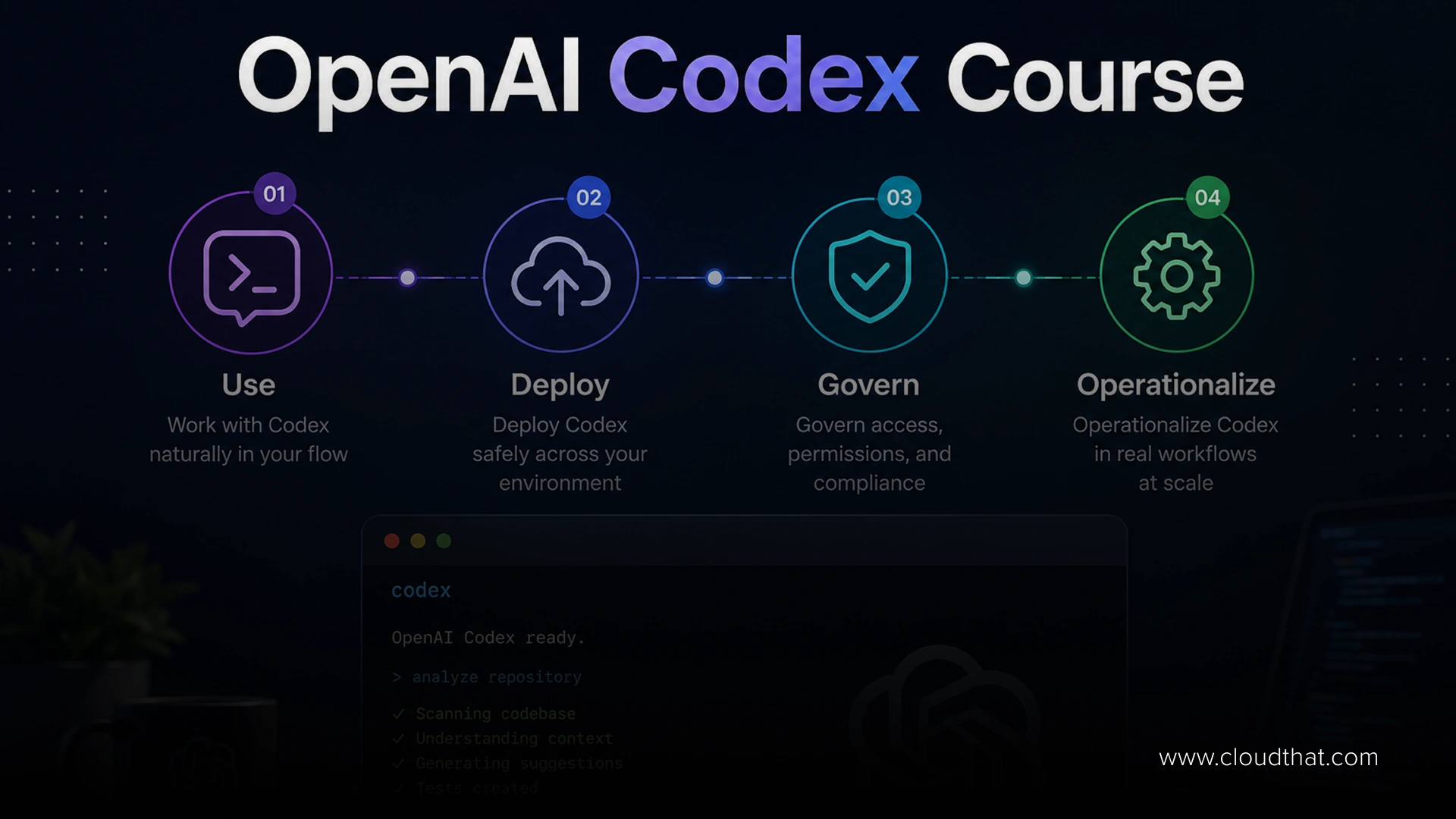
A complete OpenAI Codex course covers four layers. First, using Codex well, prompting it for real coding tasks, not toy examples. Second, deployment, running it safely inside sandboxes and CI/CD. Third, governance: controlling which repositories and permissions it can access. Fourth, operationalizing it so a whole engineering team can rely on it daily.
Most free tutorials only cover the first layer. That gap is exactly why Gartner recently named Codex a Leader in enterprise coding agents, citing its governance, sandboxing, and enterprise deployment options specifically, not just its code quality. An OpenAI Codex course that skips those parts is teaching half a skill.
Skill 1: Using Codex to Actually Ship Code
Every OpenAI Codex training program starts here, and it should. This means writing prompts that get Codex to fix bugs, generate tests, and make multi-file changes, not just autocomplete a single line.
The real skill is context. Codex performs better when it has a clear repository structure and an AGENTS.md-style file describing conventions, so it stops guessing at patterns your team has already agreed on. This layer alone will make you faster, but it is not the whole picture of what an OpenAI Codex course should teach.
CloudThat’s AI and ML training tracks treat this as the starting module, not the entire program, because “I used Codex to fix a bug” is not the same as “I can trust Codex inside our codebase.” Learners who are missing the foundational knowledge beneath this often start with the Master Data Science with Azure program first.
Skill 2: Deploying Codex Safely Across a Team
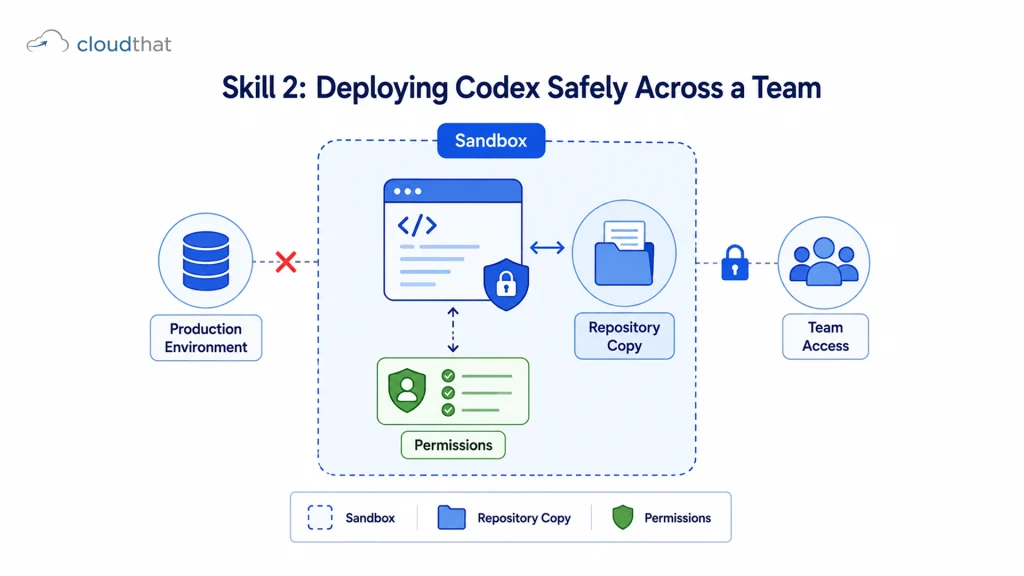
This is where a real OpenAI Codex course earns its name. Deployment means understanding sandboxed execution environments, where Codex runs isolated with a copy of the repository instead of touching production directly, and knowing how to configure that sandbox correctly for your stack.
It also means understanding the cost side. Enterprise teams typically budget somewhere in the range of one to two hundred dollars per developer per month for active Codex usage, and a runaway retry loop on a flaky test can burn through that fast if nobody caps turns or token limits on automated runs.
CloudThat’s consulting practice builds exactly these kinds of production AI integrations for enterprise clients: the sandboxing, the cost guardrails, the actual rollout plan that a course slide never shows you.
Skill 3: Governing What Codex Is Allowed to Touch
Governance is the layer most OpenAI Codex training completely skips, and it is the one that keeps you out of trouble. This means scoping repository permissions so Codex only touches what it should, isolating secrets from the sandbox, and logging every action for audit.
Admins should be able to manage plugins and marketplace installs through policy settings, blocking or permitting specific plugins and marketplace installs across teams. A real OpenAI Codex course walks through how to set this up, not just mentions that it exists.
CloudThat’s GenAI Innovation Center works with enterprise teams on exactly this kind of governed rollout, where an AI coding agent gets access on an as-needed basis rather than a blanket yes to every repository.
Skill 4: Operationalizing Codex Inside Real Workflows
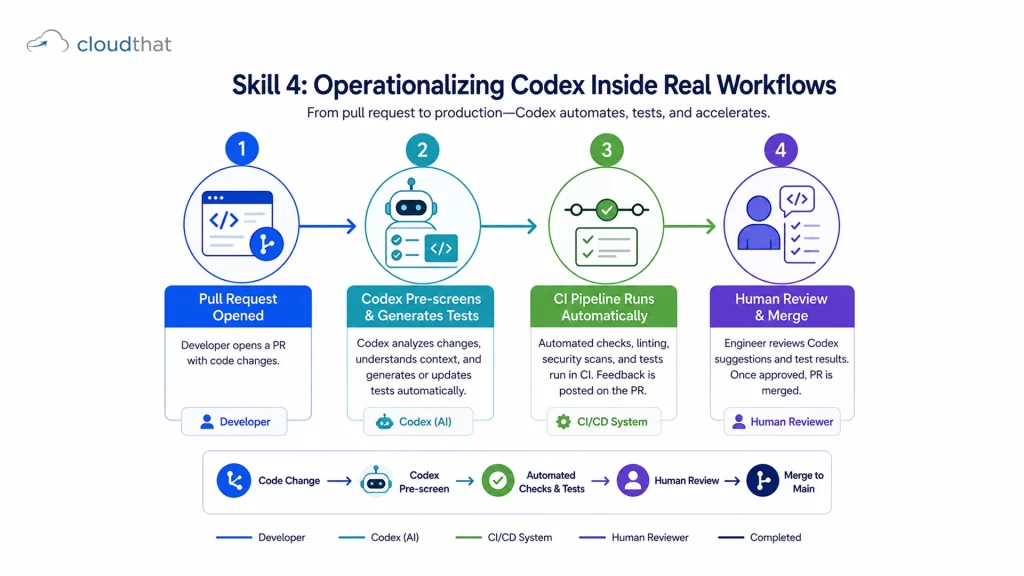
The highest-value pattern is running Codex headlessly in CI, pre-screening pull requests, generating tests, updating documentation, and handing routine fixes to a human reviewer before merge. That is very different from opening a chat window and asking it a question.
An OpenAI Codex course that reaches this stage teaches you to treat Codex as infrastructure, not a chatbot. Once it is correctly wired into your pipeline, the agent becomes part of how code ships, not a side tool that a few developers experiment with on Fridays.
Why Most OpenAI Codex Training Stops Too Early
Most short workshops stop at skill one because skills two through four require trainers who have actually deployed this in a company, not just used the personal app. Skipping governance and operationalization means you walk away able to use Codex but not trusted to run it in a real engineering org.
This gap is exactly why picking the right OpenAI Codex course matters more than picking the cheapest one.
Why CloudThat Teaches This the Right Way
CloudThat runs this as a live, instructor-led program that covers all four layers, not just by prompting Codex for a demo. Trainers teaching deployment and governance are the same people who set up sandboxing, permissions, and CI integration for enterprise clients between sessions.
The AI/ML and GenAI training tracks include 50 to 60 percent hands-on lab time, so you configure sandbox policies and repository permissions yourself rather than watching a slide about them. For companies rolling this out across an engineering team, the Capability Development Framework runs a scoped, assessed program across a cohort, and Experiential Learning tests whether each engineer can actually operate Codex safely in a real scenario, not just describe governance in an interview.
CloudThat is an AWS Premier Tier Training Partner and an NVIDIA Training Partner with a dedicated GenAI focus, backed by 14+ years of training experience across enterprise clients. Check the training calendar for upcoming Codex batches.
Conclusion
A real OpenAI Codex course is not a prompting tutorial; it is a deployment and governance program. Using Codex well gets you started; safe deployment keeps your systems intact; governance keeps auditors happy; and operationalizing it turns a demo into something your whole engineering team can actually rely on.
Key Takeaways
- A real OpenAI Codex course covers four layers, using it, deploying it, governing it, and operationalizing it, not just prompting.
- Repository context and an AGENTS.md style file make Codex noticeably more reliable.
- Sandboxed execution keeps Codex isolated from production while it works on real tasks.
- Cost guardrails matter, retry loops on flaky tests can burn through a team’s budget fast.
- Governance means scoping repository permissions and logging every action for audit.
- Operationalizing Codex means running it headlessly inside CI, not just in a chat window.
- Most openai codex training stops at prompting and skips deployment and governance entirely.
- Gartner has recognised Codex specifically for enterprise governance and deployment options.
- Hands on configuration work matters more than watching a slide about sandboxing.
- Enterprise teams can roll this out across a full engineering group using a structured, assessed framework.
Ready to actually deploy Codex safely instead of just prompting it? Check CloudThat’s live training calendar and pick your batch.
About CloudThat
FAQs
1. Is an OpenAI Codex course useful if I already use Codex personally?
ANS: – Yes. Personal use teaches prompting. It rarely teaches sandboxing, permission scoping, or CI integration, which is what most companies actually need before trusting Codex on real repositories.
2. Does openai codex training require a DevOps background?
ANS: – It helps for the deployment and governance layers, but a good program teaches the CI/CD and sandbox concepts from scratch rather than assuming you already know them.
3. How much should a company budget for Codex per developer?
ANS: – Enterprise estimates typically land between one and two hundred dollars per developer per month, though usage patterns and retry loops on automated runs can push that higher without proper caps.
4. What is the biggest governance mistake teams make with Codex?
ANS: – Giving broad repository access by default instead of scoping permissions per project. A proper OpenAI Codex course teaches you to start narrow and expand access deliberately.
5. Can Codex run unattended inside a CI pipeline safely?
ANS: – Yes, when configured correctly. Headless execution with capped turns, token limits, and a human review gate before merge is the standard enterprise pattern.
6. Can a whole engineering team go through this openai codex training together?
ANS: – Yes. CloudThat’s Capability Development Framework runs a structured, assessed rollout across a full engineering cohort on one scoped timeline.

WRITTEN BY Himisha Raval
Himisha Raval is a Digital Marketing Manager at CloudThat with a strong command of search engine optimization, web analytics, link building, and content strategy. She brings a data-driven approach to digital marketing, helping IT companies strengthen their online presence, improve search rankings, and generate consistent leads across channels. Beyond execution, she plays an active role in ideation, campaign strategy, and website performance optimization. Outside of work, she balances her analytical side with a love for travel, nature painting, and dancing.


 PREV
PREV








Comments