

 Login
Login


 September 2, 2026
|
Voiced by Amazon Polly |
As organizations deploy AI-powered applications, intelligent agents, and retrieval-augmented solutions, networking is becoming a critical part of architecture discussions. While AI models often receive the spotlight, the underlying network determines how securely and efficiently applications can access data, communicate with services, and scale across regions.
A well-designed Azure Networking strategy helps reduce latency, strengthen security, simplify governance, and support future AI growth. As Microsoft expands enterprise AI capabilities through Azure AI services and Microsoft Foundry, architects must ensure their network foundations are ready for increasing demands.
Start Learning In-Demand Tech Skills with Expert-Led Training
- Industry-Authorized Curriculum
- Expert-led Training
Why AI Places New Demands on Network Architecture
Unlike traditional business applications, modern AI Workloads frequently interact with multiple services simultaneously. A single user request may involve a language model, a storage account, a vector database, an enterprise data source, and a monitoring platform.
This increased interaction creates additional network traffic and introduces new security challenges. Organizations must therefore focus on performance, private connectivity, and governance from the start. Microsoft’s latest AI platform updates continue to emphasize enterprise-grade connectivity, observability, and secure access to organizational data.
Adopt a Hub-and-Spoke Architecture
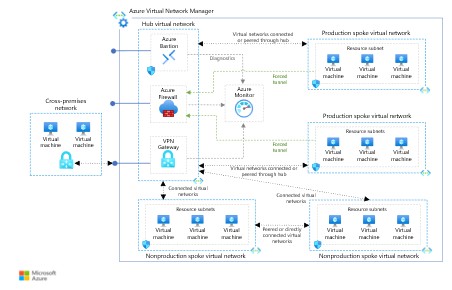
Fig 1: Hub-and-Spoke Architecture
For most enterprise deployments, Hub-and-Spoke remains a recommended networking pattern.
A central hub hosts common services such as:
- Azure Firewall
- VPN or ExpressRoute Gateways
- DNS Services
- Monitoring Tools
Spoke networks can then host:
- AI applications
- Data platforms
- Development environments
- Business applications
This design centralizes governance while allowing teams to manage workloads independently. It also simplifies network administration as AI adoption expands across the organization.
Secure Resources with Private Endpoints
Many organizations still expose data services to the public internet unnecessarily. For AI environments handling sensitive business information, private connectivity should be the default approach.
Use Private Endpoints for services such as:
- Azure OpenAI
- Azure SQL Database
- Azure Storage Accounts
- Azure Cosmos DB
- Azure Key Vault
By keeping traffic within the Microsoft backbone network, organizations can significantly reduce exposure and strengthen compliance controls. This approach aligns closely with modern Azure security recommendations.
Implement Zero Trust Security
Traditional perimeter security is no longer sufficient for cloud-native AI environments.
Zero Trust Security follows a simple principle: every request must be verified before access is granted. Whether accessing an AI model, database, or application, identity and authorization controls should always be enforced.
Key Azure services include:
- Microsoft Entra ID
- Conditional Access
- Privileged Identity Management
- Azure Firewall
- Microsoft Defender for Cloud
This model helps protect sensitive AI systems while supporting secure collaboration across teams and applications.
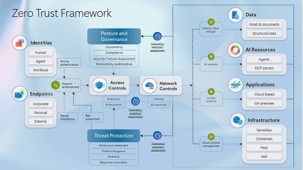
Fig 2: Zero Trust Security Model
Keep Data Close to AI Services
Performance is heavily influenced by where data resides.
When AI services and data platforms operate in different regions, latency increases, and response times can suffer. For workloads such as chat applications, AI agents, and retrieval-augmented generation, even small delays can impact user experience.
Whenever possible:
- Deploy AI services and data sources in the same region.
- Minimize unnecessary network hops.
- Use private connections for backend communication.
These practices help maintain consistent application performance and reduce operational complexity.
Prepare for Resilience and Growth
AI solutions often evolve from small pilot projects into business-critical platforms. Network designs should accommodate future growth without requiring major redesign efforts.
Important considerations include:
- Availability Zones
- Multi-region deployments
- Azure Front Door
- Traffic Manager
- Geo-redundant Storage
In addition, continuous monitoring through Azure Monitor, Network Watcher, and Log Analytics provides visibility into latency, traffic patterns, and potential security risks. Microsoft continues to invest in observability capabilities for enterprise AI environments and hosted agents.
To strengthen your Azure architecture and networking expertise, consider training on Azure Architecture and Azure Network. These courses cover networking, security, governance, and architecture patterns commonly used in enterprise Azure deployments.
Building AI-Ready Networks
Successful AI adoption depends on more than powerful models. A strong Azure Networking foundation enables secure access to enterprise data, supports scalable AI Workloads, and helps organizations maintain compliance and operational efficiency.
By adopting Hub-and-Spoke architecture, securing resources with Private Endpoints, implementing Zero Trust Security, and designing for resilience, organizations can build Azure environments that are ready for both current and future AI initiatives.
Upskill Your Teams with Enterprise-Ready Tech Training Programs
- Team-wide Customizable Programs
- Measurable Business Outcomes
About CloudThat


WRITTEN BY Kavya B.S
Kavya B.S is a Subject Matter Expert and MCT at CloudThat, specializing in Microsoft Azure. With 15 years of experience in training and academics, she has trained over 5,000 professionals to upskill in Architect, Administrator and Security. Known for simplifying complex concepts through real-world analogies, she brings deep technical knowledge and practical application into every learning experience. Kavya’s passion for teaching reflects in her unique approach to learning and development.


 PREV
PREV






Comments