

 Login
Login

 August 6, 2026
|
Voiced by Amazon Polly |
Introduction
You don’t pass SAA-C03 by memorizing flashcards. You pass it by building actual AWS systems that force you to think like an architect. This means designing VPCs that make sense, creating highly available applications, implementing security, and optimizing costs. Five specific projects will transform you from “I know AWS services” to “I can architect production systems.” VPC from scratch. Web application with HA. Serverless data pipeline. Secure database. Auto-scaling architecture. Do these. Understand why each decision matters. You won’t just pass the exam. You’ll actually know how to build on AWS.
You know the feeling. Three weeks before the exam. You’re grinding through practice tests. You’re scoring 72%. 78%. Sometimes 81%. You feel ready. Then exam day hits. The questions feel different. Not harder. Different. The scenarios don’t match the practice tests. They feel real. Because they are. And suddenly you realize something terrifying. Studying domains doesn’t mean you understand architecture.
That’s where projects come in.
Here’s the truth nobody wants to hear: You can memorize that RDS has automated backups. You can memorize that Multi-AZ gives you high availability. But until you actually design a database architecture, handle failover, think about recovery time objectives, configure read replicas for scaling, you don’t really know it. You’ve just memorized words.
This is the exact gap CloudThat’s Exam Readiness Intensive Workshop is built to close, moving learners past domain memorization and into scenario-based problem solving before they ever sit the real exam.
Projects change that. Projects force you to solve problems. Projects make concepts stick because you’ve lived through the consequences of getting them wrong. It is why the Architecting on AWS course leans so heavily on lab exercises and real-world case studies instead of slide decks. That hands-on structure mirrors the same progression CloudThat maps out for learners moving from beginner to certified architect, where the shift from theory to hands-on expertise is what actually separates a passing score from a working architect.
The difference between passing the exam and becoming an architect? Projects. The difference between forgetting everything after two months and actually being able to design systems for your job? Projects.
Transform Your Career with AWS Certifications
- Advanced Skills
- AWS Official Curriculum
- 10+ Hand-on Labs
Why Projects Matter More Than Flashcards
When you build something, you’re forced to make decisions. When you make decisions, you’re forced to justify them. When you justify them, you understand them.
Example: You’re designing a web application. You know you need high availability. So you spin up EC2 instances across two Availability Zones. But wait. If one AZ goes down, who routes traffic away from it? Load balancer. So you add an Application Load Balancer. But now you realize the ALB itself is in one AZ. So you configure it for multi-AZ. But wait. That requires listeners and target groups. Now you’re learning about health checks. Now you’re understanding why they matter. Suddenly the domain “high availability” isn’t abstract. It’s a system you designed.
That’s the magic of projects.
The exam questions test whether you can make these decisions quickly. They give you a scenario. They ask what architecture solves it best. If you’ve built that architecture, the answer isn’t “I think it might be this” but “I’ve done this exact thing, I understand the trade-offs, the answer is obviously this.”
Projects also surface your gaps. You might think you understand S3, but then you’re designing a pipeline that needs encryption at rest and in transit. Suddenly you’re learning about KMS. About bucket policies. About cross-region replication. Suddenly S3 becomes three-dimensional instead of flat.
This is why the SAA exam is designed around scenarios. It assumes you’ve built things. Projects close that gap between theory and practice.
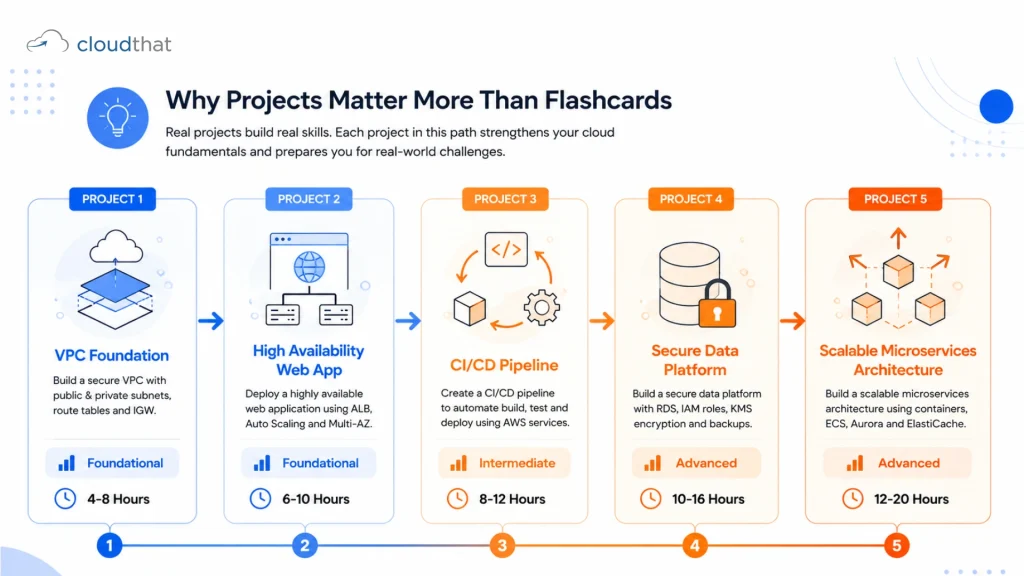
Project 1: Build a Multi-Tier VPC from Scratch
Start here. Not because it’s easiest. Because it’s foundational.
Create a VPC. Don’t use a wizard. Do it manually. Create public and private subnets. Put them in multiple Availability Zones. Add a NAT gateway for private subnet internet access. Add security groups. Understand what inbound and outbound rules actually do. Make an EC2 instance. SSH into it. Break it. Fix it. Do this three times until it’s muscle memory.
Time spent: 3-4 hours.
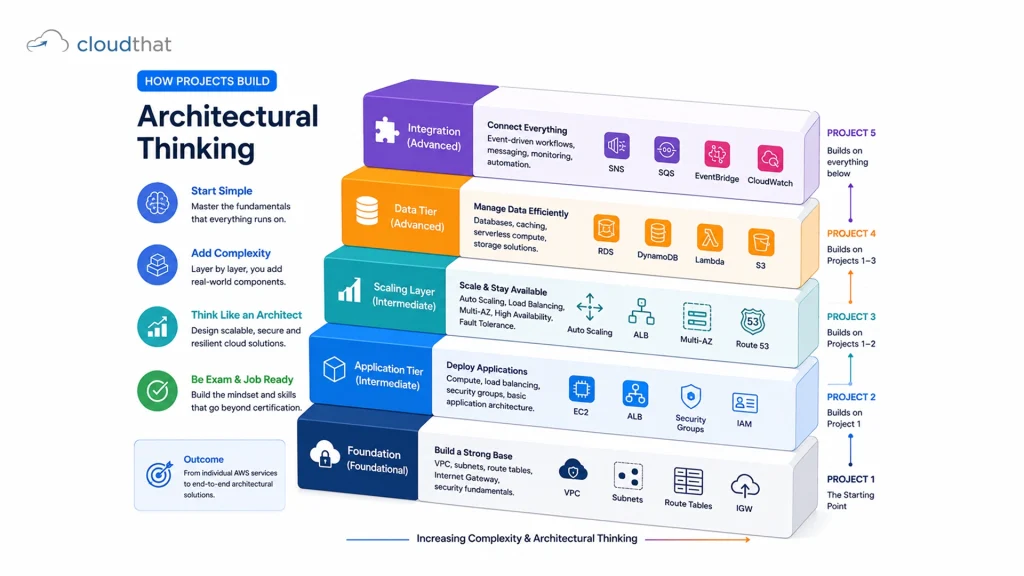
Why this first? Every complex AWS architecture starts with a VPC. You’re going to design databases, load balancers, microservices, all within VPCs. If you don’t understand how subnets, availability zones, NAT gateways, and security groups work together, you’ll be lost when exam questions throw complex scenarios at you.
The exam will ask things like “Your application needs to access the internet but shouldn’t be directly exposed to the internet. What architecture do you recommend?” If you’ve built this, you already know the answer. Private subnet with NAT gateway. Done.
Build it. Test it. Understand it.
Project 2: Design a Highly Available Web Application
Now make something real. Deploy a simple web app (Node, Python, doesn’t matter) across multiple EC2 instances in different AZs. Add an Application Load Balancer. Configure Auto Scaling so instances scale up when CPU hits 70% and scale down when it drops below 30%. Add CloudWatch monitoring.
Test what happens when you manually kill an instance. Does the load balancer remove it? Yes. Does Auto Scaling launch a replacement? Yes. Now you’ve lived through what the exam means by “highly available.”
Time spent: 5-6 hours (including debugging, which you will do).
Why does this matter? The exam loves high availability questions. “Your application is getting 100 requests per second. You currently have two t3. medium instances and your CPU is hitting 95%. What do you do?” You’re going to be asked this a hundred different ways. If you’ve built auto-scaling, the answer becomes obvious. You’ve seen it work.
This project also teaches you about load balancers. About health checks. About target groups. About sticky sessions. These aren’t just concepts. They’re things you’ve configured and watched work.
Project 3: Implement a Serverless Data Pipeline
Skip EC2 for a moment. Build something with Lambda. Create an S3 bucket. Upload a CSV file. Trigger a Lambda function that processes the file. Store results in another S3 bucket or a DynamoDB table.
Time spent: 4-5 hours.
Why this? Because the exam is increasingly testing serverless architectures. Companies are moving away from managing EC2 instances toward Lambda, DynamoDB, API Gateway. The exam reflects that shift. If you’ve only built EC2 stuff, you’re missing half the architecture patterns.
This project teaches you about event-driven architecture. About Lambda permissions (IAM roles). About designing for scale without thinking about infrastructure. It teaches you that “serverless” doesn’t mean “no servers” but “someone else manages the servers.”
Bonus: This is closer to what actual cloud architects are building. You’re not just passing an exam. You’re learning real skills.
Project 4: Set Up a Secure Database Architecture
Create an RDS instance (MySQL, Postgres, doesn’t matter). Put it in a private subnet. Access it only through an EC2 instance in a public subnet (bastion pattern). Enable backup. Enable encryption at rest. Set up read replicas. Configure automatic failover (Multi-AZ).
Time spent: 3-4 hours.
Why this? Databases are always part of architecture questions. “Your company needs a database that can handle 1000 transactions per second. Recovery time objective is 5 minutes. What do you recommend?” If you’ve set up RDS with replicas and Multi-AZ, you already know why those matter.
This project also teaches security. The bastion pattern. Encryption. VPC security groups. These aren’t abstract concepts anymore. You’ve implemented them. You’ve verified they work.
Project 5: Build Auto-Scaling and Load Balancing
Combine everything. Create an Auto Scaling group. Add a load balancer. Add CloudWatch alarms that trigger scaling. Add cross-zone load balancing. Add stickiness. Then stress-test it (use Apache Bench or similar). Watch the system scale up as load increases. Watch it scale down after load drops.
Time spent: 6-8 hours.
Why this? Because this is what the exam is really testing. Can you design a system that scales? That stays available? That handles failures gracefully? This project forces you to think about all the pieces together. VPCs. Subnets. Security groups. Load balancers. Auto Scaling groups. Monitoring. It’s the capstone. Everything connects.
Why CloudThat Is Your Accelerator for Solutions Architect Mastery
Here’s the thing about building projects alone: you can do it. But you’re debugging alone. You’re learning alone. You’re guessing at best practices.
CloudThat’s AWS Certified Solutions Architect Associate course guides you through exactly these projects. But guided. With instructors who’ve built production AWS architectures. With labs where you follow along first, then do variations on your own.
The AWS Mastery Pass gives you access to 35+ AWS courses, including deep dives into VPC architecture, high availability patterns, security design, and database optimization. You’re not just learning Solutions Architect. You’re learning the foundations every architecture requires.
And if you’re building in a corporate environment, CloudThat’s DevOps training teaches you infrastructure-as-code (Terraform, CloudFormation) so your projects become repeatable systems your teams can actually use.
The difference between “I passed the exam” and “I’m genuinely ready to architect production systems” is having someone who’s done it show you the path. That’s what CloudThat does. You build the projects. Instructors make sure you’re building them right.
Conclusion
You have two paths. Path one: study for three weeks, memorize domains, pass the exam, forget everything. Path two: spend 30 hours building actual systems, develop real architectural intuition, pass the exam easily, actually know how to do this job.
The choice is obviously path two.
These five projects aren’t just exam prep. They’re your foundation as an architect. They’re the reason you’ll confidently design systems instead of guessing. They’re why you’ll spot architectural problems in real production systems and know exactly how to fix them.
Ready to move from “studying for the exam” to “actually becoming a solutions architect”? Explore CloudThat’s comprehensive AWS Solutions Architect training programs where you’ll build these projects with expert guidance, learn the reasoning behind every architectural decision, and develop the intuition that separates certification-holders from actual architects.
Key Takeaways
- The AWS Solutions Architect exam tests whether you can make architectural decisions under pressure, which only comes from actually making architectural decisions.
- Projects aren’t extra credit. They’re the core of learning. Flashcards are supplements.
- Start with VPC fundamentals. Everything else builds on understanding subnets, security groups, NAT gateways, and routing.
- High availability requires design decisions: load balancers, auto-scaling, multi-AZ deployments. You need to build these to understand why they matter.
- Serverless architectures (Lambda, DynamoDB) are becoming exam favorites because they reflect real industry shifts. Don’t skip them.
- Security isn’t a separate project. It’s embedded in every project. Private subnets, encryption, IAM roles, security groups. These are architectural choices.
- Auto-scaling and load balancing are the capstone. They force you to think about everything together. Failure modes, recovery, monitoring, and scaling.
- Cost optimization should influence every decision. Cheaper doesn’t mean better. But your architecture should justify its costs.
- Monitoring and alarms are part of architecture. You can’t design a system and ignore how it performs. CloudWatch, alarms, logging matter.
- The projects take time but save time later. You’ll study for the exam faster because concepts are already embedded through building.
- Actually passing the exam is one win. Being able to architect in your job is the real goal. These projects get you there.
Already in IT? Switch to Cloud & Earn 55% More
- Weekend Batches
- Dedicated Career Support
- Official AWS Labs
About CloudThat
FAQs
1. How long should these projects take total?
ANS: – Realistically, 25-35 hours spread over 4-6 weeks. If you’re working full-time, that’s about 10-15 hours per week. Totally doable if you’re serious.
2. Do I need all five projects or can I skip some?
ANS: – You need at least three. The VPC project is non-negotiable. Pick two more based on what you’re weaker on. If you don’t understand auto-scaling, do projects 2 and 5. If you’re shaky on databases, do projects 2 and 4.
3. Can I do these projects without paying for AWS?
ANS: – Yes, AWS Free Tier covers all of this. But you’ll have limited resources and might hit usage limits. A few dollars invested in learning is worth it.
4. Will doing these projects automatically make me pass the exam?
ANS: – No. But it can significantly improve your chances. You’ll recognize patterns in exam questions, understand why certain answers are better than others, and solve questions more confidently.
5. What if I get stuck building a project?
ANS: – Stack Overflow is your friend. AWS documentation is also excellent. If you’re learning with CloudThat, you can ask instructors for guidance. Don’t stay stuck for days. Get help, learn, and keep moving.
6. Should I document these projects for my resume?
ANS: – Absolutely. “Designed and implemented a multi-AZ web application with auto-scaling” is valuable resume material. It shows employers you can apply AWS concepts in real-world scenarios, not just pass certification exams.

WRITTEN BY Himisha Raval
Himisha Raval is a Digital Marketing Manager at CloudThat with a strong command of search engine optimization, web analytics, link building, and content strategy. She brings a data-driven approach to digital marketing, helping IT companies strengthen their online presence, improve search rankings, and generate consistent leads across channels. Beyond execution, she plays an active role in ideation, campaign strategy, and website performance optimization. Outside of work, she balances her analytical side with a love for travel, nature painting, and dancing.


 PREV
PREV












Comments