

 Login
Login

 August 6, 2026
|
Voiced by Amazon Polly |
Introduction
DP-100 is the Microsoft credential that tells employers you can build production machine learning systems on Azure. It’s not just another certification. It’s a career inflection point. Data scientists with DP-100 jump two salary bands. Get hired into ML engineer roles that didn’t exist in their previous search. Move from Python notebooks to production pipelines. The certification tests your ability to design, train, deploy, and monitor models in Azure environments. It takes 3-4 months if you’re systematic. It pays for itself in the first salary negotiation. And CloudThat has the fastest path there.
You’re a data scientist. Good one. You know Python, statistics, machine learning theory. You’ve built models that work. They sit in Jupyter notebooks. They work locally. When the company asks “can we put this in production?” you hand it off to an engineer who translates your code into something that actually scales.
That’s when you realize something. Your skills have a ceiling. You’re good at building models. You’re not good at deploying them. And deployment is where the real money lives. That’s where the career accelerates.
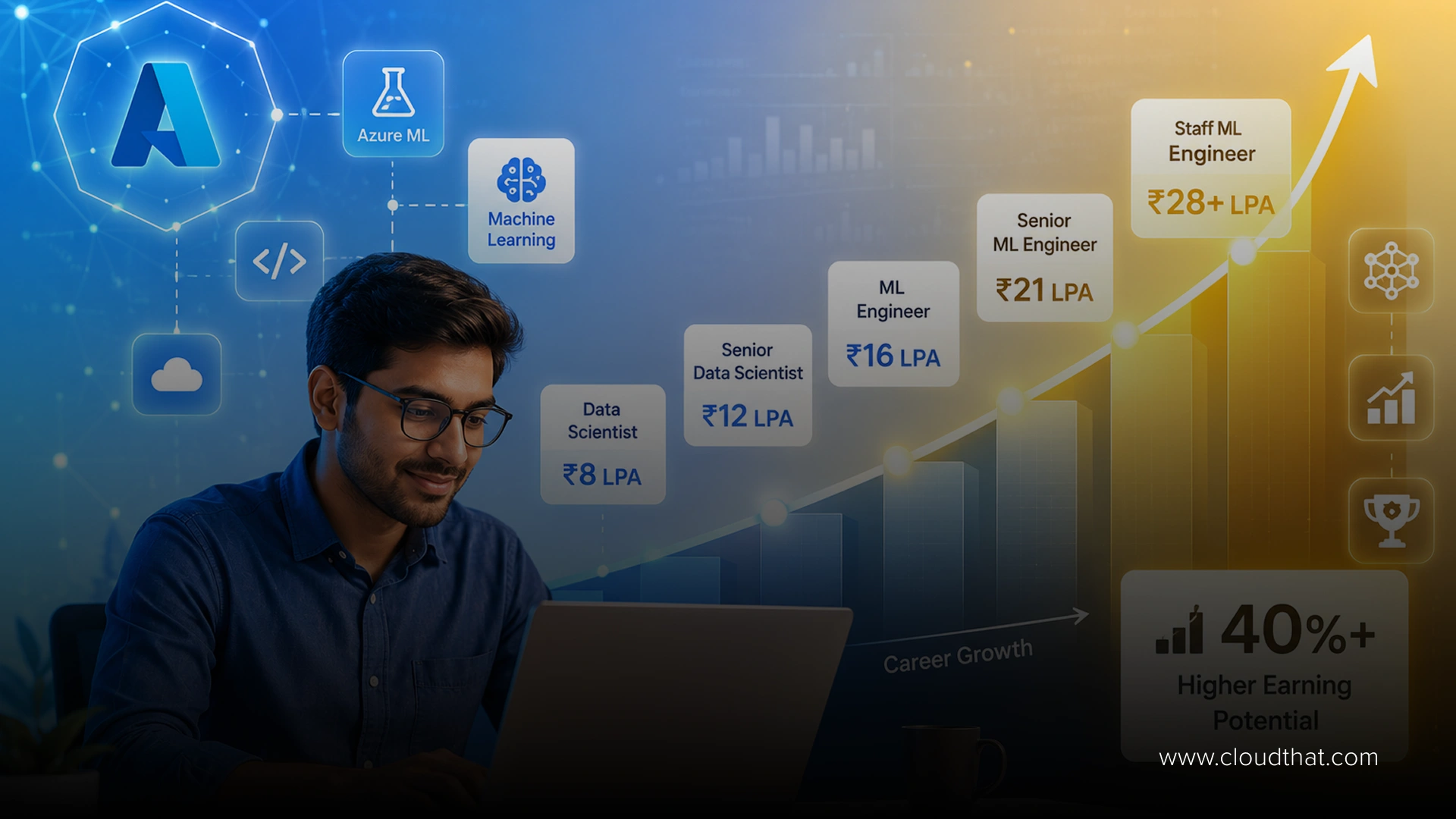
DP-100 changes that. It’s the certification that says you’re not just a data scientist who builds. You’re a data scientist who deploys, monitors, maintains, optimizes. You’re an ML engineer. And ML engineers earn 30% more and have three times the job options.
But here’s the catch. DP-100 requires learning Azure. And Azure is massive. It’s easy to spin your wheels studying the wrong things, to fail the exam twice, to lose confidence and convince yourself data science is as good as it gets. This is exactly why CloudThat’s DP-100 study guide points people toward the DP-900 fundamentals first, since walking in without that base is usually where the wheel-spinning starts.
That’s why this path matters. CloudThat’s DP-100 BootCamp is built around exactly the gap described above: taking someone who can build a model locally and giving them the Azure Machine Learning skills to plan a working environment, run experiments, and train and deploy predictive models at scale, the difference between a notebook that works and a system that ships.
Accelerate Your Azure Career Without Quitting Your Job
- Authorized Training
- Live Hands-on Labs
- Flexible Batches
The DP-100 Reality Check
DP-100 is the “Designing and Implementing Data Science Solutions on Azure” exam. And unlike some certifications that test trivia, this one tests whether you can actually do the job.
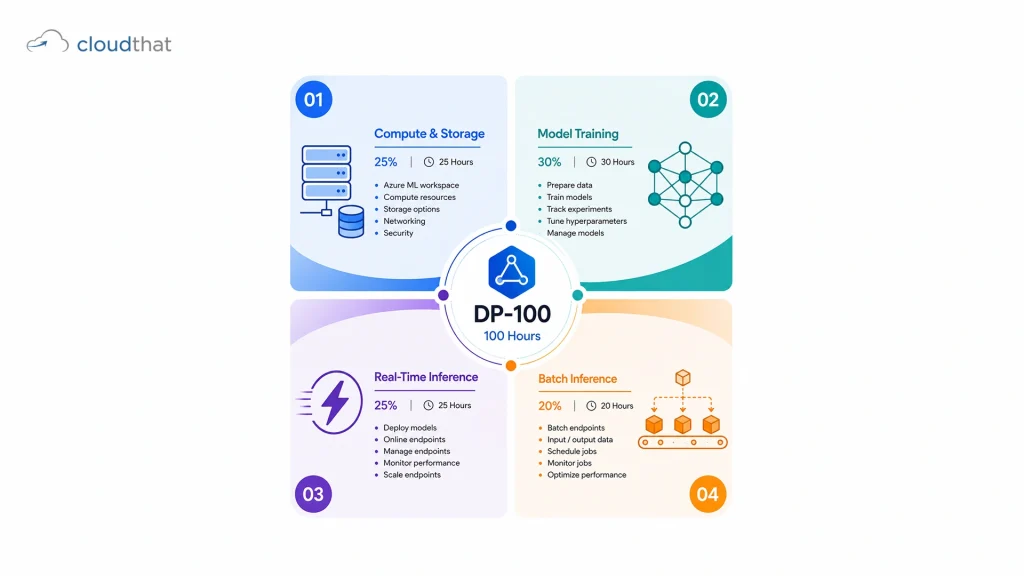
The exam has four domains. Each one matters. None are optional.
Compute and storage: Can you design Azure infrastructure for data science workloads? Not as a DevOps engineer. As someone who understands what data pipelines need and how to build them.
Model training and management: Can you use Azure Machine Learning to train models at scale? Can you use AutoML? Can you experiment with different algorithms and track results? Can you work with MLflow?
Real-time inference: Can you deploy a model as a web service? Can you handle predictions at scale? Can you monitor model performance after deployment?
Batch inference: Can you process millions of records through a model asynchronously? Can you trigger pipelines? Can you schedule jobs?
These aren’t theoretical. Every data scientist in a real job faces these problems. DP-100 teaches you to solve them on Azure’s infrastructure.
What DP-100 Actually Tests
Let’s be specific about what you need to know.
First, Azure fundamentals. Resource groups, storage accounts, compute options. You don’t need to be an Azure admin, but you need to understand how resources connect. This takes about 40 hours if you’re learning from scratch.
Second, Azure Machine Learning (the platform, not just the ML part). How to create workspaces, register datasets, create experiments, log metrics, and compare runs. This is your day-to-day environment. It takes 30-40 hours to feel comfortable.
Third, model training and MLOps. How to structure experiments so they’re reproducible. How to use pipelines. How to track models. How to version datasets. This is where your data science skills become production-grade. 25-30 hours.
Fourth, deployment patterns. Real-time endpoints, batch endpoints, scheduling. How to monitor model drift. How to update models without downtime. 20-25 hours.
Fifth, Python. You already know it. But you need to know it at the level where you can script infrastructure. Write training code. Build preprocessing pipelines. 15-20 hours.
That’s roughly 130-155 hours of actual learning. Spread over 12 weeks, that’s 11-13 hours per week. Totally doable if you’re focused.
The Three-Month Fast Track Strategy
Week 1-2: Azure Fundamentals. Get your hands dirty. Create a resource group. Deploy a storage account. Understand regions and availability. This is boring but foundational. Don’t skip it.
Week 3-4: Azure Machine Learning Platform. Create a workspace. Ingest some data. Run a simple classification model. Use AutoML. Get comfortable with the UI. This is where it feels like a real tool instead of abstract concepts.
Week 5-6: Data Preparation and Model Training. Work with real datasets. Build preprocessing pipelines. Experiment with different algorithms. Log metrics. Compare runs. This starts feeling like actual data science work.
Week 7-8: MLOps and Reproducibility. Learn how to structure experiments. Use MLflow. Understand model registries. Create reusable pipelines. This is the difference between notebook science and production science.
Week 9-10: Deployment and Inference. Deploy models as real-time endpoints. Create batch pipelines. Schedule jobs. Understand endpoint management. This is where you cross from data scientist to ML engineer.
Week 11-12: Practice exams and gap filling. Take full-length exams. See where you’re weak. Deep-dive those areas. By week 12, you should be confident.
The key: Don’t just watch videos and read documentation. Build something every week. Real projects with real data. Only then do concepts stick.
Real Career Impact: Who Gets Hired and Why
Here’s what happens when you pass DP-100.
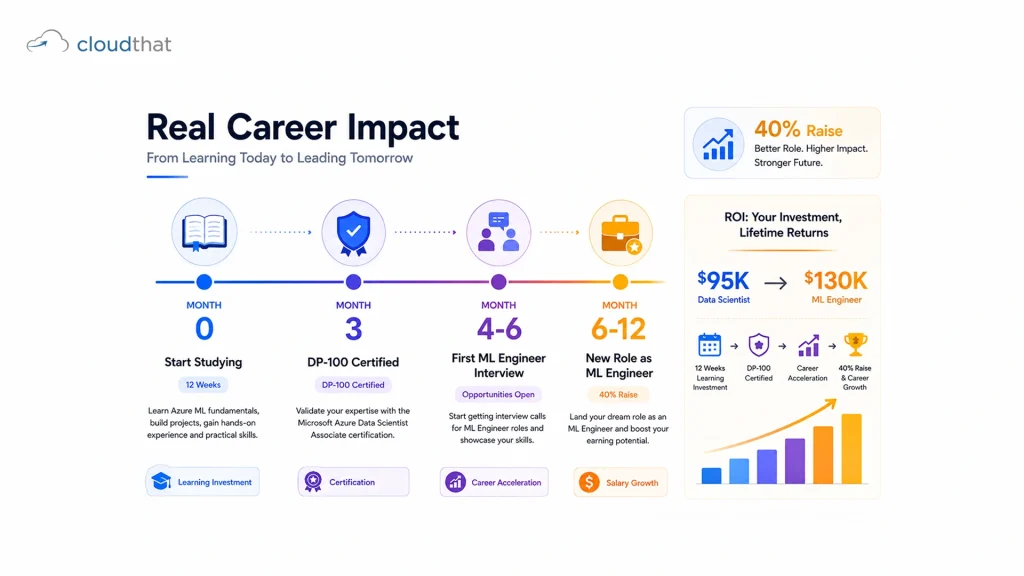
First, your job options expand. Data scientist roles stay on the board. But suddenly ML engineer roles appear. Senior data engineer roles. ML platform engineer roles. Roles that didn’t exist in your search before. And these roles pay 40-60% more than data scientist positions.
Second, your salary negotiation changes. You can justify $130K instead of $95K. You can negotiate for remote work because suddenly you’re competing for a smaller, higher-value talent pool.
Third, career trajectory changes. Inside your company, you become the person who can actually ship ML. Models that were stuck in notebooks suddenly go to production. That visibility matters for promotions. For respect. For your next role.
Companies like Google, Microsoft, Amazon, and countless startups are hiring people with DP-100 specifically. They’re saying “we know you can build on Azure infrastructure. We know you understand production ML. We know you won’t hand off models to DevOps engineers and call it done.”
This isn’t hypothetical. Every recruiter in the ML space knows DP-100 means “production-ready ML engineer.”
Building Your Study Strategy and Resources
Official Microsoft Learn is free and surprisingly good. Their data science learning path covers 80% of what you need. Start there. Read the modules. Do the exercises.
The Azure Mastery Pass gives you structured courses from certified instructors. Not just videos. Actual labs where you’re building in Azure environments. The difference between watching someone use Azure ML and actually using it yourself is everything.
For hands-on deep dives into production ML on Azure, the Integrated Program in AI and Data Science covers the full pipeline. Data engineering, model training, MLOps, deployment. It’s designed for people serious about moving from notebooks to production.
Practice exams matter. Take them weekly starting in week 6. Use the gaps to guide your study, not to measure readiness. A 72% practice exam score doesn’t mean you’re ready. It means you have specific gaps to close.
The Azure Data Engineering and ML Mastery programs have exam-specific modules that map directly to DP-100 domains. Use these for targeted learning.
Common Failure Points and How to Avoid Them
People fail DP-100 for specific reasons. Know them. Avoid them.
First: Not understanding Azure infrastructure basics before jumping into Azure ML. You can’t build production pipelines if you don’t understand storage accounts, compute options, and networking. Spend the time on fundamentals.
Second: Focusing on theory instead of hands-on. The exam is scenario-based. You need to have actually built things. Watched them fail. Fixed them. Watched them succeed. Reading about it is not enough.
Third: Underestimating the operational side. People study model training extensively but skip monitoring and drift detection. The exam tests your ability to maintain models, not just train them. That’s half the job.
Fourth: Weak Python scripting. You’re going to write code. Custom training scripts. Preprocessing pipelines. If you can’t write Python confidently, you’ll struggle. Brush up.
Fifth: Time management. Three months is realistic but tight. If you’re working full-time and have commitments, budget 12-15 hours weekly. If you’re not getting those hours, extend the timeline. Rushing causes mistakes.
Sixth: Ignoring practice exam results. Your weak areas are hints. If you’re scoring 65% on deployment questions, that’s where the exam will probe. Deep dive there.
Why CloudThat Is Your DP-100 Accelerator
DP-100 certification is one thing. Becoming an ML engineer who can deploy production systems on Azure is another. CloudThat bridges that gap.
Here’s why: CloudThat’s trainers have actually built production ML systems on Azure. They’ve dealt with data drift. They’ve optimized pipelines. They’ve scaled models from notebooks to millions of predictions per day. That’s not theoretical knowledge. That’s lived experience. And it changes how they teach.
The DP-100 certification courses are structured around the exam domains but built on real production scenarios. You’re learning AutoML because you’ll use it. You’re learning MLOps because you’ll need it. Every concept maps to something you’ll actually do.
For data scientists ready to go beyond DP-100, the Integrated Program in AI and Data Science covers the full stack. Data preparation, feature engineering, model training, MLOps, deployment, monitoring. It’s the 360-degree view of production ML.
And for enterprises scaling ML, CloudThat’s corporate training programs can customize curriculum for your team’s specific infrastructure, data, and problems. You’re not learning generic scenarios. You’re learning how to solve your actual challenges.
The ROI is clear: fast-track to certification, fast-track to ML engineer roles, fast-track to salary growth. Three months with CloudThat, and you’re not just certified. You’re ready to ship.
Conclusion
DP-100 is the credential that unlocks ML engineer roles, salary growth, and career respect. It’s not about passing an exam. It’s about becoming the person who ships ML in production.
Three months from now, you can be on the other side. Certified. Ready. Hired into roles that didn’t exist six months ago. Or you can keep building notebooks and wondering why your skills have a ceiling.
Ready to stop wondering? Start with CloudThat’s Azure-focused data science programs where you’ll learn DP-100 domains in the context of real production scenarios. Twelve weeks later, you won’t just be certified. You’ll be an ML engineer.
Key Takeaways
- DP-100 is not just another certification. It’s a career inflection point from data scientist to ML engineer.
- The exam tests production ML skills: infrastructure, training, deployment, monitoring. Not theory. Actual work.
- Three months is realistic if you study 12-15 hours weekly. Fundamentals matter. Don’t skip Azure basics.
- Real career impact: 30-60% salary increase, 3x job options, clear path to senior engineering roles.
- Practice exams reveal gaps. Use them strategically to guide study, not just to measure readiness.
- Hands-on experience is non-negotiable. Build things. Break things. Fix things. Only then do concepts stick.
- Azure infrastructure fundamentals take 4-6 weeks. This is boring but foundational. Don’t underestimate.
- MLOps and production patterns are half the exam. Invest time in pipelines, monitoring, deployment, not just model training.
- Your Python skills need to handle infrastructure scripting, not just data analysis. Brush up on that specifically.
- Studying alone is harder than guided learning. Having experts point out what matters saves weeks.
- Your investment pays off immediately. First salary negotiation after DP-100 usually recoups all learning costs. After that, it’s pure upside.
Launch Your AI Career with AWS GenAI Training
- Interview Guarantee
- Up to 75% Money Back
- Real-World Learning
About CloudThat
FAQs
1. Is DP-100 really worth it if I'm already a strong data scientist?
ANS: – Yes. Strong data scientists without production deployment skills often have a gap in their skill set. DP-100 helps bridge that gap by focusing on deploying and managing machine learning solutions on Azure. It can also expand your career opportunities.
2. How much does DP-100 cost?
ANS: – The exam voucher costs $99 USD. Training costs vary depending on your learning path, ranging from free Microsoft Learn resources to comprehensive instructor-led programs that can cost several thousand dollars. If you’re aiming to build practical skills, expect to invest in quality learning resources.
3. What's the actual passing rate?
ANS: – Microsoft does not publish official DP-100 passing rates. Community reports suggest many well-prepared candidates pass on their first attempt, especially if they consistently score around 75% or higher on quality practice exams.
4. Does DP-100 increase salary for data scientists?
ANS: – It can. Earning DP-100 may qualify you for machine learning engineering and Azure-focused AI roles, which often offer higher salaries. However, salary growth depends on factors such as your experience, location, industry, and overall skill set.
5. Can I pass DP-100 without Azure experience?
ANS: – Yes. A solid foundation in Python, statistics, and machine learning is more important. You can learn the Azure-specific concepts during your preparation, although beginners should plan for a few extra weeks to become comfortable with the Azure ecosystem.
6. Is DP-100 harder than other data science certifications?
ANS: – It depends on the certification. Deep learning certifications often focus on building and optimizing models, while DP-100 emphasizes deploying, managing, and monitoring machine learning solutions on Azure. Both test different skill sets and are valuable for different career paths.

WRITTEN BY Himisha Raval
Himisha Raval is a Digital Marketing Manager at CloudThat with a strong command of search engine optimization, web analytics, link building, and content strategy. She brings a data-driven approach to digital marketing, helping IT companies strengthen their online presence, improve search rankings, and generate consistent leads across channels. Beyond execution, she plays an active role in ideation, campaign strategy, and website performance optimization. Outside of work, she balances her analytical side with a love for travel, nature painting, and dancing.


 PREV
PREV











Comments