

 Login
Login


 July 14, 2026
|
Voiced by Amazon Polly |
Introduction
Quick Answer: An AI prompt engineering course teaches you how to communicate with large language models to produce consistent, production-quality outputs. At the beginner level, that means structured prompts and few-shot examples. At an advanced level, it means building RAG pipelines, designing AI agents, and evaluating model outputs at scale. The skill is in demand. The path is learnable. And the right course makes the difference between theory and something you can actually ship.
You typed something into ChatGPT once. It gave you a mediocre answer. You tweaked the wording. Suddenly, the output was three times better.
That moment. Right there. That was your first prompt engineering lesson.
And somebody out there is getting paid a lot of money to do that at scale, for real enterprise systems, on production AI applications that serve thousands of users.
That somebody could be you. But there is a gap between “I know how to word a prompt” and “I am a prompt engineer.” This blog is about closing it.
Launch Your AI Career with AWS GenAI Training
- Interview Guarantee
- Up to 75% Money Back
- Real-World Learning
What Prompt Engineering Actually Is (And What It Is Not)
Let’s clear something up before we go further.
Prompt engineering is not about asking AI nicely. It is not a soft skill dressed in technical clothes. And it definitely won’t go away once models get smarter.
Prompt engineering is the practice of designing inputs to language models that produce reliable, accurate, and useful outputs at scale. The word “scale” is doing a lot of work in that sentence. Anyone can get one good output from ChatGPT. The engineering challenge is to get 10,000 consistent outputs from a production system that powers a customer-facing product.
That is a different problem entirely. And it requires real skills.
According to McKinsey’s 2024 State of AI report, organizations deploying generative AI at scale consistently cite prompt quality and output reliability as top operational challenges. The engineers who solve those challenges are not in oversupply.
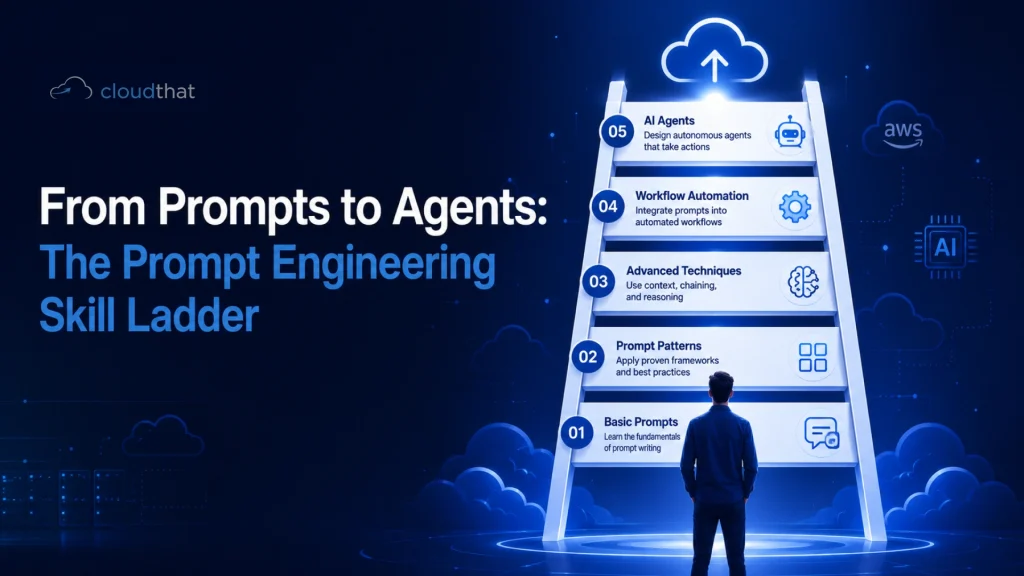
The Skill Ladder: From Basic Prompts to AI Agents
Here is something the short YouTube tutorials never show you: prompt engineering is not one skill. It is a ladder.
Most people learn the first two rungs and call it done. The jobs are on the higher rungs.
Rung 1: Basic Prompting: Zero-shot instructions. Clear task framing. Telling the model what role to play, what format to use, and what to avoid. This is the entry point. Necessary. Not sufficient.
Rung 2: Few-Shot and Chain-of-Thought. You show the model examples of what good looks like. You ask it to reason step by step before giving a final answer. This is where output quality improves meaningfully. It is also where most hobbyists stop.
Rung 3: Structured Outputs and Evaluation. You are no longer writing prompts for yourself. You are writing prompts for a system. That means enforcing JSON schemas, building eval frameworks, measuring hallucination rates, and versioning prompts like code. This is where prompt engineering becomes engineering.
Rung 4: RAG Architecture. You are connecting the model to real data. Documents, databases, internal knowledge bases. The model does not know what your company policy says. You build a pipeline that retrieves the right context and injects it at query time. This rung is where most enterprise LLM projects actually live.
Rung 5: AI Agents. You are giving the model tools. The ability to call APIs, run searches, execute code, and take multi-step actions. The prompt engineer here is designing the agent’s reasoning, planning, and failure recovery. This is the frontier.
An AI prompt engineering course worth taking moves you up this ladder. Not just tell you the rungs exist.
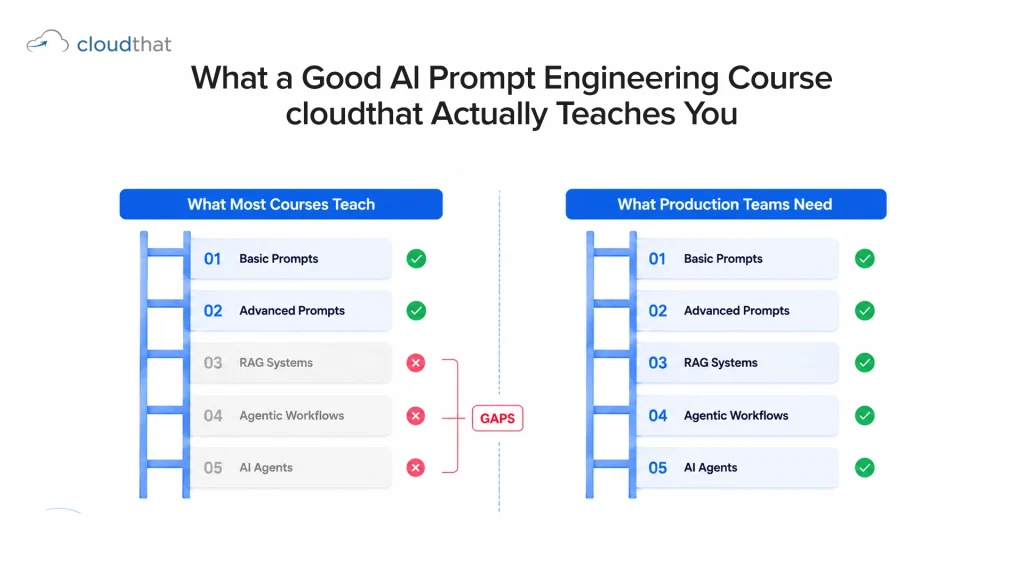
What a Good AI Prompt Engineering Course Actually Teaches You
You have probably seen the free courses. The 9-hour YouTube marathons. The Coursera certificates look impressive in a thumbnail.
Here is the honest problem with most of them: they stop at rung two. They teach you to talk to a model. They do not teach you to build with one.
A good AI prompt engineering course covers a different set of things.
Prompt frameworks for production systems. RISEN, CO-STAR, chain-of-thought variants, self-consistency prompting. Not as academic concepts but as tools you pick up and use depending on the task.
Evaluation and iteration methodology. How do you know your prompt is working? Not “it seems right” but actually measurable. Eval frameworks, benchmark datasets, A/B testing prompt variants. This is the part that separates practitioners from experimenters.
Integration with real cloud tools. Prompts do not float in the air. They run inside applications built on AWS Bedrock, Azure OpenAI, or Google Vertex AI. Understanding how to deploy, monitor, and version prompts inside real infrastructure is what makes the skill hireable.
CloudThat’s AI/ML training courses are built on exactly this premise. Labs happen in live AWS environments. The tools are real. The deployment patterns are what actual production systems use.
The RAG Chapter Nobody Talks About Enough
Picture this.
You have built a beautiful AI assistant. The prompts are clean, the outputs are sharp, and the demo looks great. Then someone asks a question about a document uploaded last Tuesday. The model hallucinates confidently. The client is watching.
That is a RAG problem.
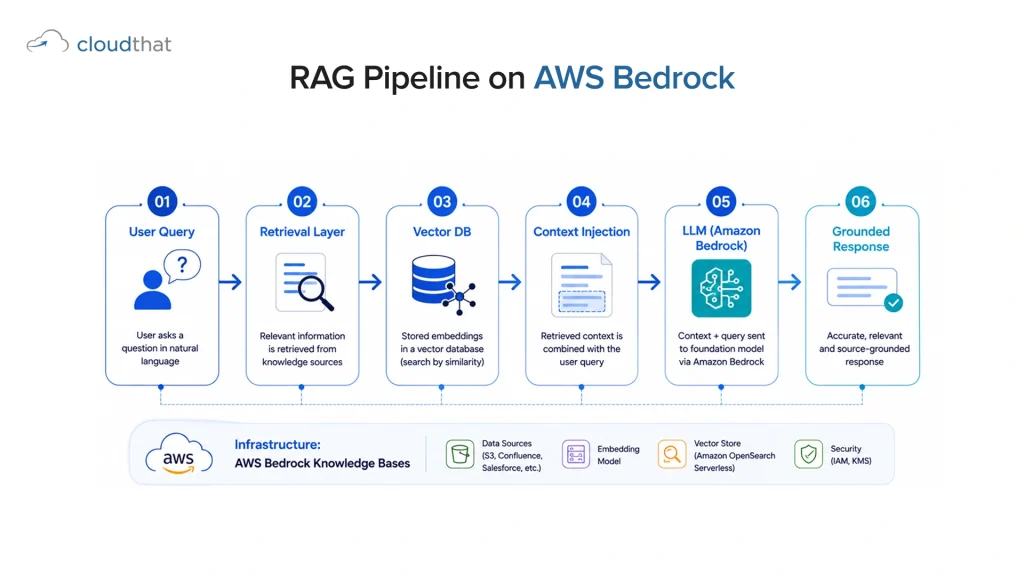
Retrieval-Augmented Generation connects your prompt engineering skills to real-world enterprise use cases. The model’s training data ends somewhere. Your company’s knowledge does not. RAG is the bridge.
In a RAG system, when a user asks a question, the system retrieves the most relevant chunks from a document store, passes them to the model as context, and then generates a response grounded in that context. The prompt engineer designs the retrieval logic, the context window strategy, and the instructions that tell the model how to use what it has been given.
Bad RAG prompting produces answers that ignore the retrieved context, contradict it, or blend it incoherently with the model’s prior knowledge. Good RAG prompting produces answers that are accurate, cited, and on topic.
AWS Bedrock Knowledge Bases handles the RAG infrastructure natively on AWS. The prompting layer on top of it is still entirely your job to design.
This is why prompt engineering is not a commodity skill. The infrastructure gets easier. The craft of designing what runs on top of it does not.
Agents: Where Prompt Engineering Gets Serious
This is the part that changes how you think about the whole field.
An AI agent is not a chatbot. A chatbot responds. An agent acts. It can call a search API, read a database, write code, send an email, chain multiple steps together, and decide what to do next based on what it found in the previous step.
The prompt engineer designing an agent is making decisions that look more like software architecture than copywriting. What tools does the agent have access to? In what order does it use them? How does it handle ambiguity? What happens when a tool call fails?
These are engineering decisions. They are written in prompts, system instructions, and tool descriptions. And they determine whether the agent is reliable enough to put in front of real users.
The AWS Bedrock Agents documentation shows just how much of an agent’s behavior is shaped by the prompts and instructions you write. The infrastructure is managed. The reasoning design is yours.
This is the frontier of prompt engineering in 2026. The engineers who understand it are not easy to find. The courses that actually teach it are few and far between.
Why CloudThat Is the Right Choice for Your AI Prompt Engineering Course
If you are serious about this, the learning environment matters as much as the content.
CloudThat is an AWS Premier Tier Training Partner with a dedicated GenAI practice that runs production AI implementations for enterprises. That is not a branding line. It shapes what gets taught. The trainers are consultants who have designed RAG systems, deployed Bedrock agents, and debugged prompt failures in real enterprise environments. The course content reflects what those environments actually demand.
For individual learners, the AWS Mastery Pass gives you access to 35+ AWS courses, including AI/ML and Bedrock-focused tracks, with hands-on labs that run in live AWS environments. It is structured around the skill ladder described in this blog, not around passive video consumption.
For teams and enterprises, CloudThat’s corporate AI training programs use the Capability Development Framework to build prompt engineering and GenAI skills across cohorts, with pre- and post-training assessments to measure what actually changed. The GenAI Innovation Center takes it further for organizations that need implementation support, not just skilling.
1.1 million professionals trained. 850+ corporates. Three consecutive AWS awards in the same category. The proof is in the track record.
Conclusion
Prompt engineering started as a clever workaround. It has become a serious engineering discipline.
The path from “I know how to word a prompt” to “I build AI systems for a living” runs through RAG, agents, eval frameworks, and cloud platforms. It is a learnable path. But it requires more than a free course and a YouTube playlist.
The right AI prompt engineering course teaches you to build, not just to experiment. Explore CloudThat’s Generative AI and AI/ML training programs and see how fast the latter moves when you are learning in live environments.
Key Takeaways
- Prompt engineering is a production skill, not just the ability to write clever instructions for a chatbot
- The skill ladder runs from basic prompting to few-shot, structured outputs, RAG, and AI agents
- Most free courses stop at rung two; hireable skills start at rung three and above
- RAG architecture is the backbone of most real enterprise LLM applications
- AI agents require prompt engineers to make decisions that resemble software architecture
- AWS Bedrock is the dominant cloud platform for enterprise prompt engineering deployments
- Evaluation frameworks and prompt versioning separate practitioners from experimenters
- A good AI prompt engineering course runs labs in live cloud environments, not slides
- Prompt engineering demand is increasing as more enterprises ship production AI products
- Structured, instructor-led training with real AWS tooling accelerates the learning path significantly
Become an AI Engineer with AWS GenAI Training
- Mock Interviews
- AWS Expert Trainers
- Career Support
About CloudThat
FAQs
1. What is the best AI prompt engineering course for beginners?
ANS: – Look for a course that covers not just prompt syntax but also evaluation, RAG architecture, and cloud deployment. Courses that run labs in live environments, such as AWS Bedrock, produce more job-ready skills than passive video libraries.
2. How long does it take to become an AI prompt engineer?
ANS: – With structured, hands-on training, 2–4 months is realistic for reaching a hireable skill level. The timeline shortens significantly when you are building real projects alongside the coursework.
3. Do I need a coding background for an AI prompt engineering course?
ANS: – Basic Python helps, especially for advanced topics like RAG and agents. Many foundational prompt engineering skills, however, are accessible without deep coding experience.
4. Is prompt engineering a good career in 2026?
ANS: – Yes. Demand is outpacing supply across enterprise AI teams. Roles range from a prompt engineer on product teams to an LLM application developer, with salaries ranging from INR 12 LPA to 30+ LPA depending on experience and cloud platform expertise.
5. Are prompt engineers still in demand?
ANS: – Demand is growing, not shrinking. As more enterprises deploy production AI applications, the need for engineers who can design reliable prompts, RAG systems, and agents is outpacing the talent pool.
6. What qualifications do you need to be an AI prompt engineer?
ANS: – No formal degree is required. Practical skills, a portfolio of projects, and a relevant certification, such as AWS Certified Machine Learning Specialty, carry more weight in hiring than academic credentials.

WRITTEN BY Himisha Raval
Himisha Raval is a Digital Marketing Manager at CloudThat with a strong command of search engine optimization, web analytics, link building, and content strategy. She brings a data-driven approach to digital marketing, helping IT companies strengthen their online presence, improve search rankings, and generate consistent leads across channels. Beyond execution, she plays an active role in ideation, campaign strategy, and website performance optimization. Outside of work, she balances her analytical side with a love for travel, nature painting, and dancing.


 PREV
PREV












Comments