

 Login
Login


 June 26, 2026
|
Voiced by Amazon Polly |
Introduction
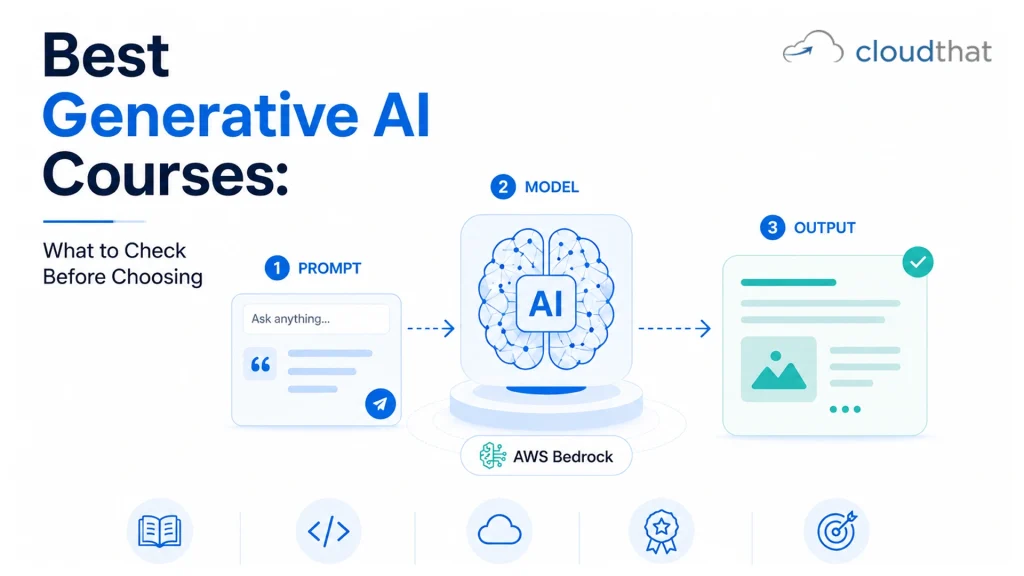
The generative AI course market is crowded. Coursera, DeepLearning.AI, LinkedIn Learning, and Google all have options. Most of them are fine for awareness. But if you are an IT professional deciding where to spend serious time and money, or an L&D leader choosing a vendor for a cohort of engineers, “fine for awareness” is not good enough. The right GenAI course covers foundational models, prompt engineering, RAG pipelines, Bedrock or Vertex AI, and real deployment scenarios. It is taught by practitioners, not slide narrators. And it ends with something you can actually use on the job, not just a certificate image.
You have probably already Googled “best generative AI courses.”
You found Coursera. DeepLearning.AI. Google’s free modules. Maybe a few Reddit threads from people who are also trying to figure this out.
The options are not the problem. The problem is knowing which ones are actually worth your time, because the gap between a good generative AI course and a bad one is not small. It is the difference between understanding how LLMs work and knowing how to build something with them in a production environment.
Here is what to actually look for before you enroll.
Launch Your AI Career with AWS GenAI Training
- Interview Guarantee
- Up to 75% Money Back
- Real-World Learning
What Makes a Generative AI Course Worth Taking
Most GenAI courses will teach you what a transformer is. Very few will show you how to build an agentic workflow on AWS Bedrock, connect it to a knowledge base, and handle failure states in a real deployment.
That gap matters.
According to McKinsey’s 2024 State of AI report, over 65% of organizations are now regularly using generative AI in at least one business function. Which means the demand for engineers who can actually implement it, not just explain it, has significantly outpaced the supply.
A course that prepares you for that environment needs to do more than introduce the technology. It needs to get you comfortable with the actual tooling.
The Curriculum Checklist Most People Skip
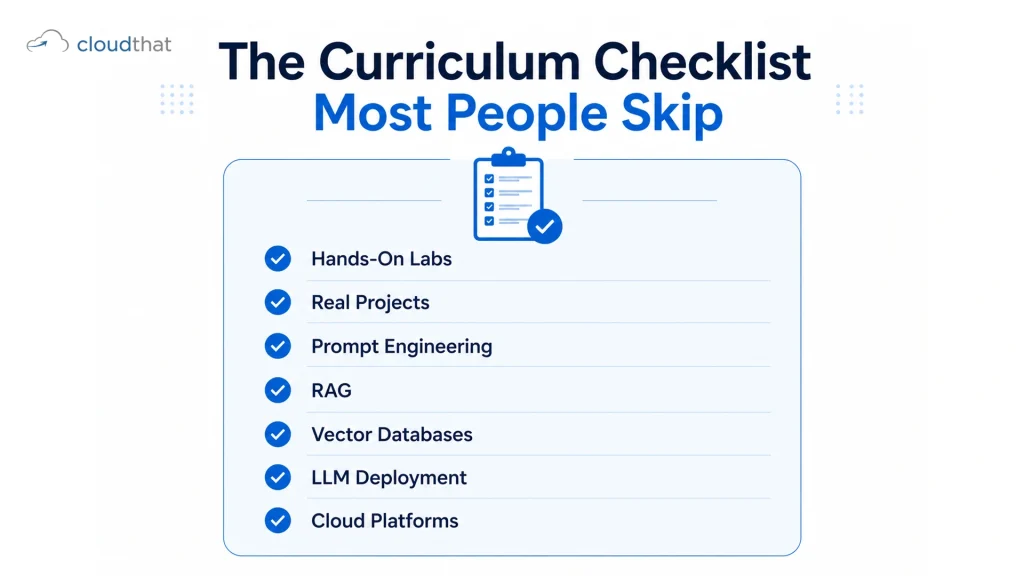
Before you sign up for anything, run the syllabus through this list.
Does it cover:
- Foundation models and how they work (not just what ChatGPT does, but how transformers, tokenization, and attention mechanisms behave)
- Prompt engineering with real examples, not just tips
- Retrieval-Augmented Generation (RAG) and why it matters for enterprise use cases
- Fine-tuning and when NOT to fine-tune
- Agentic AI patterns and multi-agent orchestration
- At least one major cloud platform’s GenAI stack (Bedrock, Vertex AI, or Azure OpenAI)
- Deployment, cost management, and guardrails
If the syllabus stops at “understanding large language models,” that is an awareness course. Good for orientation. Not good for building things.
Hands-On vs. Conceptual: Why It Matters More Than You Think
Here is something most course comparison articles won’t say clearly.
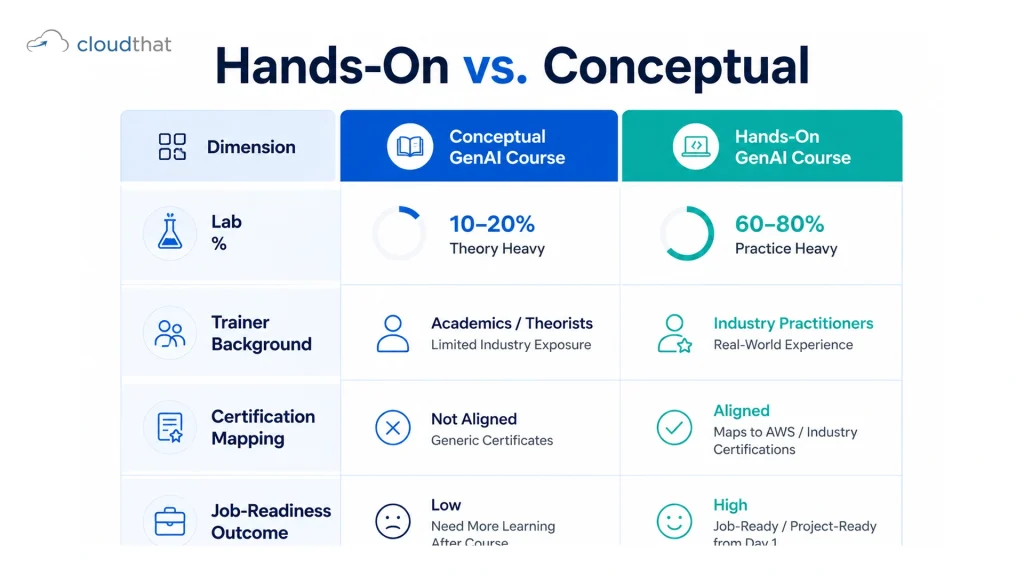
Watching someone build a RAG pipeline is not the same as building one yourself. Your muscle memory for the Bedrock console, the IAM permissions, the chunking strategy for your knowledge base, the evaluation loop, these things only come from doing it.
The best generative AI courses allocate at least 50% of contact hours to hands-on labs. You should be spinning up real environments, not watching a video of someone who already did.
AWS’s own documentation on Bedrock emphasizes this: working with foundation models effectively requires practical exposure to model selection, inference parameters, and guardrail configuration. None of that is learnable from slides alone.
If a course does not tell you upfront what percentage of the training is hands-on, that is worth asking before you pay.
Trainer Credentials That Actually Signal Quality
This is where many training programs quietly fall apart.
A trainer who has only ever taught the material is different from a trainer who has used it in production. When you hit an edge case in your Bedrock implementation or your agent starts hallucinating in a demo environment, the right trainer has seen that before and knows what to do. A theoretical instructor sends you to StackOverflow.
Look for trainers who hold relevant certifications themselves. AWS Certified Machine Learning Specialty, AWS Certified AI Practitioner, and cloud architect credentials are the floor. Real consulting experience on top of those certifications is what makes the difference.
Google Cloud’s own guidance on AI training separates AI training into beginner, intermediate, and advanced tracks based on deployment experience, not just conceptual understanding. That framing is a useful filter for evaluating any training provider.
Certifications Worth Pursuing in GenAI
If you are an individual learner trying to build credentials, these are worth your attention:
- AWS Certified AI Practitioner: entry point, validates foundational knowledge
- AWS Certified Machine Learning Specialty: serious signal for ML and GenAI engineers; covers SageMaker, model training, and deployment
- Google Professional Machine Learning Engineer: strong for Vertex AI and GCP-native GenAI workflows
- NVIDIA AI certifications: increasingly relevant as organizations move into GPU-accelerated inference and edge deployment
The right generative AI course should map to one or more of these rather than exist in a vacuum. If the certificate you get at the end does not connect to something employers recognize, it is marketing, not credentialing.
Learners who want structured AWS GenAI preparation with career-focused guidance can also explore the AWS GenAI Interview Guarantee Program, which is designed to strengthen practical GenAI skills for real interview and job-readiness scenarios.
Why CloudThat Is the Right Training Partner for Generative AI
If you are serious about generative AI, the training program you pick should be backed by people who actually run GenAI in production.
CloudThat’s Generative AI with AWS training covers Bedrock, SageMaker, and agentic AI implementation from practitioners who have built these systems for enterprise clients. The program runs 50–60% hands-on, which means you spend more time in the environment than listening to someone describe it.
For organisations upskilling engineering teams, CloudThat’s Capability Development Framework maps GenAI training to actual role requirements, runs pre and post-training skill assessments, and measures whether engineers are project-ready after the engagement. That is not a video library. That is workforce transformation.
CloudThat also operates the GenAI Innovation Center, which means the trainers are not working from a static curriculum. They are building real GenAI solutions, including Smart Document Search, Intelligent Document Processing, Real-Time Customer Call Analysis, and agentic AI implementations on AWS Bedrock, and they bring that current, live experience into the classroom.
As an AWS Premier Tier Services Partner with competencies in GenAI, MLOps, Agentic AI, and Machine Learning, CloudThat sits at a tier that less than a fraction of AWS partners reach. That credential matters when you are deciding whom to trust with your GenAI skills.
Explore the AI/ML training catalogue and the corporate GenAI training programs to see what a curriculum designed by practitioners actually looks like.
Conclusion
The generative AI course market will only get noisier. More platforms, more certifications, more free content. What will not change is the gap between people who can talk about GenAI and people who can ship it.
Choose a program that covers the full stack, runs on real cloud environments, is taught by practitioners, and maps to certifications employers actually look for. That combination is rarer than it should be.
If you are ready to go beyond the basics, explore CloudThat’s generative AI training programs or talk to the team about building a custom GenAI upskilling path for your organization at cloudthat.com/corporate-training.
Key Takeaways:
- Check the syllabus for RAG, agentic AI, and cloud-native GenAI tooling before enrolling in any program.
- The hands-on lab percentage matters more than the total course hours; aim for at least 50%.
- Trainers with active consulting experience are more useful than theoretical instructors when you hit real deployment problems.
- AWS, Google, and NVIDIA certifications are the ones employers in this space actually recognize.
- Free courses are useful for orientation; structured programs are for people who need to ship.
- Agentic AI and multi-agent workflows are now standard scope, not advanced topics.
- Enterprise GenAI training should include skill assessment and post-training measurement, not just content delivery.
- AWS Premier Tier partner status is a meaningful quality signal when choosing a training vendor.
- Curricula that connect to real consulting projects stay current in a way that static course libraries do not.
- A program without a certification pathway at the end is selling awareness, not career advancement.
Become an AI Engineer with AWS GenAI Training
- Mock Interviews
- AWS Expert Trainers
- Career Support
About CloudThat
FAQs
1. Which generative AI course is best for working engineers?
ANS: – Look for programs that cover Bedrock, Vertex AI, or Azure OpenAI with real hands-on labs, not just conceptual modules. The best programs map to certifications like AWS Certified Machine Learning Specialty and are taught by practitioners with deployment experience.
2. Can you self-teach generative AI?
ANS: – You can get started, yes. But self-teaching typically covers theory. Production-ready GenAI skills, like agentic workflows, RAG pipelines, and cost-efficient inference, come faster in structured, hands-on environments where you get real feedback.
3. What is the salary of a GenAI engineer in India?
ANS: – According to LinkedIn and Glassdoor data from 2025, GenAI engineers in India with 2–5 years of experience earn between INR 15–35 LPA, with senior roles and cloud specializations pushing significantly higher. Certification and hands-on project experience are the primary differentiators.
4. What is the best certification for generative AI?
ANS: – AWS Certified Machine Learning Specialty is the most recognized for engineers working in AWS environments. AWS Certified AI Practitioner is a good entry point. For GCP, the Professional Machine Learning Engineer certification is the strongest signal.
5. Which institute is best for generative AI training in India?
ANS: – CloudThat is an AWS Premier Tier Services Partner with specific competencies in GenAI, Agentic AI, and MLOps, a dedicated GenAI Innovation Center, and 14+ years of cloud training and consulting experience. That combination of partner credentials and live consulting practice is not common in the Indian training market.
6. Is generative AI a good career path in 2025–26?
ANS: – Yes. Organisations across sectors are actively looking for engineers who can implement GenAI, not just understand it. Roles in prompt engineering, MLOps, and GenAI solution architecture are growing faster than supply right now.
7. Do generative AI courses cover agentic AI?
ANS: – Strong programs do. Agentic AI involves multi-agent orchestration, tool use, and action-group configuration within frameworks such as AWS Bedrock Agents. If a course does not mention this, it is behind the current deployment curve.

WRITTEN BY Himisha Raval
Himisha Raval is a Digital Marketing Manager at CloudThat with a strong command of search engine optimization, web analytics, link building, and content strategy. She brings a data-driven approach to digital marketing, helping IT companies strengthen their online presence, improve search rankings, and generate consistent leads across channels. Beyond execution, she plays an active role in ideation, campaign strategy, and website performance optimization. Outside of work, she balances her analytical side with a love for travel, nature painting, and dancing.


 PREV
PREV






Comments