

 Login
Login


 July 1, 2026
|
Voiced by Amazon Polly |
Introduction
An LLM engineer builds, fine-tunes, and deploys large language model applications. The role combines prompt engineering, Python, cloud infrastructure, and ML fundamentals. Entry-level roles expect hands-on experience with AWS Bedrock, LangChain, or similar tools. You do not need a PhD. You need structured upskilling, real projects, and the right certifications to prove you can actually ship.
There is a role going viral in engineering teams right now.
It is not a frontend. It is not DevOps. It is not even regular machine learning.
It is the LLM engineer. And companies cannot hire them fast enough.
The job boards are lighting up. The salaries are absurd. And somewhere in a LinkedIn comment section, someone is asking: “What exactly does an LLM engineer even do?”
If that is you, stay here. This blog is written for you.
No Job After Graduation? Cloud Engineering is Your Answer
- Beginner Friendly
- 92% Placement Rate
- Live Instructor-Led
What Does an LLM Engineer Actually Do?
Here is the honest answer nobody gives you.
An LLM engineer sits at the intersection of software engineering and AI. They do not train models from scratch. That is the ML researcher’s job. What they do is take existing large language models, like GPT, Claude, or Llama, and build real products with them.
Think: a customer support bot that actually understands context. A document processing pipeline that extracts structured data from messy PDFs. An internal search tool that stops employees from wanting to quit.
The outputs are real. The engineering problems are real. And the demand? Very, very real.
According to the World Economic Forum’s Future of Jobs Report, AI and machine learning specialists are among the fastest-growing job categories globally. LLM engineering is at the sharp end of that growth curve.
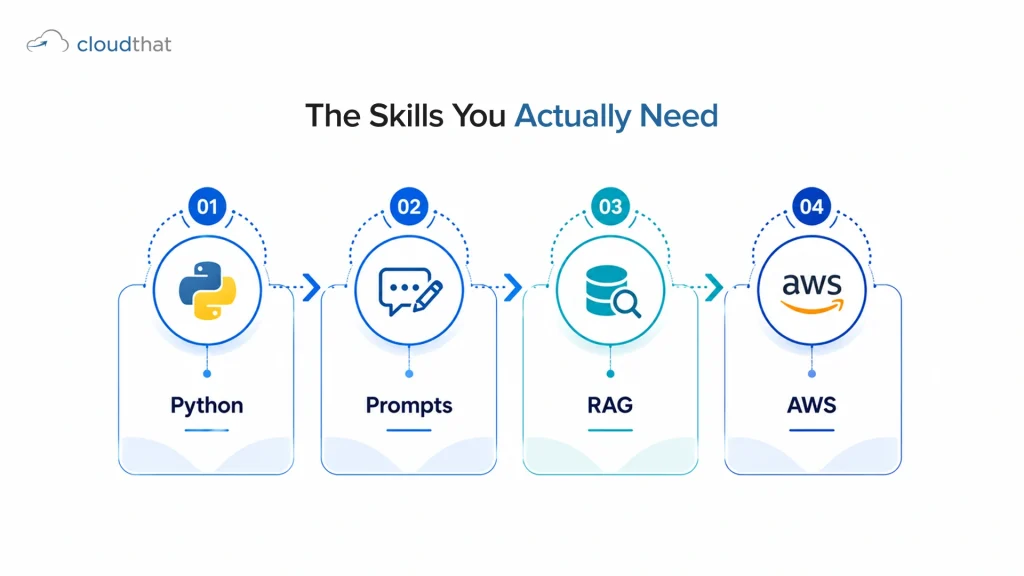
The Skills You Actually Need (Not the Hype List)
Let’s skip the 47-bullet skill tree you’ve seen on every other blog.
Here is what actually matters.
Python, But the Right Python
Not just syntax. You need to be comfortable with async programming, API calls, working with unstructured data, and handling the chaos of LLM outputs. Libraries like LangChain, LlamaIndex, and Hugging Face Transformers are your daily tools.
If your Python knowledge stopped at for-loops and pandas, that is the first gap to close.
Prompt Engineering That Goes Beyond “Write a better prompt”
Prompt engineering sounds deceptively simple. It is not.
At the production level, you are doing chain-of-thought prompting, few-shot examples, structured output enforcement, and prompt versioning. You are debugging why a model confidently returns wrong answers. You are building eval frameworks to measure output quality at scale.
It is a legitimate engineering skill. OpenAI’s prompt engineering guide is a solid starting point, but real fluency comes from building and breaking things in live environments.
RAG Architecture
Retrieval-Augmented Generation is the backbone of most production LLM applications.
The model does not have access to your company’s internal data. So you build a pipeline: embed documents, store them in a vector database, retrieve the relevant chunks at query time, and pass them to the model. Simple in theory. Full of edge cases in practice.
Knowing how to design, optimize, and debug a RAG pipeline is what separates a junior prompt-tinkerer from someone who ships real products.
Cloud Infrastructure Basics
LLM applications do not run on your laptop. They run on cloud infrastructure. That means understanding how to deploy APIs, manage compute costs, handle scaling, and set up monitoring.
AWS is the dominant platform for enterprise LLM deployments. Knowing your way around it is not optional.
Portfolio Projects That Get You Hired
Nobody cares about your certificates alone. They want to see what you built.
Here is what to build.
A Document Q&A System
Take a set of technical PDFs, build a RAG pipeline on top, and let users query them in natural language. Sounds simple. The implementation teaches you vector databases, chunking strategies, embedding models, and retrieval quality evaluation. It also looks genuinely useful to any hiring manager who reviews it.
An AI Agent with Tool Use
Build an agent that can call external tools: a search API, a calculator, a database lookup. This shows you understand how LLMs plan, reason across steps, and handle failures. AWS Bedrock’s Agents API is a great way to build this with a proper cloud backbone. CloudThat’s Generative AI with AWS consulting practice does exactly this for enterprise clients, so the skills translate directly.
A Fine-Tuned Model for a Niche Task
Even a small fine-tuning project on an open-source model demonstrates you understand training data, model behavior, evaluation metrics, and deployment. It does not have to be state-of-the-art. It has to show you understand the process.
These three projects, hosted on GitHub with clean documentation, will do more for your job search than a dozen passive online certificates.
AWS Tools Every LLM Engineer Should Know
This is where most courses skip ahead too fast.
Let’s slow down.
Amazon Bedrock
Bedrock is AWS’s managed service for foundation models. You can access Claude, Llama, Titan, and others through a unified API, without managing any infrastructure. For most enterprise LLM applications, this is the starting point.
Bedrock Agents extend this with multi-step reasoning and tool integration. Bedrock Knowledge Bases natively support the RAG architecture. If you are building on AWS, you are building with Bedrock.
CloudThat’s AI/ML training courses include dedicated modules on Bedrock workflows and production deployment patterns, including hands-on labs where you build real agentic pipelines.
Amazon SageMaker
When you need to fine-tune, SageMaker is where it happens. It handles training jobs, model registry, endpoint deployment, and monitoring. The learning curve is steeper than Bedrock, but the control it gives you is worth it for custom model work.
AWS’s own SageMaker developer documentation is comprehensive and regularly updated.
AWS Lambda and API Gateway
Your LLM application needs to serve requests. Lambda lets you run serverless inference endpoints without managing servers. API Gateway puts a proper HTTP interface in front of it. Together, they are the fastest path from model to production API.
Understanding this stack is what makes you deployable, not just capable.
Amazon OpenSearch with Vector Engine
For RAG, you need somewhere to store and query embeddings. Amazon OpenSearch’s vector engine is the AWS-native answer. Knowing how to set up vector indices, tune similarity search, and integrate it with Bedrock Knowledge Bases is a concrete, hireable skill.
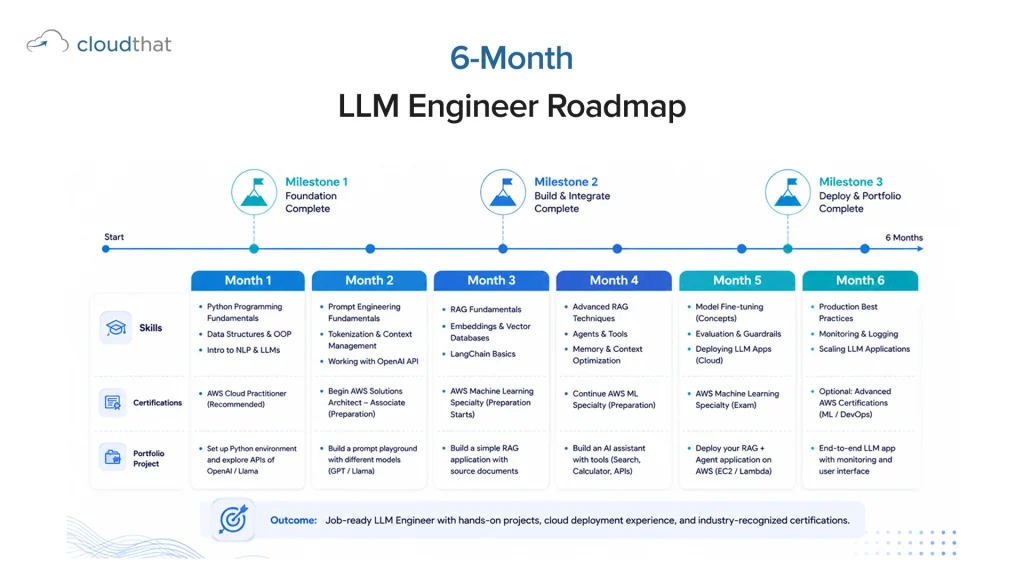
How Long Does It Take to Become an LLM Engineer?
Real answer: 4 to 6 months of focused effort, assuming you already code.
Here is the rough sequence.
Months 1–2: Close the Python gaps. Learn prompt engineering fundamentals. Build your first RAG system on Bedrock.
Months 3–4: Go deeper on agents, fine-tuning, and eval frameworks. Start your portfolio projects.
Months 5–6: Get the AWS Certified Machine Learning Specialty certification. Finish portfolio projects. Start applying.
The timeline compresses significantly with structured, instructor-led training that forces you to build instead of just watch. Passive video courses feel productive. Active labs are where the actual learning happens.
Why Serious LLM Engineers Train with CloudThat
There are many places to learn about LLMs right now. Most of them teach you to use the tools. CloudThat teaches you to build with them. That distinction shows up in what happens after training ends.
CloudThat’s AI/ML courses include hands-on AWS Bedrock labs, Agentic AI workshops, and RAG pipeline builds in live cloud environments. The AWS Mastery Pass gives you access to 35+ AWS courses, including the Machine Learning Specialty track, for a full year. Trainers are not instructors working from slides. They are consultants who have designed and shipped the same RAG systems and Bedrock agents that the course is teaching. On the consulting side, CloudThat’s GenAI Innovation Center runs production GenAI implementations across intelligent document processing, enterprise search, and real-time customer call analysis. That production context does not stay on the consulting side. It flows directly into what gets taught and how.
Three consecutive AWS awards in the same category. That is not a badge. That is a signal.
Conclusion
The LLM engineer role is not a trend. It is a function that every serious technology team is building out right now.
The path to it is not mysterious. It is Python, prompt engineering, RAG, AWS tooling, and a portfolio that proves you can ship. Start with Bedrock. Build something real. Get the certification. Repeat.
The gap between where you are and where you want to be is smaller than you think. It just requires the right structure to close it fast.
Explore CloudThat’s Generative AI and AWS training programs and see what a structured path to this role actually looks like.
Key Takeaways
- LLM engineers build production AI applications using existing models, not training from scratch
- Python, prompt engineering, RAG architecture, and AWS tooling are the four non-negotiable skill areas
- A portfolio with three real projects matters more to hiring managers than passive certificates
- AWS Bedrock is the primary cloud platform for enterprise LLM applications
- RAG pipelines are the backbone of most production LLM products and require real hands-on practice
- AWS Certified Machine Learning Specialty is the most recognized credential for this career path
- A structured 4–6 month upskilling path is realistic for engineers with existing coding experience
- SageMaker handles fine-tuning workflows; Lambda and API Gateway handle serving
- Passive video courses underperform instructor-led, lab-heavy training for a role this hands-on
- CloudThat’s trainers are practicing consultants who build the same systems they teach
Already in IT? Switch to Cloud & Earn 55% More
- Weekend Batches
- Dedicated Career Support
- Official AWS Labs
About CloudThat
FAQs
1. What is an LLM engineer?
ANS: – An LLM engineer builds applications using large language models. The role involves prompt engineering, RAG architecture, fine-tuning, and deploying AI features in production on cloud platforms like AWS.
2. Do I need a background in machine learning to become an LLM engineer?
ANS: – Not necessarily. Strong Python skills, cloud fundamentals, and hands-on experience with tools like AWS Bedrock and LangChain matter more than a formal ML background for most application-layer roles.
3. How much does an LLM engineer earn in India?
ANS: – Salaries range from INR 12 LPA at the entry level to 30+ LPA for experienced engineers with production deployments and certifications, according to current listings on LinkedIn and Glassdoor.
4. What is the best LLM engineer course for someone starting out?
ANS: – A course that covers AWS Bedrock, RAG architecture, prompt engineering, and hands-on deployment in a single structured path. Passive video libraries tend to underperform live instructor-led training for this kind of role.
5. Is AWS certification necessary to become an LLM engineer?
ANS: – Not strictly required, but the AWS Certified Machine Learning Specialty signals real cloud competency to employers and is widely recognized across enterprise hiring teams.
6. How long does it take to become job-ready as an LLM engineer?
ANS: – Approximately 4–6 months with focused, structured learning. The timeline shortens through hands-on labs and mentorship from practitioners actively building in this space.

WRITTEN BY Himisha Raval
Himisha Raval is a Digital Marketing Manager at CloudThat with a strong command of search engine optimization, web analytics, link building, and content strategy. She brings a data-driven approach to digital marketing, helping IT companies strengthen their online presence, improve search rankings, and generate consistent leads across channels. Beyond execution, she plays an active role in ideation, campaign strategy, and website performance optimization. Outside of work, she balances her analytical side with a love for travel, nature painting, and dancing.


 PREV
PREV











Comments