

 Login
Login


 July 14, 2026
|
Voiced by Amazon Polly |
Introduction
Quick answer, since I know you’re skimming before committing to the full read. A data science ai course only turns into a job offer if the projects inside it cover four things: working with real, messy data, building and evaluating machine learning models, using GenAI tools like RAG and agents, and deploying that work somewhere people can actually use it. Four to six solid projects, each with a clear problem statement, your code on GitHub, and a short writeup of what you did and why, will get you more interview calls than another certificate badge on your profile. The rest of this blog breaks down exactly which projects to pick and how to present them.
You finished the course.
Certificate downloaded. LinkedIn updated. Resume polished.
And still, nothing. No callbacks, no interview rounds, just silence.
Here’s the part nobody puts in the brochure. The market is not short on people who have completed a data science ai course. It is short on people who can prove they can actually work with data and AI.
That proof is your portfolio. The course gives you the skills. The projects give you the receipts.
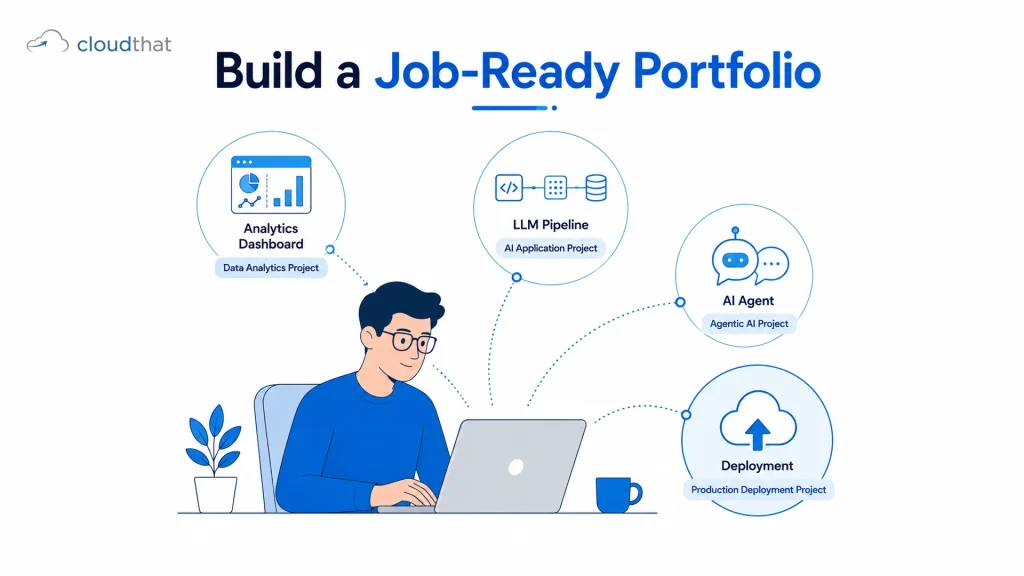
This blog covers which projects genuinely belong in that portfolio, why most “build these 10 projects in a weekend” lists do not help much, and how to pick the ones that match the job you are actually applying for.
No Job After Graduation? Cloud Engineering is Your Answer
- Beginner Friendly
- 92% Placement Rate
- Live Instructor-Led
Why Your Portfolio Matters More Than Your Certificate
A certificate tells a recruiter you sat through a course and passed a test. It does not tell them you can open a messy CSV, figure out what is wrong with it, and turn it into something useful.
Projects do that.
The demand side backs this up too. The World Economic Forum’s Future of Jobs Report 2026 lists AI and machine learning specialists and big data specialists among the fastest-growing roles through 2030. Great news for the field, but it also means more people are chasing the same titles and certificates.
A portfolio is how you stop looking like everyone else with the same badge.
What Recruiters Actually Check Before They Call Back
Recruiters and hiring managers skim your GitHub before they skim your resume, and they are looking for three things: can you frame a problem, can you justify your approach, and can you explain your results without jargon.
Your resume says Python, SQL, scikit-learn, maybe a bit of Power BI or Tableau. That is a list of tools.
A project shows the same tools applied to an actual problem, with your decisions written down. Why did you pick this model. Why did you drop these columns. What did the result actually mean for the business.
That last part, the why, is what most portfolios skip entirely.
Data Analysis Projects That Show You Can Think With Data
Start here, even if your end goal is a GenAI heavy role.
A solid data analysis project usually looks like this. Take a real-world dataset such as retail sales, hospital admissions, or ride-hailing trips, clean it, explore it, and pull out two or three insights a business team would actually act on.
Think sales dipping in a specific region, or one customer segment churning faster than the rest.
This is the project that proves you can sit with ambiguous data and come out the other side with something a decision-maker can use. Skip this one, and everything that follows looks a little shakier.
Machine Learning Projects That Prove Your Models Actually Work
This is where most portfolios fall apart, not because the model is bad, but because the explanation is.
Pick one classification problem, such as credit risk, churn, or fraud, and one regression or forecasting problem, such as demand forecasting or delivery time estimation. For each, show your evaluation metrics properly. Accuracy alone means very little when your classes are imbalanced, so include precision, recall, and a confusion matrix.
If you want a structured way to build toward this, CloudThat’s exam prep for the AWS Certified Machine Learning Engineer Associate walks through ingesting data, feature engineering, and training and evaluating models against real AWS services. That sequence maps almost directly onto what a strong ML project should look like.
GenAI and Agentic AI Projects That Make Recruiters Pause
If your portfolio stops at traditional ML, you are leaving out the part that gets the most attention right now.
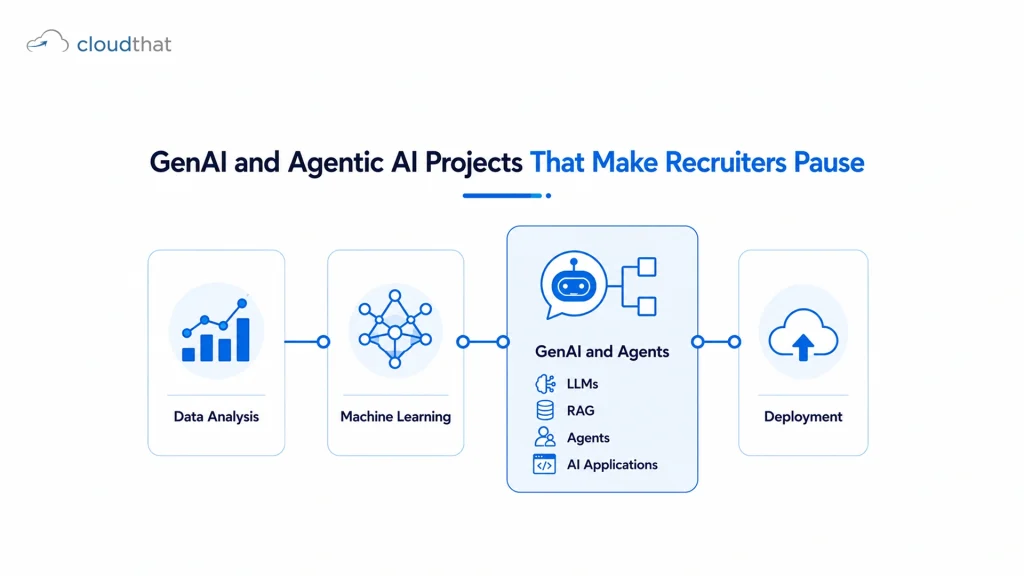
Almost every job description mentions GenAI, agents, or LLMs these days, even for roles that are not strictly AI roles. Two project types cover most of this ground.
Retrieval Augmented Generation Projects
Build a small RAG application over a document set you actually care about. Lecture notes, a company’s public reports, or a set of product manuals all work fine, as long as there is enough text to search through.
Show how you chunk the documents, store embeddings, retrieve relevant pieces, and pass them to a model for a grounded answer. Amazon’s documentation on how Bedrock Agents work is a useful reference for understanding the moving parts before you build your own version.
Multi-Agent Workflow Projects
Take it a step further with a small multi-agent setup. One agent reads incoming queries, another searches a knowledge base, and a third drafts a response, all coordinating on a single task.
You do not need a huge use case here. A simple internal helpdesk assistant or a policy lookup tool is enough to show you understand orchestration, not just prompting.
Deployment and MLOps Projects Because a Notebook Is Not a Product
A model that only runs in your Jupyter notebook is a draft, not a project.
Take at least one of your earlier models a step further. Wrap it in a simple API, containerize it, and set up basic monitoring so you would know if it started behaving badly in production.
CloudThat’s Generative AI in Production course covers exactly this shift, from experimentation to deployment, including the monitoring and CI/CD practices that separate a working model from a production-ready one. Even if your target role is not GenAI specific, the deployment thinking transfers directly.
How to Pick Projects Based on the Role You Want
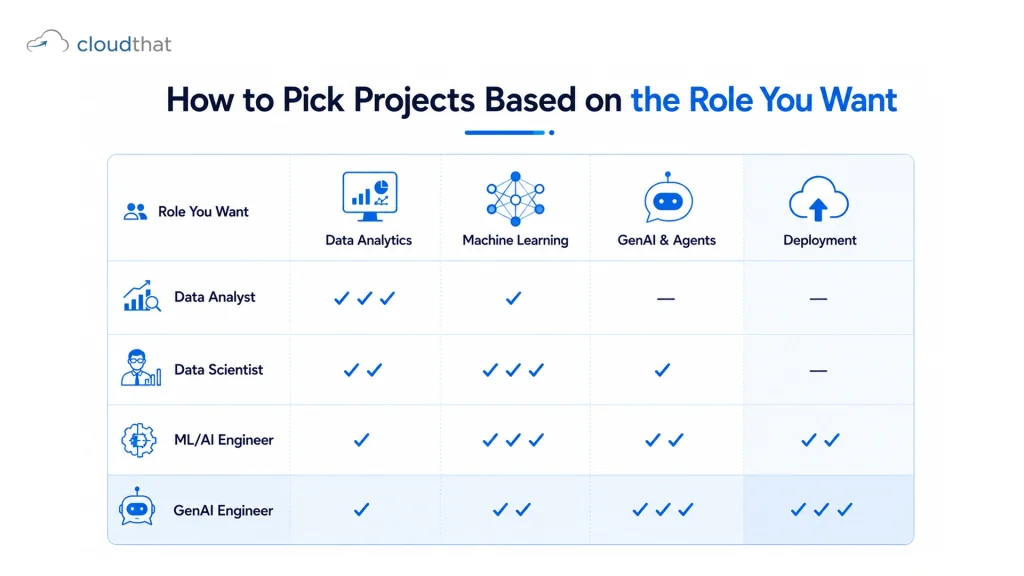
Different roles need a different project mix. Here’s a quick way to think about it.
- Data analyst roles: lean on the data analysis project, plus a dashboard or two.
- Data scientist roles: the data analysis project plus at least two ML projects with proper evaluation.
- ML engineer or AI engineer roles: one strong ML project, with deployment and monitoring as the centerpiece, not an afterthought.
- GenAI focused roles: the RAG and agent projects carry the most weight, backed by one traditional ML project to show fundamentals.
If you are aiming for a role that sits between data science and engineering, something like CloudThat’s AI-300 Operationalizing Machine Learning and Generative AI Solutions is worth a look, since it focuses on exactly that handoff, taking a model from experimentation to something running in production with proper monitoring.
On the AI engineer versus data scientist question, it is less about which is harder and more about what you are asked to prove. Data scientist interviews probe your statistical reasoning. AI engineer interviews probe whether your systems actually run.
How to Present Projects So They Actually Get Noticed
A great project with a bad README is an invisible project.
Each project repo should answer four things in the first few lines: what problem you were solving, what data you used, what approach you took, and what the result was. Add a short writeup, even a few paragraphs, explaining your reasoning, not just your code.
If you can, link a live demo or a short video walkthrough. Recruiters skim. A 60-second video of your RAG app answering a real question does more than three paragraphs of description ever will.
Mistakes That Make a Good Project Look Weak
A quick list of the things that quietly tank an otherwise decent project.
- Using a Kaggle dataset everyone has used, with zero changes to the questions you ask.
- Reporting only accuracy, especially on imbalanced data.
- No business framing. “I trained a model” is not a story. “I built a model that flags high-risk loan applications before disbursement” is.
- Code with no comments, no structure, and no way for someone else to run it.
- Treating GenAI projects like a wrapper around an API call, with no thought given to retrieval quality, prompt design, or evaluation.
Fix even two or three of these across your existing projects and your portfolio will look noticeably more serious.
Why CloudThat Should Be Your Go-To for Data Science and AI Training
Building a portfolio alongside a full-time job or college takes more than motivation. It takes structure.
CloudThat’s Integrated Program in AI and Data Science is built around the exact project types covered above, data analysis, ML modeling, and GenAI work, with hands-on labs designed around real business scenarios rather than toy datasets. The program is built for people with 1 to 12 years of experience who want to move into the most in-demand roles in the field, and it includes placement assistance and career support to bridge the gap between learning and landing a role.
For the machine learning and certification side, the AWS Mastery Pass gives you a year of access to 35 AWS courses, including machine learning and GenAI focused tracks, so you can move from one certification path to the next without re-enrolling each time. The Machine Learning Engineer Associate on AWS course, for example, prepares you for end-to-end ML pipelines on SageMaker, which is the kind of practical, cloud-native work that shows up directly in ML engineer interviews.
If your interest leans more toward GenAI and agentic AI specifically, CloudThat’s Advanced Generative AI Development on AWS covers RAG applications, multi-agent systems, and production deployment using AWS Bedrock, exactly the kind of hands-on context you can reference directly in interviews once your portfolio includes similar work. And for teams or individuals who want applied GenAI solutions built alongside training, the Center of Generative AI Innovation works on document search, intelligent document processing, and multi-agent assistants across enterprise environments.
CloudThat is an AWS Premier Tier Training Partner as well as a Microsoft, Google Cloud, and NVIDIA training partner, which is part of why these tracks map closely to current certification paths and what hiring managers are actually screening for.
Conclusion
Here is the thing about portfolios nobody tells you. You do not need ten projects. You need four good ones that tell a coherent story.
One that shows you can dig into messy data and find something worth acting on. One that shows you can build and evaluate a model properly. One that puts you in the GenAI conversation. And one that proves you know the difference between a notebook and a product.
That combination, well documented and honest about your reasoning, will do more for your job search than a shelf full of certificates ever will.
A data science AI course gives you the foundation. Your projects are what convince someone to take a chance on you. Pick four to six, make sure they cover analysis, modeling, GenAI, and deployment, document them properly, and your portfolio will do more talking in an interview than your resume ever could.
Key Takeaways
- A data science ai course gives you skills, but projects are what prove you can use them.
- Recruiters check your GitHub before your resume, looking for reasoning, not just code.
- Start with one EDA project on a real-world dataset to show you can think with messy data.
- Build at least one classification and one regression or forecasting project with proper evaluation metrics.
- Add one RAG project and one small multi-agent project to cover current GenAI expectations.
- Deploy at least one model behind an API with basic monitoring, since a notebook is not a product.
- Match your project mix to the specific role you are targeting, not a generic do-everything list.
- Document each project with a clear problem statement, approach, and results, not just code.
- Avoid unedited Kaggle notebooks, accuracy-only metrics, and projects with zero business framing.
- Four to six well-documented projects beat ten rushed ones when it comes to interview callbacks.
If you would rather build these projects inside a structured program than figure it out alone, explore CloudThat’s Integrated Program in AI and Data Science and start turning your course work into a portfolio that actually gets you shortlisted.
Already in IT? Switch to Cloud & Earn 55% More
- Weekend Batches
- Dedicated Career Support
- Official AWS Labs
About CloudThat
FAQs
1. Which projects should I prioritize in a data science and AI course portfolio?
ANS: – Start with one data analysis project, one machine learning project with proper evaluation metrics, one GenAI project such as a RAG app or a small agent, and one deployment project. That combination covers what most job descriptions ask for.
2. Can I build a job-ready portfolio in 3 months?
ANS: – Yes, if you focus on quality over quantity. Four well-documented projects built over 10 to 12 weeks, alongside a structured course, will get you further than ten rushed ones.
3. Do I need separate portfolios for data science and AI roles?
ANS: – Not separate portfolios, but different emphasis. The same four to six projects can be reordered or expanded depending on whether you are applying for analyst, data scientist, or AI engineer roles.
4. Will AI replace data scientists, so is this portfolio still worth building?
ANS: – Reports like the WEF Future of Jobs survey show AI and big data roles among the fastest growing, not disappearing. AI is changing the tools data scientists use, which makes hands-on project experience more relevant, not less.
5. What is the 80/20 rule in data science projects?
ANS: – It refers to the idea that around 80 percent of project time goes into collecting, cleaning, and preparing data, while the remaining 20 percent goes into modeling. Portfolio projects that show this prep work look far more credible.
6. Should portfolio projects use real company data or public datasets?
ANS: – Public datasets are fine as long as you reframe the problem with your own questions and business context. What matters is your reasoning and presentation, not where the raw data came from.
7. How many GenAI projects should be in a portfolio right now?
ANS: – One solid RAG or agent based project is usually enough, as long as it is well documented. A single thoughtful GenAI project outperforms three shallow ones built by copying a tutorial.

WRITTEN BY Himisha Raval
Himisha Raval is a Digital Marketing Manager at CloudThat with a strong command of search engine optimization, web analytics, link building, and content strategy. She brings a data-driven approach to digital marketing, helping IT companies strengthen their online presence, improve search rankings, and generate consistent leads across channels. Beyond execution, she plays an active role in ideation, campaign strategy, and website performance optimization. Outside of work, she balances her analytical side with a love for travel, nature painting, and dancing.


 PREV
PREV












Comments