

 Login
Login

 June 16, 2026
|
Voiced by Amazon Polly |
Introduction
Did you know that global spending on cloud services has already reached $1.3 trillion? Cloud computing is currently a very crucial business requirement across a wide range of industries. This raises a very important issue for the people. Should you pursue an AWS DevOps certification or simply follow a cloud engineer certification path?
While both may appear similar, they have significant differences in their responsibilities. With so many organizations rapidly adopting AWS and modern DevOps practices from providers like CloudThat, choosing the right certification can significantly transform your career trajectory.
Let’s understand all the differences, benefits, and other aspects that will help you decide which certification truly aligns with your professional goals.
Transform Your Career with AWS Certifications
- Advanced Skills
- AWS Official Curriculum
- 10+ Hand-on Labs
What is an AWS DevOps Certification?
An AWS DevOps certification will help you learn how to effectively automate various cloud operations, streamline all types of deployments, and even manage cloud infrastructure, and more, using various DevOps principles.
The most recognized credential in this category is the AWS Certified DevOps Engineer – Professional certification. Here you typically focus on:
- Continuous Integration and Continuous Delivery (CI/CD)
- Infrastructure as Code (IaC)
- Monitoring and logging
- Incident response
And more…
What is Cloud Engineer Certification?
A cloud engineer focuses mainly on the overall design, deployment, maintenance, and optimization of the cloud infrastructure. They ensure that your cloud environments are always available, secure, scalable, and cost-effective.
Typical cloud engineering responsibilities include:
- Cloud infrastructure provisioning
- Network configuration
- Storage management
- Virtual machine deployment
- Cloud security implementation
- Resource optimization
- Disaster recovery planning
- Cloud migration
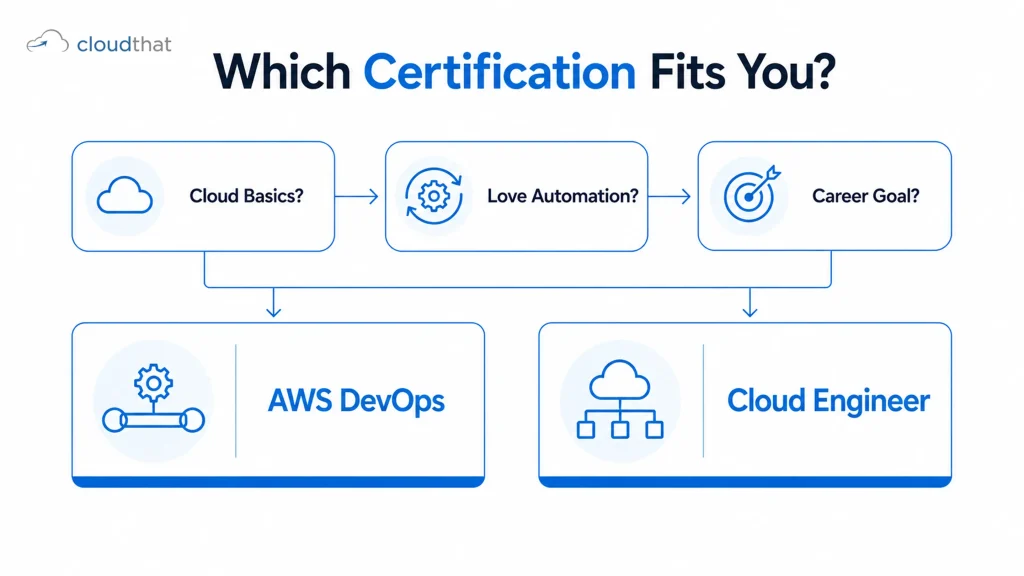
AWS DevOps Certification vs. Cloud Engineer Certification
While these two certifications overlap significantly, there is a massive difference in their overall day-to-day responsibilities, such as:
| Category | AWS DevOps | Cloud Engineer |
| Focus Area | Automation, deployment pipelines, and software delivery acceleration | Infrastructure design, cloud architecture, governance, and resource management |
| Primary Goal | Improve software delivery speed and operational efficiency | Build and maintain secure, scalable cloud environments |
| Tools Used | Jenkins, Terraform, Docker, Kubernetes, GitHub Actions, AWS CodePipeline | Amazon EC2, Amazon VPC, Amazon S3, Route 53, Load Balancers, AWS IAM |
| Career Progression | DevOps Engineer, Site Reliability Engineer, Platform Engineer, Automation Engineer, DevSecOps Engineer | Cloud Engineer, Cloud Administrator, Infrastructure Engineer, Solutions Architect, Cloud Operations Engineer |
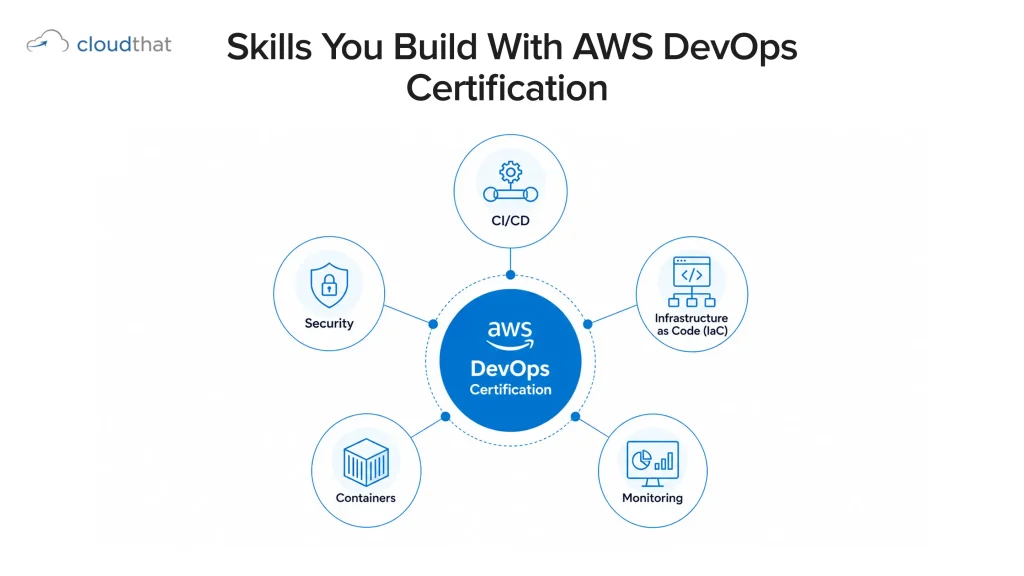
Which skills do you learn in AWS DevOps?
An AWS DevOps certification equips professionals with highly practical automation skills that organizations increasingly demand, such as:
- CI/CD Pipeline Automation
You learn how to actually automate software testing, building, deployment, and release management.
- Infrastructure As Code
Tools such as Terraform and CloudFormation enable engineers to create full-stack, scalable infrastructure deployments.
- Containerization
AWS DevOps professionals regularly work with Docker and even Kubernetes to manage modern cloud-native applications. As containerized applications continue to grow, professionals often complement their AWS DevOps learning with training in modern application development and cloud platforms.
- Monitoring And Observability
You gain expertise in:
- Amazon CloudWatch
- Grafana
- Prometheus
- Logging systems
- Alerting frameworks
- Security Integration
Modern AWS DevOps environments require top-notch security that is actively integrated throughout the development lifecycle.
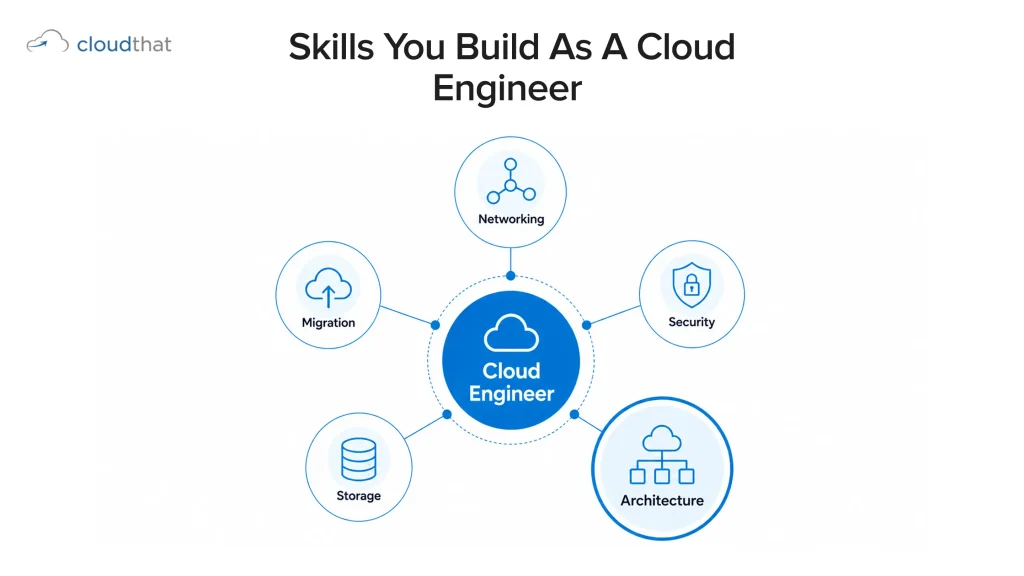
Which Skills Do You Learn As A Cloud Engineer?
Cloud engineer certifications focus heavily on infrastructure management and cloud architecture.
Major skills include:
- Cloud Networking
Understanding VPCs, routing, DNS, subnets, VPNs, and connectivity models.
- Cloud Security
Implementing IAM policies, encryption mechanisms, access control, and governance frameworks.
- Resource Optimization
Managing cloud costs while ensuring performance and scalability.
- High Availability Design
Building fault-tolerant architectures capable of handling failures and traffic spikes.
- Cloud Migration
Helping organizations actually move applications and workloads right from the on-premises environments to various cloud platforms. Cloud engineers frequently work across multiple platforms, including AWS, Azure, Google Cloud, and VMware environments.
Career Opportunities And Salary Potential
While both certifications are excellent for earning potential, the main point to consider is career outcomes. AWS DevOps professionals are in higher demand as organizations usually prefer faster software releases without really compromising on reliability.
They typically prefer candidates who can quickly automate deployments, reduce downtime, and even improve the department’s entire workflows.
AWS DevOps
Common AWS DevOps roles include:
- DevOps Engineer
- DevSecOps Engineer
- Platform Engineer
- Site Reliability Engineer
- Release Engineer
AWS DevOps Engineer positions can range from ₹4.5–7 LPA for freshers, while mid-level AWS DevOps Engineers command ₹10–18 LPA, and senior professionals with 6+ years of experience can earn anywhere between ₹20–45 LPA.
Cloud Engineer
Cloud engineer certifications open opportunities such as:
- Cloud Engineer
- Infrastructure Engineer
- Cloud Administrator
- Solutions Architect
- Cloud Consultant
For fresh graduates or those with limited experience, AWS Cloud Engineer roles typically start at ₹3-6 LPA. Salaries rise significantly: AWS Cloud Engineers, typically earning ₹8–16 LPA, and seniors with 6+ years of experience can earn between ₹20–45 LPA.
Which Certification Is Better For Beginners?
The answer depends on your background and career objectives.
Choose a cloud engineer certification if:
- You are completely new to cloud computing.
- You want strong AWS fundamentals.
- You want to understand networking and architecture.
- You are more inclined towards infrastructure-focused roles.
Choose an AWS DevOps certification if:
- You already understand cloud basics.
- You enjoy automation and scripting.
- You want to work with CI/CD pipelines.
- You are interested in modern software delivery practices.
How AWS DevOps Is Reshaping Modern Organizations?
Businesses today simply cannot afford any delayed software releases. Customers now expect faster updates, instant bug fixes, and truly smooth digital experiences. This is where AWS DevOps becomes so important.
Organizations implementing AWS DevOps practices benefit from:
- Faster deployment cycles
- Reduced operational risk
- Improved application reliability
- Better collaboration between teams
- Enhanced security automation
- Greater scalability
How CloudThat Supports AWS DevOps Success?
Organizations that are gradually adopting AWS DevOps need the right kind of expertise, processes, and automation strategies now. There is a wide range of training modules from CloudThat that help businesses scale their DevOps journey quickly. Here’s how:
- It helps set up automated CI/CD pipelines that strategically enable teams to release different applications with minimal manual errors.
- Implementing Infrastructure as Code (IaC) practices to improve the department’s consistency, scalability, and resource management.
- Integrating various DevSecOps principles in the right manner. This helps security become a part of the development lifecycle rather than just an afterthought.
- Helping teams adopt containerization and cloud-native technologies to build modern, scalable applications.
- Streamlining various cloud operations through different kinds of automation aspects that enable teams to focus on innovation instead of repetitive tasks.
- Supporting organizations with AWS DevOps best practices that improve collaboration between development, operations, and security teams.
Apart from pursuing a certification in AWS DevOps, it is also important to learn how to implement them in real-world environments. CloudThat training courses ensure that you get all the knowledge and expertise before you join the industry and scale your career trajectory in the right way.
Conclusion
The cloud industry is growing rapidly. With so many exciting opportunities in AWS and cloud services, more and more people are choosing various training modules by CloudThat. Starting from AWS DevOps to cloud services. You can choose the kind of certification you will need to scale your career growth.
While they differ, both are equally important for improving your employability and real-world expertise. And a high-quality, reliable training module is your next best step to succeeding in this era.
Key Takeaways:
- AWS DevOps certification is better for people who are interested in automation, CI/CD, and overall operational excellence. It helps organizations accelerate their software delivery while maintaining adequate reliability and security.
- Cloud engineer certification is more focused on cloud infrastructure, networking, and cloud architecture. It builds a technical foundation that helps manage and scale cloud environments.
- So many successful professionals start with cloud engineering. They gradually shift towards an AWS DevOps specialization, gaining a better understanding of both infrastructure and automation.
- Most modern businesses prefer choosing people with AWS DevOps skills. This is because automation directly impacts the business agility and deployment speed.
- Certification is not just enough for career success. It is also very important to work on hands-on projects, cloud deployments, and real-world problem-solving.
Earn Multiple AWS Certifications for the Price of Two
- AWS Authorized Instructor led Sessions
- AWS Official Curriculum
About CloudThat
FAQs
1. Is AWS DevOps certification worth it?
ANS: – Yes, with AWS DevOps certification, you gain skills like automation, CI/CD, monitoring, infrastructure, and more, which makes it absolutely worth it for running successful cloud environments.
2. Can a cloud engineer become a DevOps engineer?
ANS: – Absolutely. Many professionals begin simply as cloud engineers and later transition into AWS DevOps roles after gaining adequate infrastructure experience.
3. Which AWS certification should beginners start with?
ANS: – Most beginners benefit from starting with foundational or associate-level cloud certifications before pursuing any advanced AWS DevOps certification tracks.
4. Is coding required for AWS DevOps roles?
ANS: – Basic scripting knowledge is highly recommended here. You can start with learning Python, Bash, and automation frameworks.
5. Does AWS DevOps certification cover security?
ANS: – Yes. Security automation, compliance monitoring, governance, and DevSecOps practices are some of the very crucial aspects of modern AWS DevOps workflows.
6. What is the difference between DevOps and Cloud Engineering?
ANS: – DevOps focuses more on automation and software delivery processes, while cloud engineering focuses primarily on designing and maintaining cloud infrastructure.
7.
ANS: – Both careers offer strong growth opportunities. However, AWS DevOps roles often experience higher demand because organizations increasingly prioritize automation and continuous delivery.

WRITTEN BY Himisha Raval
Himisha Raval is a Digital Marketing Manager at CloudThat with a strong command of search engine optimization, web analytics, link building, and content strategy. She brings a data-driven approach to digital marketing, helping IT companies strengthen their online presence, improve search rankings, and generate consistent leads across channels. Beyond execution, she plays an active role in ideation, campaign strategy, and website performance optimization. Outside of work, she balances her analytical side with a love for travel, nature painting, and dancing.


 PREV
PREV





Comments