

 Login
Login


 July 14, 2026
|
Voiced by Amazon Polly |
Introduction
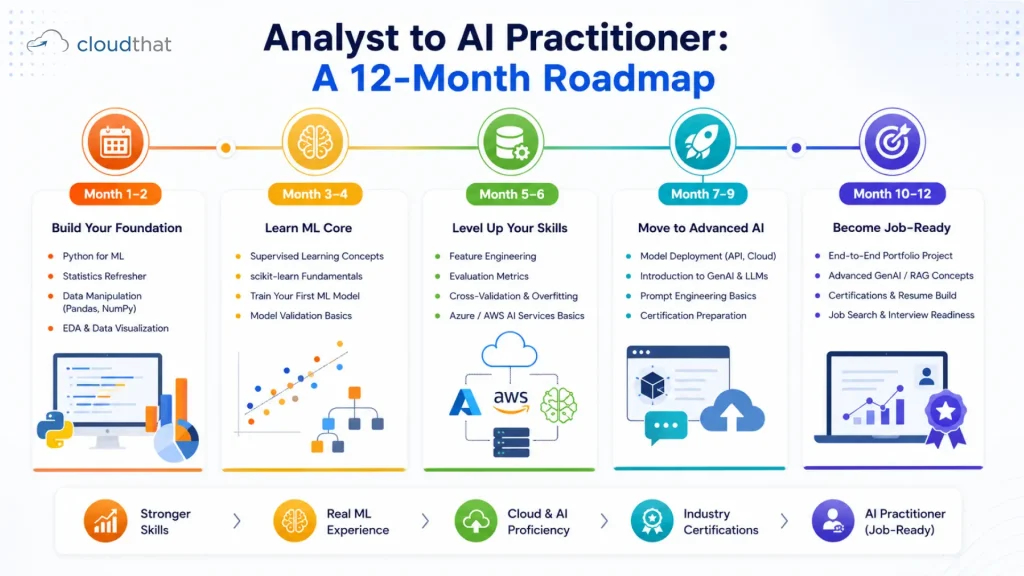
If you already work in data analytics, you are closer to an AI role than you think. The gap is not as wide as LinkedIn job descriptions make it look. A focused data analytics and AI course covers machine learning theory, Python for ML, and model deployment skills that separate an analyst from an AI practitioner. Most analysts make this transition in six to twelve months with the right structured program, without having to start from scratch.
You have been pulling dashboards, building reports, and running SQL queries for years.
You are good at your job. Maybe very good.
But something keeps nagging at you every time you see a job posting for “AI Data Scientist” or “ML Engineer” with a salary that makes your current one look like a first draft.
The frustrating part? You already know the data. You understand business problems. You can spot a bad dataset from across the room.
So why does the AI world still feel like a locked door?
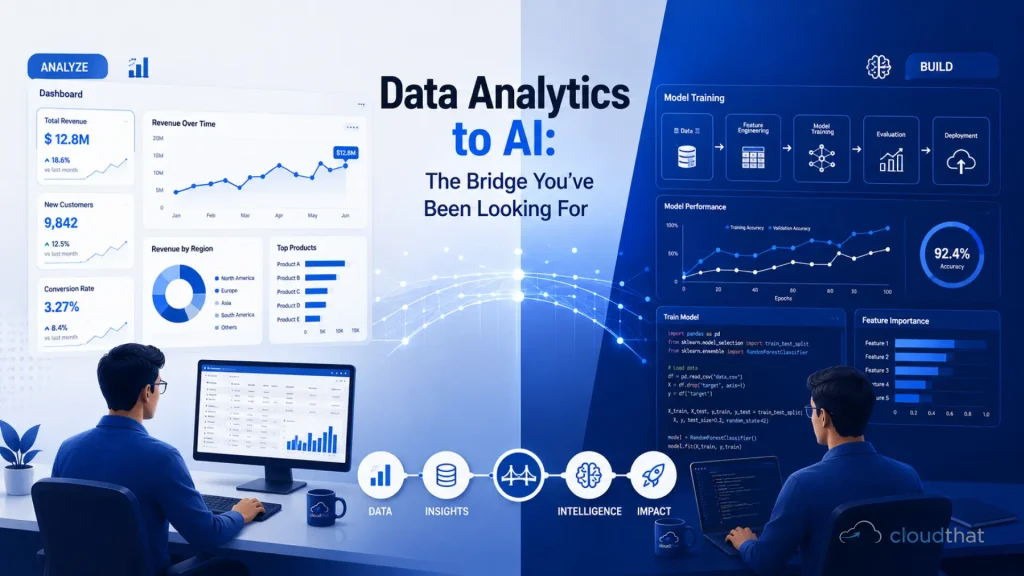
Here is the thing nobody tells data analysts: the gap between where you are and where you want to be is not as enormous as it looks. A targeted data analytics and AI course is not about starting over. It is about building on everything you already know and filling in the specific pieces that are missing.
This blog is about what those pieces actually are and how analysts have been making this exact switch.
No Job After Graduation? Cloud Engineering is Your Answer
- Beginner Friendly
- 92% Placement Rate
- Live Instructor-Led
Why Data Analysts Are Actually Well-Positioned for AI Roles
Let’s be honest about something.
Most “AI experts” you see online started somewhere extremely ordinary. A finance role. A business analyst seat. An Excel spreadsheet and way too much free time.
Data analysts have something that fresh computer science graduates often do not: real business context.
You already know that a 99% accurate model is useless if it is predicting the wrong thing. You already know how to clean messy data, ask the right questions, and explain findings to someone who does not care about your methodology. These are not soft skills. They are survival skills in any AI role.
According to the World Economic Forum’s Future of Jobs Report, analytical thinking and AI literacy are among the top skills employers will prioritize through 2030. Analysts who add AI capabilities to their existing toolkit are not just upskilling. They are becoming exactly what companies are hunting for.
The data foundation is already there. What needs to happen next is building the AI layer on top of it.
Here’s the section with internal links added to the relevant course pages; nothing else changed:
What Skills Are Actually Missing (Not What You Think)
Here is where most people get it wrong.
They assume the gap is massive. They need to go back to college, get a PhD, or spend three years learning mathematics from scratch.
It is not that dramatic.
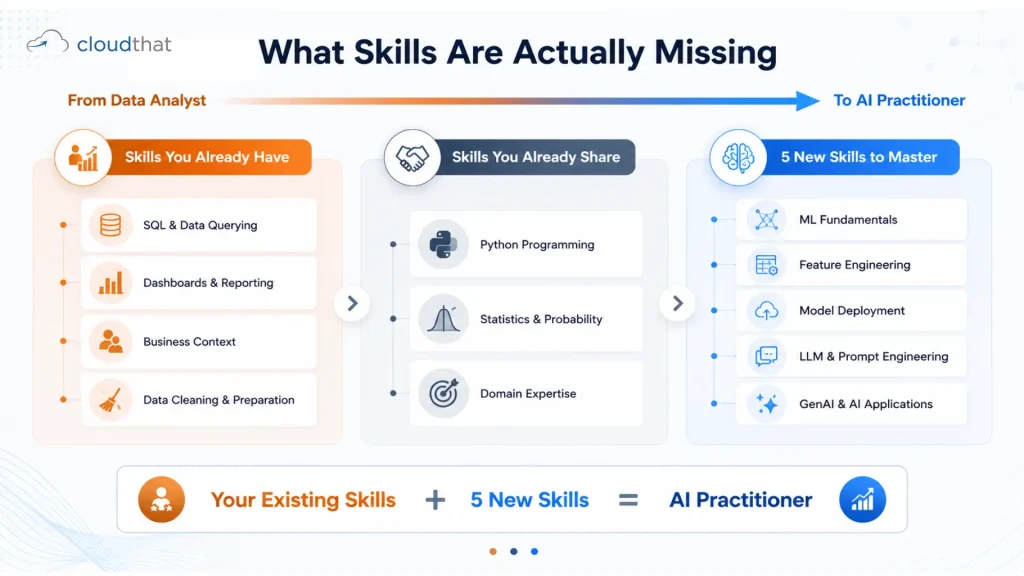
The actual skill gaps between a data analyst and an AI practitioner usually come down to:
- Machine learning fundamentals: supervised and unsupervised learning, model evaluation, overfitting covered in depth in CloudThat’s AI and Machine Learning courses
- Python for ML: not just Python basics, but libraries like scikit-learn, pandas in a modeling context, and eventually TensorFlow or PyTorch, as taught in the Data Science and AI Specialist Program
- Feature engineering: turning raw data into inputs that models can actually use
- Model deployment: getting a trained model into a production environment, which most analysts have never had to do; this is the core focus of Machine Learning Engineering on AWS
- Statistics for inference: moving from descriptive stats to predictive statistics and probability theory
That is it. That is the list.
Not quantum computing. Not a research paper on transformers. Just these five areas, applied consistently over a focused period.
What a Good Data Analytics and AI Course Covers
A course worth your time will not start by making you feel like a complete beginner.
It will start where you already are and build outward.
The best data analytics AI programs are structured around a logical progression: understanding the ML workflow first, then writing code to implement it, and finally deploying it in production. They include hands-on labs where you work on actual datasets, not toy examples invented for a textbook. They cover generative AI concepts because that is where the market is moving, whether analysts are ready for it or not.
The Google Cloud documentation on ML fundamentals is a solid free reference for understanding how supervised learning pipelines are structured. But a course gives you something documentation cannot: feedback, structure, and someone to tell you when your model evaluation logic is completely backward.
What separates a credible data analytics and AI course from a generic online certification is depth on the applied side. Anyone can teach you what a random forest is. Fewer can put you in a situation where you have to debug why your feature importance scores make no business sense and work through it until they do.
The Real Difference Between an Analyst and a Data Scientist
This question comes up constantly, and the answer is more annoying than people want to hear.
It depends on the company.
In some organizations, a data scientist mostly writes SQL and builds dashboards. In others, they are training transformer models on proprietary data and pushing them to production. The title is almost meaningless on its own.
What is not meaningless is the work you can actually do.
An analyst who can build and evaluate a classification model, explain its business implications, and communicate uncertainty to a non-technical stakeholder is already operating at a data scientist level in most mid-market companies.
The shift is less about job title and more about capability. A data analytics and AI course accelerates that capability shift in a way that self-studying YouTube videos on a Tuesday night never quite manages.
McKinsey’s research on AI adoption shows that organizations are significantly scaling AI deployments, but talent with both business understanding and technical AI skills remains rare. Analysts who close this gap have genuine leverage.
How to Know If You Are Ready to Make the Move
You are probably ready if:
- You have been working in data analytics for at least one to two years and genuinely understand the business side of your domain
- You are comfortable with Python basics or willing to get there fast
- You are frustrated by the ceiling you are hitting in your current analyst role
- You can look at a business problem and immediately think about what data would help solve it
You might want to wait if:
- You are still learning how databases work or what a join actually does
- Your Python experience is zero, and you expect to learn both Python and ML simultaneously without any structure
The honest answer is that most analysts who decide to make this move are ready enough. The course fills the gaps. The existing experience does the rest.
Why CloudThat Is the Go-To for AI and Data Science Training
If you are serious about moving into AI and data science, the training partner matters as much as the curriculum. CloudThat is an AWS Premier Tier Training Partner and Microsoft Partner. That means the certifications you earn here are recognized by the same cloud providers running the infrastructure you will eventually work on. Not a small thing when you are trying to get hired.
The Integrated Program in AI and Data Science is built for professionals who are not starting from zero. It covers machine learning fundamentals, Python for ML, Azure AI services, and end-to-end model deployment. 50–60% of the program runs through hands-on labs. Trainers have worked on actual enterprise ML deployments. For GenAI-specific roles, the Generative AI training programs cover AWS Bedrock, Azure OpenAI Service, prompt engineering, and agentic AI. These are not passive theory courses. They are structured around building things that work in production. The AI and ML course offerings span 23 dedicated programs across platforms, with corporate tracks that have moved cohorts at Accenture and Deloitte into AI-ready roles.
If you have been sitting on this decision for six months, the CloudThat training calendar has upcoming batches across time zones. Pick a date and start.
Conclusion
The story most people tell themselves about moving from data analytics into AI is that it requires a complete reinvention.
It does not.
It requires a structured bridge. The right data analytics and AI course is that bridge. Your analytics experience is not a detour. It is the foundation that makes everything you learn in a good AI program actually stick.
The only thing standing between where you are and where you want to be is the decision to stop waiting until you feel completely ready. Nobody ever does.
Key Takeaways
- Data analysts already have the business context that makes AI skills immediately applicable in the real world
- The actual skill gap is specific: machine learning fundamentals, Python for ML, feature engineering, model deployment, and inferential statistics
- A structured data analytics and AI course is faster and more effective than self-studying scattered resources
- The job title difference between analyst and data scientist matters less than actual capability
- Python is the non-negotiable starting point for any analyst making this transition
- Hands-on labs in a course matter more than lecture hours because deployment is where most people get stuck
- GenAI skills are becoming a separate layer that analysts should add after ML fundamentals, not before
- Most analysts who have been in the field for one to two years are already ready to start, not just almost ready
- Certifications from cloud providers like AWS and Azure add credibility to a portfolio that does not yet have job titles to prove the skills
- The transition is a bridge, not a rebuild. Everything you know transfers.
Ready to start? Explore CloudThat’s AI and ML training programs or check the upcoming training calendar for the next available batch.
Already in IT? Switch to Cloud & Earn 55% More
- Weekend Batches
- Dedicated Career Support
- Official AWS Labs
About CloudThat
FAQs
1. Can a data analyst become a data scientist without a degree?
ANS: – Yes, and many have. What matters to most employers is demonstrated capability: an AI certification from a credible provider, a portfolio project, and the ability to explain your work clearly. A degree helps, but is not a gate.
2. How long does it take to transition from data analytics to an AI role?
ANS: – Typically, six to twelve months with a structured program and consistent practice. Analysts with a strong Python foundation can move faster. Those starting with Python from scratch should expect to invest more time upfront.
3. What programming language should analysts focus on for AI?
ANS: – Python is the clear choice. Most ML libraries, cloud AI SDKs, and GenAI frameworks are Python-first. SQL skills you already have continue to matter, especially for feature engineering and data preparation.
4. Is a data analytics and AI course worth the investment?
ANS: – For analysts who are genuinely hitting a ceiling in their current role, yes. The salary differential between a senior analyst and an AI practitioner in most markets justifies the investment within the first year of the transition.
5. What is the difference between a data analytics course and an AI course?
ANS: – A data analytics course focuses on business intelligence, reporting, and data interpretation. An AI course adds machine learning, model training, and deployment. A combined data analytics and AI course connects both, which is why it works better for analysts than jumping straight into a standalone ML curriculum.
6. Do I need to know statistics before starting an AI course?
ANS: – Descriptive statistics, yes. Most analysts already have this. You do not need to know probability theory in depth before starting. A good course will build that context as it becomes relevant.

WRITTEN BY Himisha Raval
Himisha Raval is a Digital Marketing Manager at CloudThat with a strong command of search engine optimization, web analytics, link building, and content strategy. She brings a data-driven approach to digital marketing, helping IT companies strengthen their online presence, improve search rankings, and generate consistent leads across channels. Beyond execution, she plays an active role in ideation, campaign strategy, and website performance optimization. Outside of work, she balances her analytical side with a love for travel, nature painting, and dancing.


 PREV
PREV







Comments