

 Login
Login


 July 14, 2026
|
Voiced by Amazon Polly |
Introduction
Quick Answer: An AWS DevOps course covers CI/CD pipelines, infrastructure as code, containerization, monitoring, and release automation using AWS-native tools. A structured roadmap typically runs 12 to 20 weeks, moving from Linux and scripting basics through to CloudFormation, CodePipeline, EKS, and CloudWatch. The tools you need to know are Git, Jenkins or AWS CodePipeline, Docker, Kubernetes, Terraform or CloudFormation, and CloudWatch. Hands-on projects matter more than video hours. If you are going for a cloud operations role, the AWS Certified DevOps Engineer Professional is the credential that employers actually notice.
Most people researching an AWS DevOps course already have a general idea of what they want. They want a cloud job. They know DevOps is involved. They are just not sure where to start, what order to learn things in, and how long it realistically takes.
This blog gives you that roadmap. No fluff. Just the skills, the tools, the projects, and the honest answer on how long it takes.
No Job After Graduation? Cloud Engineering is Your Answer
- Beginner Friendly
- 92% Placement Rate
- Live Instructor-Led
What an AWS DevOps Course Actually Covers
People assume AWS DevOps is one thing. It is not. It is a combination of practices, tools, and mindset changes that sit across development, operations, and infrastructure.
A good AWS devops course covers six core areas:
- CI/CD automation: Building pipelines that move code from commit to deployment without manual steps. AWS tools here are CodeCommit, CodeBuild, CodeDeploy, and CodePipeline.
- Infrastructure as Code (IaC): Writing infrastructure definitions instead of clicking through consoles. CloudFormation and Terraform are the main tools.
- Containerization and orchestration: Packaging applications in Docker containers and managing them at scale with Kubernetes on Amazon EKS.
- Monitoring and observability: Using CloudWatch, X-Ray, and OpenSearch to know what is happening in your environment before users notice something is wrong.
- Security and compliance automation: Automating policy checks and audit trails using AWS Config, Security Hub, and IAM policies.
- Version control and collaboration: Git workflows, branching strategies, and integrating code reviews into automated pipelines.
If a course skips any of these, it is not preparing you for a real cloud operations role. It is preparing you for the theory part of an exam, which is not the same thing.
The Roadmap: What to Learn and In What Order
Order matters here. Jumping into Kubernetes before you understand containers, or into CodePipeline before you understand CI/CD concepts, just means you will be confused for longer.
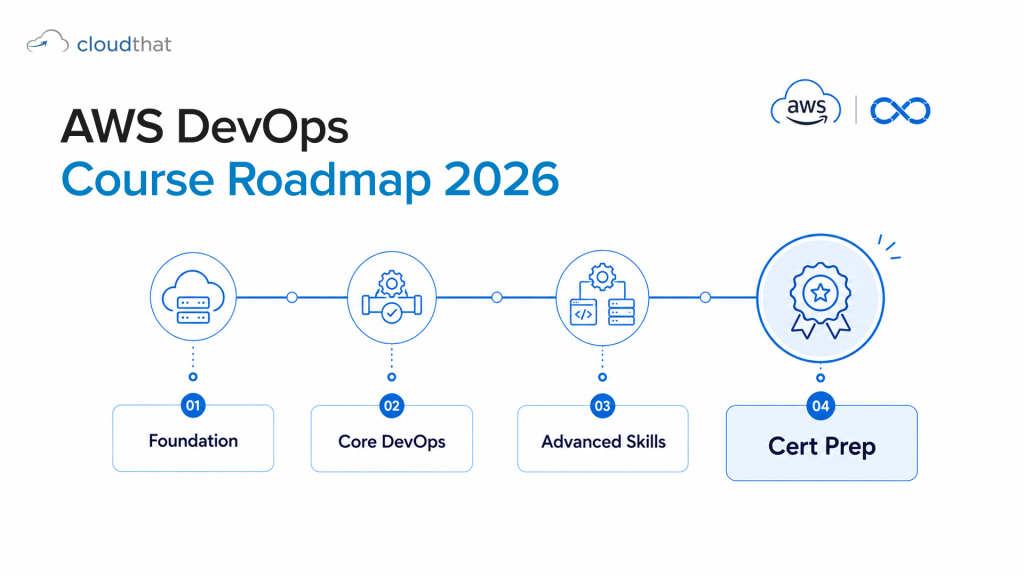
Phase 1: Foundation (Weeks 1 to 4)
Start with Linux command line basics, shell scripting, and Git. These are not optional prerequisites you can skip. Every AWS DevOps tool you will use later assumes you are comfortable with terminals and version control.
Then get familiar with core AWS services: EC2, S3, VPC, IAM, and RDS. If you have not used these in a real environment, nothing in Phase 2 will make full sense.
Phase 2: Core DevOps on AWS (Weeks 5 to 10)
This is where the actual DevOps work starts. You are building pipelines, writing CloudFormation templates, and deploying applications using CodeDeploy. This phase also covers Docker basics and pushing images to Amazon ECR.
The Cloud and DevOps Expert Program at CloudThat is structured around this exact sequence. It does not drop you into advanced tooling before you have the foundation underneath it.
Phase 3: Advanced Skills (Weeks 11 to 16)
Kubernetes on Amazon EKS, Terraform for multi-environment infrastructure, advanced CloudWatch dashboards and alarms, and AWS Config for compliance automation. This is also where you start building the kinds of projects that go on your resume.
Phase 4: Certification Prep (Weeks 17 to 20)
If you are targeting the AWS Certified DevOps Engineer Professional, this phase is focused on exam readiness. Practice exams, scenario review, and gap-filling on whichever domains you are weaker in.
Tools You Will Actually Use on the Job
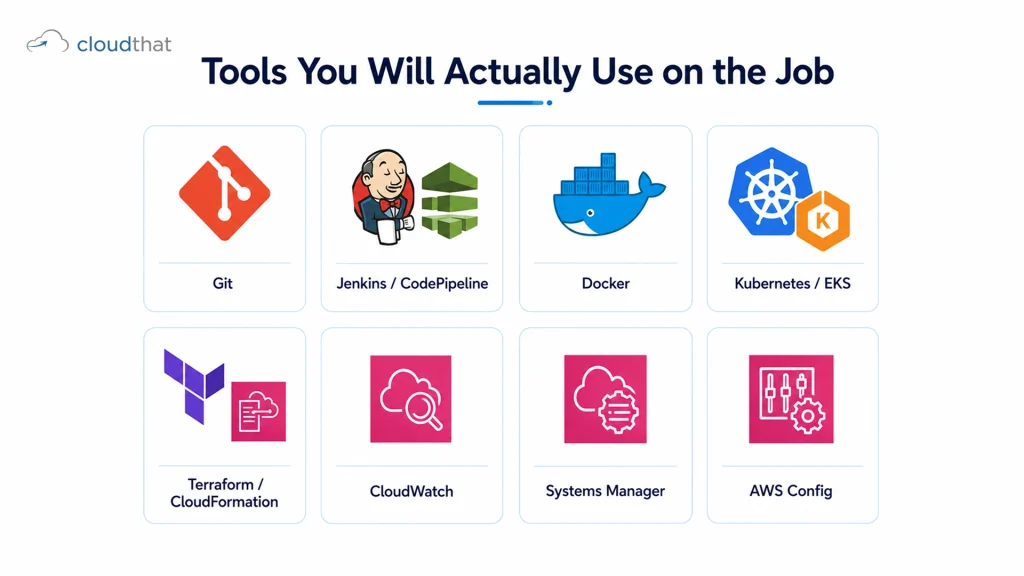
There is a difference between tools that appear in course syllabuses and tools that show up in actual job descriptions. Here is the overlap that matters:
- Git and GitHub or GitLab for version control and pull request workflows
- Jenkins or AWS CodePipeline for CI/CD pipeline orchestration
- Docker for containerising applications
- Kubernetes and Amazon EKS for container orchestration at scale
- Terraform or AWS CloudFormation for infrastructure as code
- AWS CloudWatch and X-Ray for monitoring, tracing, and alerting
- AWS Systems Manager for operational management and patching at scale
- AWS Config for configuration compliance and drift detection
The DevOps Mastery Pass from CloudThat covers all of these tools in instructor-led format with hands-on labs making up more than half the training time. It is priced at INR 74,900 for one year of access across all DevOps courses.
According to the AWS DevOps Tools and Resources page, AWS offers several of these tools with a free tier, which means you can practice most Phase 2 and Phase 3 skills without spending on infrastructure during training.
Projects That Show Employers You Are Ready
Certifications tell employers you passed an exam. Projects tell them you can actually build things.
These are the three project types that cloud operations roles consistently look for:
- End-to-end CI/CD pipeline Build a pipeline that takes a code commit, runs automated tests using CodeBuild, and deploys to an EC2 environment or ECS cluster using CodeDeploy. Document what happens at each stage and why.
- Multi-environment infrastructure with IaC Write CloudFormation or Terraform templates that provision separate dev, staging, and production environments from the same codebase. Show how environment-specific variables are handled without hardcoding.
- Containerised application on EKS Containerise a simple application, push it to Amazon ECR, and deploy it to an EKS cluster. Add a CloudWatch dashboard and set up alerts for CPU utilisation and pod health.
These three projects, documented properly on GitHub, are more valuable in an interview than most certifications on their own.
How Long Does It Take to Learn AWS DevOps
Honest answer: it depends on what you already know.
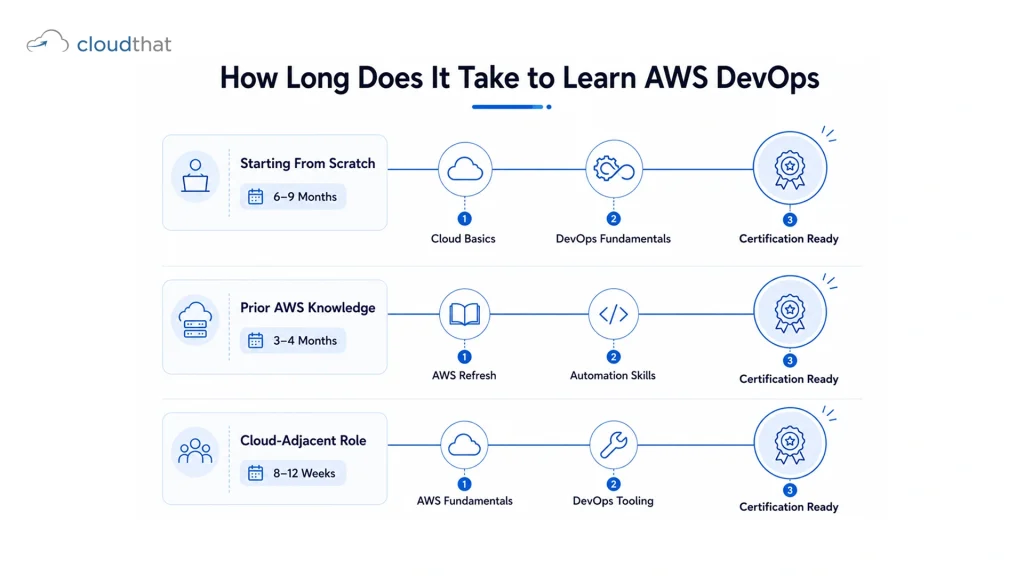
If you are starting with zero cloud experience and no Linux background, budget 6 to 9 months to reach a job-ready level for an entry-level cloud operations role.
If you already have AWS associate-level knowledge and some scripting experience, 3 to 4 months of structured training gets you to DevOps Professional exam readiness.
If you are already working in a cloud-adjacent role and just filling gaps, 8 to 12 weeks of focused training is realistic.
What slows people down most is not the content. It is inconsistency. Watching videos on weekends without building anything means the same concepts need re-learning repeatedly.
Is AWS DevOps Worth It in 2026
Short answer: yes, but not for the reason most people cite.
The certification itself is not magic. What it signals is that you have worked through the full AWS DevOps toolset at a level detailed enough to answer hard scenario questions under pressure. Employers in fintech, SaaS, and enterprise IT services know what that means.
Salary data from LinkedIn and Glassdoor shows AWS Certified DevOps Engineers in India earning between INR 12 to 25 LPA, with the upper end in product companies and financial services. The World Economic Forum’s Future of Jobs Report 2025 lists cloud- and AI-related roles among the top drivers of job creation through 2030. DevOps sits squarely in that window.
The question “Is DevOps dead due to AI?” comes up frequently in search results. The real answer is that AI is changing some tasks within DevOps workflows, particularly in code review and infrastructure recommendations. But it is expanding the need for engineers who can build, maintain, and govern automated delivery systems, not shrinking it.
Why CloudThat Delivers on AWS DevOps Training
CloudThat is an AWS Premier Tier Training Partner. That is not a generic credential. It means the trainers running DevOps sessions are practitioners who work on live AWS environments for enterprise clients, not instructors who only deliver training.
The DevOps Mastery Pass gives you structured access to the full DevOps curriculum for one year. The Cloud and DevOps Expert Program takes you from cloud fundamentals through to production-level DevOps skills with job assistance built in. Both programs run with 50 to 60 percent hands-on lab time, which is what actually builds the muscle memory you need for real work and for the exam.
For engineers who want to go further, CloudThat’s AWS consulting and DevOps practice runs live client engagements in CI/CD implementation, container migrations, and DevSecOps, so the training content is grounded in what is actually happening in production environments right now. CloudThat has also received three consecutive AWS awards in the same category, a global first, as covered by Business Standard.
Conclusion
The AWS DevOps roadmap is not complicated, but it does need to be done in the right order. Foundation first, then core DevOps tooling, then advanced skills, then certification prep. Build real projects alongside the theory. Pick a program with hands-on labs and trainers who run actual AWS environments. That combination is what turns a DevOps course into a cloud operations job.
Key Takeaways
- An AWS DevOps course covers CI/CD, infrastructure as code, containerization, monitoring, and security automation, not just one of these areas.
- Learning order matters: Linux and Git before pipelines, AWS basics before CloudFormation, containers before Kubernetes.
- The tools that appear most often in job descriptions are CodePipeline, CloudFormation or Terraform, Docker, EKS, and CloudWatch.
- Three hands-on projects- a CI/CD pipeline, multi-environment IaC, and an EKS deployment- carry more interview weight than most certifications alone.
- Realistic timelines are 3 to 4 months with prior AWS knowledge, and 6 to 9 months starting from scratch.
- AI is not replacing DevOps engineers. It is changing some tasks while expanding demand for engineers who govern automated delivery systems.
- AWS Certified DevOps Engineers in India earn INR 12 to 25 LPA, with higher brackets in fintech and product companies.
- Hands-on lab time above 50 percent in training is the single biggest predictor of exam pass rates and job readiness.
- Courses that skip monitoring, security automation, or compliance tooling are not preparing you for real cloud operations work.
- Consistency through the roadmap beats intensity in short bursts. Most people who stall do so because of gaps between study sessions, not lack of ability.
Ready to start? Explore the Cloud and DevOps Expert Program for a structured path from cloud basics to job-ready DevOps skills, or check out the DevOps Mastery Pass for full-year access to every DevOps course CloudThat offers.
Already in IT? Switch to Cloud & Earn 55% More
- Weekend Batches
- Dedicated Career Support
- Official AWS Labs
About CloudThat
FAQs
1. Is AWS DevOps hard to learn?
ANS: – It has a learning curve, especially if you are new to Linux and scripting. The concepts themselves are logical once you see how the tools connect. What makes it hard for most people is doing it out of order or through theory-only courses without hands-on practice.
2. How long does it take to learn AWS DevOps?
ANS: – 3 to 4 months if you already have AWS associate-level knowledge. 6 to 9 months if you are starting from scratch. Consistency matters more than total hours. Sporadic study stretches timelines significantly.
3. Which AWS DevOps certification is best?
ANS: – Yes. Cloud operations and DevOps engineering roles are among the fastest-growing in the AWS ecosystem. Companies building or scaling on AWS consistently look for engineers who can own CI/CD pipelines, infrastructure as code, and release automation
4. What is a DevOps engineer salary in India?
ANS: – AWS Certified DevOps Engineers in India typically earn between INR 12 to 25 LPA depending on experience, company size, and industry. Product companies and financial services firms tend to pay at the higher end of that range.
5. Can I get an AWS DevOps job without prior experience?
ANS: – Entry-level cloud operations roles are possible with a combination of associate-level AWS knowledge, hands-on projects on GitHub, and a structured training credential. The Job Ready Cloud Operations Engineer Program at CloudThat is specifically designed for this path and includes job assistance.
6. Do I need to know how to code for an AWS DevOps course?
ANS: – You need scripting basics, specifically shell scripting and ideally Python. You do not need to be a software developer. Most DevOps tooling is configuration-driven rather than code-heavy, but scripting is unavoidable in production environments.

WRITTEN BY Himisha Raval
Himisha Raval is a Digital Marketing Manager at CloudThat with a strong command of search engine optimization, web analytics, link building, and content strategy. She brings a data-driven approach to digital marketing, helping IT companies strengthen their online presence, improve search rankings, and generate consistent leads across channels. Beyond execution, she plays an active role in ideation, campaign strategy, and website performance optimization. Outside of work, she balances her analytical side with a love for travel, nature painting, and dancing.


 PREV
PREV










Comments