

 Login
Login


 June 22, 2026
|
Voiced by Amazon Polly |
Introduction
Modern cloud computing depends on massive global network infrastructure operating behind the scenes. To deliver reliable connectivity and low-latency performance, AWS has built millions of kilometers of terrestrial and subsea fiber-optic cabling worldwide. This infrastructure helps ensure resilience, scalability, and secure connectivity for cloud workloads and AI-driven applications.
Pioneers in Cloud Consulting & Migration Services
- Reduced infrastructural costs
- Accelerated application deployment
Understanding AWS Global Network Infrastructure
AWS operates one of the world’s largest cloud networks, connecting AWS Regions, Availability Zones, edge locations, and customer environments through a highly resilient backbone infrastructure. The network spans terrestrial and subsea fiber-optic routes designed to support continuous connectivity and fault tolerance.
This infrastructure powers services such as:
- Cloud computing workloads
- AI and machine learning applications
- Enterprise networking
- Global content delivery
- Real-time communication systems
As businesses increasingly depend on cloud services, network resilience becomes critical for maintaining operational continuity.
AWS’s Resilience-First Approach
AWS follows a “design with failure in mind” strategy while building its network infrastructure. Instead of relying on single pathways, AWS creates multiple redundant routes to reduce the impact of outages and failures.
The company continuously evaluates network topology, physical routes, and connectivity patterns to identify potential vulnerabilities. This helps AWS maintain high availability even during unexpected disruptions.
Key resilience strategies include:
- Multiple independent network pathways
- Redundant subsea cable routes
- Automated traffic rerouting
- Fault isolation mechanisms
- Continuous infrastructure monitoring
This layered approach improves reliability for enterprise customers worldwide.
Subsea Fiber-Optic Infrastructure
A major portion of AWS’s network operates through subsea fiber-optic cables installed beneath oceans. These cables connect global AWS Regions and enable high-speed data transfer across continents.
AWS invests heavily in subsea infrastructure through partnerships and direct investments. The company also monitors environmental and operational risks associated with undersea cables.
To reduce failures, AWS collaborates with organizations such as:
- European Subsea Cable Association (ESCA)
- International Cable Protection Committee (ICPC)
These collaborations help improve awareness, cable protection, and marine repair capabilities.
AWS also strategically deploys additional cable routes in regions vulnerable to natural disasters or heavy shipping traffic, improving resilience during disruptions.
Terrestrial Fiber Network Expansion
Alongside subsea infrastructure, AWS continues expanding its terrestrial fiber network to support growing global demand for cloud and AI services. Every new AWS data center strengthens the broader AWS backbone network.
AWS focuses on:
- High-bandwidth connectivity
- Low-latency communication
- Scalable AI infrastructure
- Faster data transfer capabilities
The company has upgraded much of its infrastructure to 400 Gigabit Ethernet (400 GbE), significantly improving network speed and efficiency compared to earlier standards.
Emerging technologies such as hollow-core fiber optics and multi-core fiber are also helping improve latency and transmission capacity.
Security and Data Protection
Security is integrated throughout AWS’s global infrastructure. AWS applies multiple layers of protection to safeguard customer data as it travels across its network.
Key security measures include:
- Network-level encryption
- TLS encryption support
- VPN connectivity
- AWS Direct Connect integration
- Physical cable protection
- Restricted facility access
AWS also encrypts traffic traveling outside AWS-controlled environments between Regions, helping customers maintain secure data transmission globally.
Benefits of AWS’s Fiber Infrastructure
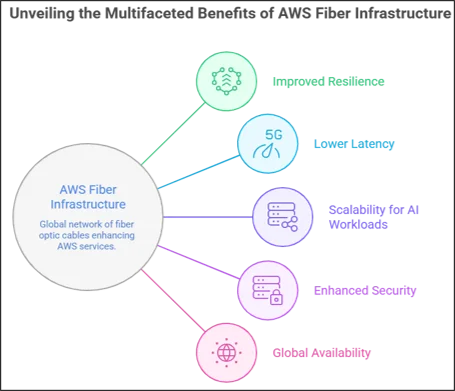
Improved Resilience
Redundant network pathways help reduce downtime and maintain service continuity during outages or cable failures.
Lower Latency
Global fiber connectivity enables faster communication between AWS Regions and customer workloads.
Scalability for AI Workloads
High-capacity networking infrastructure efficiently supports large-scale AI model training and inference workloads.
Enhanced Security
Integrated encryption and physical protection mechanisms improve the security of customer data across the network.
Global Availability
AWS infrastructure supports worldwide application deployment with consistent performance and connectivity.
Real-World Resilience Example
AWS demonstrated the effectiveness of its resilience strategy during subsea cable disruptions near the Ivory Coast and the Red Sea in 2024. Despite multiple cable failures, AWS maintained connectivity using alternative network routes across Africa.
This example highlights the importance of redundancy and proactive infrastructure planning in maintaining reliable cloud services.
Challenges and Considerations
Although AWS operates a highly resilient network, managing global fiber infrastructure involves several challenges:
Environmental Risks
Subsea cables can be affected by earthquakes, landslides, and harsh marine conditions.
Human-Related Damage
Shipping activity and anchor strikes remain major risks for undersea infrastructure.
Rapid AI Growth
Increasing AI adoption requires continuous expansion of networking capacity and performance optimization.
Infrastructure Costs
Building and maintaining global fiber-optic networks requires substantial long-term investment.
Conclusion
AWS’s global fiber-optic infrastructure plays a critical role in delivering secure, scalable, and resilient cloud services worldwide. Through redundant pathways, subsea investments, advanced networking technologies, and continuous monitoring, AWS ensures reliable connectivity for modern cloud and AI workloads.
Drop a query if you have any questions regarding fiber-optic, and we will get back to you quickly.
Empowering organizations to become ‘data driven’ enterprises with our Cloud experts.
- Reduced infrastructure costs
- Timely data-driven decisions
About CloudThat
FAQs
1. Why does AWS invest in fiber-optic infrastructure?
ANS: – AWS uses fiber-optic networks to provide reliable, low-latency, and secure cloud connectivity worldwide.
2. What is subsea cable infrastructure?
ANS: – Subsea cables are underwater fiber-optic cables used for transmitting internet and cloud data across continents.


WRITTEN BY Utsav Pareek
Utsav works as a Research Associate at CloudThat, focusing on exploring and implementing solutions using AWS cloud technologies. He is passionate about learning and working with cloud infrastructure and services such as Amazon EC2, Amazon S3, AWS Lambda, and AWS IAM. Utsav is enthusiastic about building scalable and secure architectures in the cloud and continuously expands his knowledge in serverless computing and automation. In his free time, he enjoys staying updated with emerging trends in cloud computing and experimenting with new tools and services on AWS.


 PREV
PREV












Comments