

 Login
Login


 June 22, 2026
|
Voiced by Amazon Polly |
Introduction
As organizations adopt agentic AI systems, building intelligent workflows with retrieval, reasoning, and orchestration capabilities becomes increasingly complex. To simplify this process, AWS introduced OpenSearch Agent Skills, a feature that brings built-in intelligence directly into AI agents. By providing reusable and modular capabilities, OpenSearch Agent Skills helps organizations build scalable, enterprise-ready AI applications more efficiently.
Pioneers in Cloud Consulting & Migration Services
- Reduced infrastructural costs
- Accelerated application deployment
Understanding Agentic AI
Unlike traditional AI systems that only respond to prompts, agentic AI can reason, retrieve information, and execute tasks autonomously. These AI agents can analyze documents, interact with tools, and automate workflows, making them more suitable for enterprise applications.
What Are OpenSearch Agent Skills?
OpenSearch Agent Skills are built-in intelligence capabilities within the OpenSearch ecosystem that enable AI agents to perform tasks such as retrieval, summarization, reasoning, and workflow execution. These reusable skills simplify the development of scalable and enterprise-ready AI applications.
Key Features of OpenSearch Agent Skills
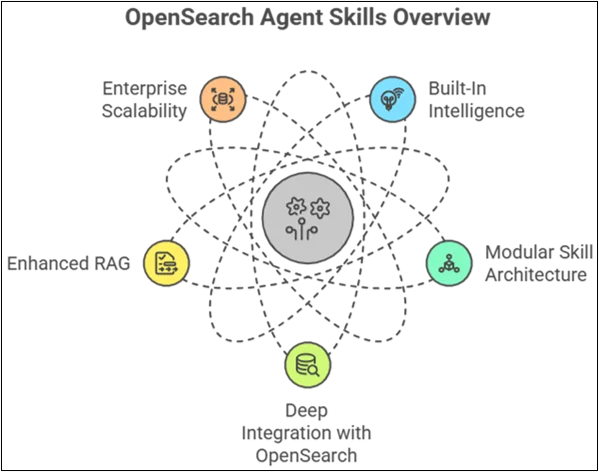
- Built-In Intelligence
One of the most important advantages of OpenSearch Agent Skills is the availability of built-in intelligence capabilities. Developers no longer need to create complex retrieval or orchestration systems from scratch manually.
The framework provides reusable capabilities that can be directly integrated into AI workflows, reducing development effort and accelerating deployment timelines.
- Modular Skill Architecture
The modular architecture allows organizations to combine multiple skills based on business requirements. Each skill is designed to handle a specific function, enabling greater flexibility and reusability.
Examples of supported capabilities include:
- Intelligent search
- Semantic retrieval
- Document summarization
- Workflow orchestration
- Conversational reasoning
- Context-aware response generation
This modular approach simplifies maintenance and promotes scalability across enterprise applications.
- Deep Integration with OpenSearch
Because Agent Skills is integrated directly with OpenSearch, AI agents can leverage advanced search and indexing capabilities efficiently.
Organizations can utilize:
- Vector search
- Semantic search
- Enterprise document indexing
- Structured and unstructured data retrieval
- Real-time information access
This integration enhances the overall performance and responsiveness of AI systems.
- Enhanced Retrieval-Augmented Generation (RAG)
Retrieval-Augmented Generation (RAG) has become a core architecture for enterprise AI systems. OpenSearch Agent Skills strengthens RAG pipelines by improving retrieval quality and orchestration logic.
Instead of simply fetching documents, the system can intelligently analyze context, rank relevance, summarize retrieved information, and generate more accurate responses.
This reduces hallucinations and improves the reliability of generated outputs.
- Enterprise Scalability
Large organizations require AI systems capable of handling high-scale workloads while maintaining governance and operational efficiency.
OpenSearch Agent Skills supports scalable enterprise deployments by enabling centralized orchestration and reusable workflows. This allows organizations to expand AI adoption without significantly increasing operational complexity.
Benefits of OpenSearch Agent Skills
Faster AI Development
Prebuilt skills reduce the amount of engineering effort required to develop intelligent AI agents. Developers can focus more on business logic and innovation rather than on infrastructure integration.
This accelerates the transition from proof of concept to production deployment.
Improved Productivity
Engineering teams spend less time building foundational AI components repeatedly. Reusable skills streamline development workflows and improve operational efficiency.
This leads to faster experimentation and innovation cycles.
Better Response Accuracy
By combining retrieval, reasoning, and contextual understanding, OpenSearch Agent Skills improves the quality and relevance of AI-generated responses.
This becomes especially important for enterprise applications involving large knowledge repositories and dynamic information sources.
Reduced Operational Complexity
Managing multiple independent AI services can become difficult over time. OpenSearch Agent Skills centralizes many core AI capabilities into a unified architecture.
This simplifies deployment, maintenance, monitoring, and governance.
Enterprise-Ready Infrastructure
Since OpenSearch already supports enterprise-grade infrastructure, organizations can build secure and scalable AI systems while maintaining operational control and compliance standards.
Real-World Use Cases
Intelligent Enterprise Search
Organizations can create AI-powered search assistants that retrieve and summarize enterprise information conversationally.
Employees no longer need to navigate through large document repositories to find relevant data manually.
Customer Support Automation
AI agents can analyze support tickets, retrieve troubleshooting information, summarize resolutions, and generate contextual responses for customer support teams.
This improves efficiency and enhances customer experience.
AI Research Assistants
Research teams can build intelligent assistants capable of analyzing technical documentation, summarizing findings, and helping users navigate large knowledge bases more effectively.
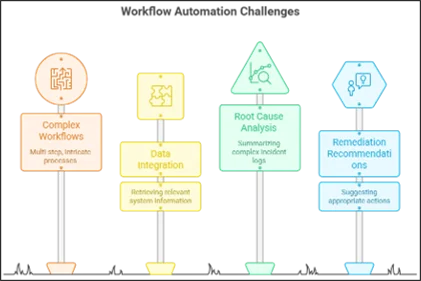
Workflow Automation
OpenSearch Agent Skills enables AI agents to automate multi-step workflows involving reasoning, retrieval, and execution.
For example, an operations assistant could:
- Analyze incident logs
- Retrieve relevant system information
- Summarize root causes
- Recommend remediation actions
This improves operational efficiency and reduces manual effort.
Challenges and Considerations
Skill Governance
As organizations create more reusable skills, governance and standardization become increasingly important. Proper access control and lifecycle management strategies are necessary to maintain consistency.
Data Quality Management
AI systems heavily depend on the quality of the underlying data. Poor indexing, outdated information, or incomplete datasets can negatively impact AI performance.
Organizations must ensure proper data management and indexing strategies.
Cost Optimization
Large-scale AI workloads can generate significant infrastructure costs. Teams need to optimize retrieval pipelines, orchestration logic, and model usage to maintain cost efficiency.
Monitoring and Observability
Agentic AI systems involve multiple interconnected components. Monitoring workflows, debugging failures, and tracking reasoning chains are critical for maintaining reliability in production environments.
Conclusion
OpenSearch Agent Skills simplifies the development of agentic AI systems by providing reusable intelligence capabilities for retrieval, reasoning, and workflow execution.
Drop a query if you have any questions regarding Agentic AI, and we will get back to you quickly.
Empowering organizations to become ‘data driven’ enterprises with our Cloud experts.
- Reduced infrastructure costs
- Timely data-driven decisions
About CloudThat
FAQs
1. What are OpenSearch Agent Skills?
ANS: – OpenSearch Agent Skills are built-in intelligence capabilities that enable AI agents to perform tasks such as retrieval, summarization, and workflow execution.
2. How do they help agentic AI?
ANS: – They simplify AI development by reducing the need to build complex retrieval and orchestration systems from scratch.


WRITTEN BY Utsav Pareek
Utsav works as a Research Associate at CloudThat, focusing on exploring and implementing solutions using AWS cloud technologies. He is passionate about learning and working with cloud infrastructure and services such as Amazon EC2, Amazon S3, AWS Lambda, and AWS IAM. Utsav is enthusiastic about building scalable and secure architectures in the cloud and continuously expands his knowledge in serverless computing and automation. In his free time, he enjoys staying updated with emerging trends in cloud computing and experimenting with new tools and services on AWS.


 PREV
PREV








Comments