

 Login
Login

 June 22, 2026
|
Voiced by Amazon Polly |
Overview
Modern developer workflows increasingly rely on AI-powered tools to improve productivity and reduce repetitive tasks. However, most terminal-based AI assistants still operate in a stateless manner, meaning they cannot recall past interactions once a session ends. This limitation often leads to repeated explanations, inefficiencies, and fragmented workflows.
Kiro CLI addresses this gap by integrating with Amazon Bedrock AgentCore Memory, enabling persistent conversational memory across sessions. With this approach, the CLI evolves into a long-lived coding assistant that retains context, including project decisions, user preferences, and ongoing tasks. This blog explores how this integration works and why it significantly improves the developer experience.
Pioneers in Cloud Consulting & Migration Services
- Reduced infrastructural costs
- Accelerated application deployment
Challenges with Stateless Terminal AI Tools
Out-of-the-box terminal AI tools are effective for quick, single-turn interactions but struggle when continuity is required. As development workflows become more complex, several limitations begin to surface:
- Loss of Context Between Sessions
Each new session starts without awareness of prior conversations, requiring developers to restate requirements, project structures, or past decisions. - Repetitive Interactions
Common details such as coding standards, frequently used commands, and debugging steps must be re-explained repeatedly, increasing friction. - Inefficient Debugging and Collaboration
Without memory, assistants cannot track unresolved issues or ongoing investigations, making multi-session debugging less effective.
4. Limited Personalization
The lack of stored preferences prevents the assistant from adapting to individual developer workflows or patterns.
Architecture for Persistent Memory Integration
To address these challenges, AWS introduces a structured approach that combines Kiro CLI with a managed memory service.
The solution is built around three core components:
- Kiro CLI – The user-facing interface for interacting with the assistant
- Custom MCP Server – Middleware handling communication and memory operations
- Amazon Bedrock AgentCore Memory – Managed service for storing and retrieving context
In this architecture, Kiro CLI sends memory-related requests to the MCP server. The server then interacts with AgentCore Memory to either store new information or retrieve previously stored context. This separation ensures that developers do not need to implement their own persistence or state management systems.
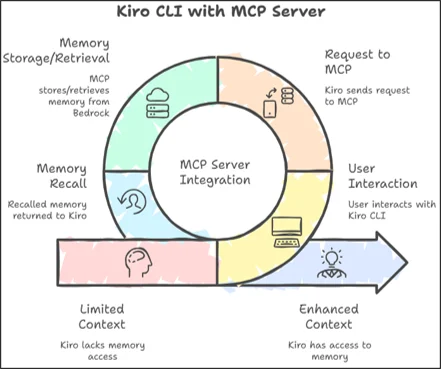
Figure: Kiro CLI integration with MCP server and Amazon Bedrock AgentCore Memory enabling persistent context across sessions
How the Memory Layer Enhances Interactions?
Adding a persistent memory layer transforms the behavior of the terminal assistant in several meaningful ways:
- It enables the assistant to recall previous conversations and decisions
- It reduces redundant clarifications by retaining known context
- It allows tracking of long-running tasks across sessions
- It supports continuity in workflows involving multiple steps or days
As a result, interactions become more fluid and resemble working with a long-term collaborator rather than a stateless tool.
Practical Implementation Approach
The AWS reference implementation uses a custom MCP server to manage memory interactions transparently.
A typical workflow includes:
- Storing summaries of conversations after each interaction
- Retrieving relevant past context when needed
- Updating memory with new insights, preferences, or decisions
From a developer’s perspective, the experience remains unchanged. The CLI continues to function normally, while the memory layer operates in the background, automatically maintaining context.
This modular approach also allows flexibility in evolving the memory backend without affecting how users interact with the tool.
Managing Memory, Security, and Control
Persistent memory introduces the need for governance and reliability. Using a managed service like Amazon Bedrock AgentCore Memory provides several advantages:
- Clear operational boundaries compared to custom storage solutions
- Built-in durability and consistency across sessions
- Easier integration with identity and access management systems
Additionally, AWS highlights the ability to monitor memory usage and manage stored data effectively. This becomes particularly important in production environments where multiple users or agents may rely on shared context.
Use Cases and Practical Applications
Persistent conversational memory significantly expands the scope of terminal-based AI tools.
Common use cases include:
- Project-Specific Development
Retaining repository structure, architecture decisions, and coding guidelines - Debugging and Troubleshooting
Tracking issues over multiple sessions without restarting the process - Developer Onboarding
Providing new team members with consistent, context-aware assistance - Workflow Automation
Remembering recurring commands, scripts, and preferences - Long-Running AI Coding Tasks
Maintaining context across multi-day development efforts
In these scenarios, the assistant operates as a reliable collaborator rather than a disposable chatbot.
Implementation Considerations
Adopting persistent memory requires thoughtful planning to ensure efficiency and scalability.
Monitoring and Observability
Track key metrics such as:
- Memory usage
- Retrieval performance
- Interaction latency
Memory Management
Regularly evaluate stored data to:
- Remove outdated or irrelevant context
- Maintain accuracy and relevance
Scalability and Performance
Ensure the system can handle:
- Increasing interaction volumes
- Multiple concurrent users or agents
These considerations help maintain a balance between performance and usability.
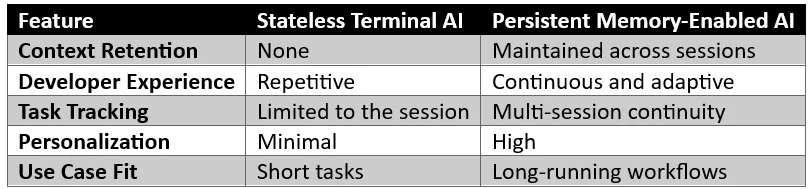
Comparison: Stateless vs Persistent Terminal Assistants
When to Use Persistent Memory?
Persistent memory is especially beneficial when:
- Projects involve multiple sessions or long timelines
- Context needs to be shared or reused
- Workflows require continuity and reduced repetition
- Developers want a more adaptive and intelligent assistant
For simple, one-time queries, a stateless approach may still be sufficient. However, for most real-world development scenarios, persistent memory offers a significant advantage.
Conclusion
Extending Kiro CLI with Amazon Bedrock AgentCore Memory addresses one of the core limitations of terminal-based AI tools: the lack of continuity. By introducing a managed memory layer through a custom MCP server, AWS enables a seamless integration that enhances both usability and efficiency.
Drop a query if you have any questions regarding Amazon Bedrock AgentCore Memory, and we will get back to you quickly.
Empowering organizations to become ‘data driven’ enterprises with our Cloud experts.
- Reduced infrastructure costs
- Timely data-driven decisions
About CloudThat
FAQs
1. What is the main advantage of integrating AgentCore Memory with Kiro CLI?
ANS: – It enables the assistant to retain context across sessions, improving continuity and reducing repetitive interactions.
2. How does Kiro CLI communicate with AgentCore Memory?
ANS: – Through a custom MCP server that manages storage and retrieval of conversational context.
3. What kind of data can be stored in memory?
ANS: – Project details, user preferences, previous conversations, debugging steps, and ongoing tasks.


WRITTEN BY Manjunath Raju S G
Manjunath Raju S G works as a Research Associate at CloudThat. He is passionate about exploring advanced technologies and emerging cloud services, with a strong focus on data analytics, machine learning, and cloud computing. In his free time, Manjunath enjoys learning new languages to expand his skill set and stays updated with the latest tech trends and innovations.


 PREV
PREV





Comments