

 Login
Login


 June 22, 2026
|
Voiced by Amazon Polly |
Overview
Managing large-scale containerized environments requires more than simply running applications. Organizations must also maintain supporting components such as monitoring agents, log collectors, and observability tools to ensure operational visibility and reliability. Amazon ECS has introduced managed daemon support for Amazon ECS Managed Instances, providing a centralized way to deploy and maintain these infrastructure-level services independently from application workloads. This enhancement simplifies operational management, improves consistency across instances, and ensures that critical system agents remain available throughout the application lifecycle.
Pioneers in Cloud Consulting & Migration Services
- Reduced infrastructural costs
- Accelerated application deployment
Introduction
As container adoption continues to grow, the teams are responsible for maintaining both the underlying infrastructure and the operational tooling that supports applications. Traditionally, deploying or updating monitoring and logging agents often required changes to application configurations and coordination across multiple development teams. This process could become time-consuming and difficult to manage in environments hosting hundreds or thousands of services.
Managed daemon support in Amazon ECS addresses this challenge by separating operational tooling from application deployments. Administrators can now manage infrastructure agents independently, reducing operational complexity while maintaining consistent observability and monitoring standards across their container environments.
Simplified Operations with Managed Daemons
Amazon ECS now provides a dedicated framework for running infrastructure-focused services as managed daemons across Amazon ECS Managed Instances. This capability enables teams to deploy essential operational components, such as monitoring, logging, security, and tracing agents, without modifying application task definitions or requiring service redeployments.
By separating daemon management from application workloads, organizations can establish standardized operational practices across their infrastructure while allowing development teams to focus exclusively on application delivery. Managed daemons can be deployed broadly across multiple capacity providers or targeted to specific infrastructure groups, offering flexibility in deployment strategies.
The service also ensures that operational agents are available whenever applications are running. Daemons are initialized before application tasks start and remain active until application workloads have completely stopped, helping maintain continuous visibility into application performance and system health.
In addition, resource allocation for daemons is centrally managed. We can define CPU and memory requirements independently from application configurations, eliminating the need to rebuild machine images or update application deployments when operational tooling changes. Since only a single daemon instance runs per host and serves multiple application tasks, resource consumption is optimized while maintaining consistent functionality across the environment.
Exploring Managed Daemons in Amazon ECS
To evaluate the new managed daemon capability, we configured the Amazon CloudWatch Agent as a daemon workload. Before this, we created an Amazon ECS cluster that used an Amazon ECS Managed Instance capacity provider, which can be configured in the Infrastructure tab of the cluster.
After navigating to the Amazon ECS console, navigate to the Daemon task definitions in the navigation menu. This feature provides a centralized location for creating and managing daemon workloads that run across Amazon ECS Managed Instances.
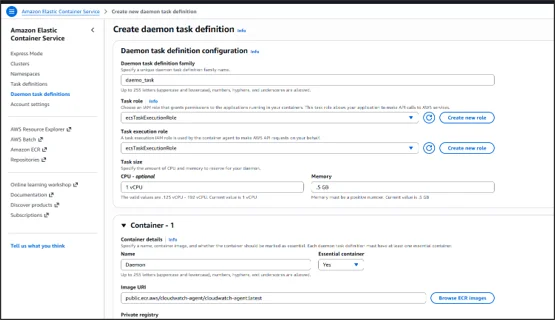
After providing the required resource allocations, AWS IAM roles, and container details, we created the Daemon task definition.
Then we opened the Clusters page, selected the Amazon ECS cluster that we created earlier, and noticed a new Daemons tab. Selected Create daemon and filled in the required configuration details to deploy the daemon across managed instances.
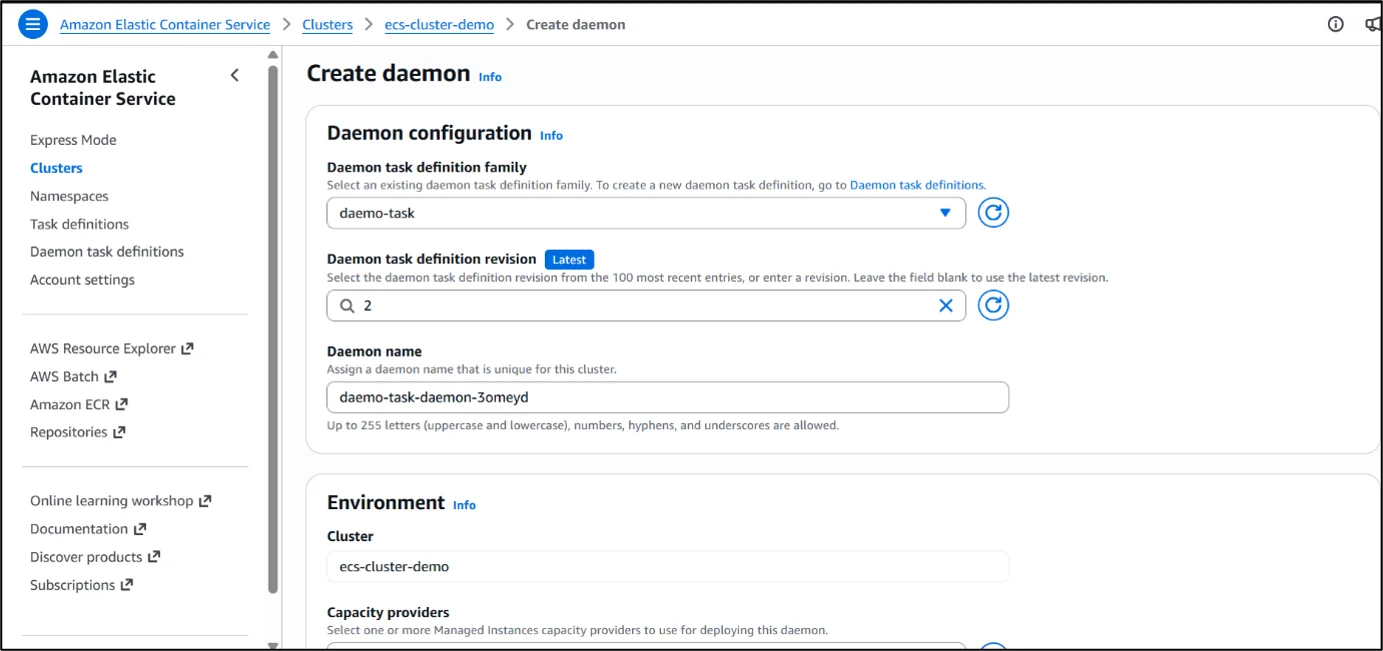
In the Daemon configuration section, select the daemon task definition created earlier and provide a name for the daemon deployment. Under Environment configuration, choose the ECS Managed Instances capacity provider where the daemon should run.
Amazon ECS automatically initiates the daemon across all managed instances associated with the chosen capacity provider, ensuring it is available before application workloads begin running.
After deploying the workload, we verified through the Amazon ECS console that the daemon had been automatically provisioned alongside the application tasks, eliminating the need for any additional manual deployment or configuration steps.
When the daemon configuration was updated, Amazon ECS automatically managed the rollout process by provisioning replacement instances with the new daemon version. The updated daemon was initialized first, application tasks were then transferred to the new instances, and the older instances were terminated after the migration was complete. This mechanism helps preserve continuous operational visibility by keeping monitoring, logging, and tracing agents active throughout the deployment, preventing gaps.
How Managed Daemons Work?
The managed daemon system uses a separate daemon task definition with its own configuration rules and validation, instead of sharing settings with regular task definitions. It also introduces a new daemon_bridge network mode, which allows daemon processes to communicate with application tasks.
Managed daemons provide enhanced access to the host system. We can run daemon containers in privileged mode, enabling Linux kernel capabilities, and mount directories directly from the host machine. These features are especially useful for monitoring and security tools that need detailed access to system-level information such as processes, metrics, and system calls.
When a daemon is deployed, Amazon ECS ensures that one daemon runs on each container instance before any application tasks start. This makes sure that monitoring or security tools are already active before the application begins handling traffic. Amazon ECS also supports rolling updates with automatic rollback, enabling safe, controlled upgrades of these daemon agents.
Conclusion
Daemons in Amazon ECS simplify the running and maintenance of infrastructure tools, such as monitoring and logging agents, by separating them from application workloads. They ensure these agents are consistently deployed across all instances, start before application tasks, and are updated safely via rolling deployments. With improved host-level access and centralized management, they help teams maintain better visibility and operational stability with less effort.
Drop a query if you have any questions regarding Amazon ECS, and we will get back to you quickly.
Making IT Networks Enterprise-ready – Cloud Management Services
- Accelerated cloud migration
- End-to-end view of the cloud environment
About CloudThat
FAQs
1. When do managed daemons start in the Amazon ECS lifecycle?
ANS: – Managed daemons are launched before application tasks start on a container instance, ensuring that operational tools like logging and monitoring agents are already active.
2. Do managed daemons consume a lot of resources?
ANS: – Resource usage is configurable per daemon task definition. Since typically only one daemon runs per host and serves multiple application tasks, resource usage is optimized.


WRITTEN BY Abhilasha D
Abhilasha D works as a Research Associate-DevOps at CloudThat. She is focused on gaining knowledge of the cloud environment and DevOps tools. Abhilasha is interested in learning and researching emerging technologies and is skilled in dealing with problems in a resourceful manner.


 PREV
PREV












Comments