

 Login
Login


 June 26, 2026
|
Voiced by Amazon Polly |
Introduction
A generative AI course teaches you to work with large language models, prompt engineering, RAG pipelines, and tools like AWS Bedrock or Azure OpenAI. An AI engineering course covers a broader set: ML fundamentals, model training and deployment, and system design, alongside GenAI. If you already have an ML background and want to specialize fast, a generative AI course gets you there in 8 to 16 weeks. If you are starting from scratch or switching to AI from another engineering role, an AI engineer course builds a foundation first. Salaries for both tracks are strong in 2026, with generative AI engineers in India earning INR 20 to 70 LPA at mid- to senior-level roles, and entry-level roles starting at INR 8 to 12 LPA for candidates with hands-on project exposure.
You’ve decided to go deep on AI. Good call. Now you’re stuck on the next question: do you do a generative AI course, or do you go for a full AI engineer program?
Both paths lead to high-paying roles. Both are genuinely in demand right now. But they are not interchangeable, and choosing the wrong one for where you are today will cost you months and money.
Here is how to actually decide.
Launch Your AI Career with AWS GenAI Training
- Interview Guarantee
- Up to 75% Money Back
- Real-World Learning
What a Generative AI Course Covers
A generative AI course is purpose-built. It does not spend six weeks on linear regression before getting to anything useful.
The core curriculum typically includes prompt engineering, fine-tuning pre-trained models, building RAG (Retrieval-Augmented Generation) pipelines, working with APIs from providers like AWS Bedrock and Azure OpenAI, and deploying agentic AI workflows. You will also cover multimodal models, vector databases, evaluation of LLM outputs, and responsible AI practices around bias and security.
The AWS Bedrock training CloudThat offers, for example, takes engineers from Bedrock foundations into production-grade agentic workflows where they build actual agent systems with action groups and knowledge bases, not just follow along with demos. That applied focus is what separates a useful generative AI certification from one that looks good on paper and does nothing in an interview.
What a generative AI course typically does not cover in depth: classical ML algorithms, model architecture design from scratch, MLOps infrastructure, or the full software engineering breadth an AI engineer role demands. It is a specialization track, not an entry point.
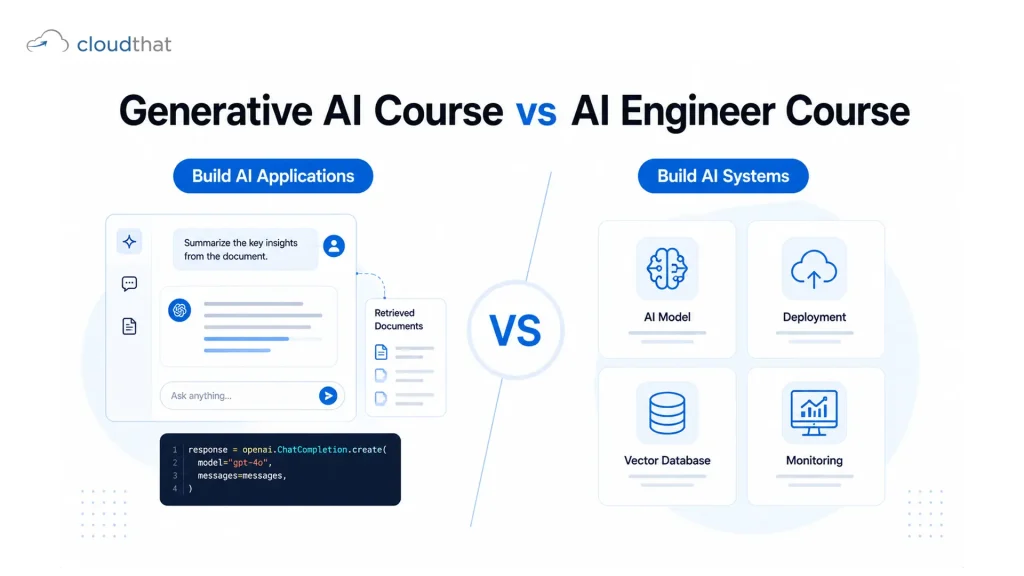
What an AI Engineer Course Covers
An AI engineer course is broader and longer. You are building the full stack.
Expect Python for ML, supervised and unsupervised learning, neural network fundamentals, natural language processing, model deployment with tools like SageMaker or Azure ML, containerization, MLOps pipelines, and then, in a good modern program, generative AI as a module at the end. The Integrated Program in AI and Data Science at CloudThat covers exactly this progression, covering Azure ML, MLOps, and GenAI applications across a structured, job-ready curriculum.
The depth here is real. You leave understanding why models behave the way they do, how to debug them, and how to build infrastructure that keeps them running in production. That breadth is what makes an AI engineer hireable across a much wider range of job descriptions than a pure GenAI specialist.
The trade-off is time. An AI engineer program typically runs 4 to 8 months. If you already have 3 to 5 years of data or software engineering experience, you may be paying for foundation content you already know.
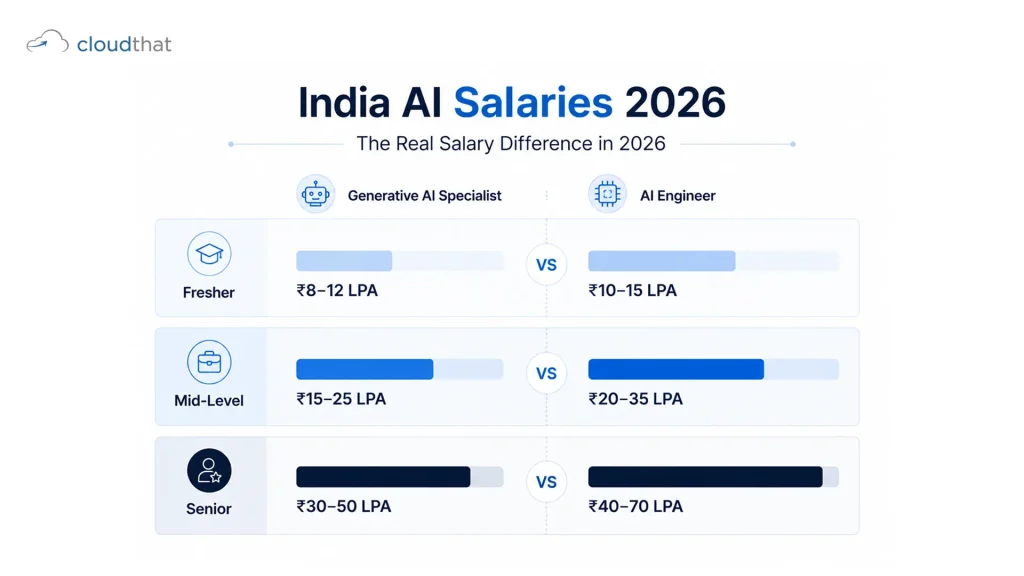
The Real Salary Difference in 2026
Both tracks pay well. The difference is in the ceiling and the speed to market.
Generative AI salaries in India for 2026 range from around INR 6 LPA to INR 45 LPA or higher, depending on experience and role. Freshers in prompt engineering or junior AI roles earn approximately INR 6 to 12 LPA, while experienced LLM engineers and AI architects command significantly higher packages.
Senior-level professionals are seeing compensation cross INR 40 LPA and move toward INR 60 to 90 LPA territory, reflecting roles where you are expected to design systems, guide teams, and solve problems without a clear playbook.
For the AI engineer track, product companies and startups offer INR 80,000 to 1,25,000 per month to freshers with strong portfolios and GenAI skills, and mid- to senior-level GenAI engineers in Bengaluru at product companies average INR 15 to 45 LPA.
The honest picture: generative AI specialists with strong experience in AWS Bedrock, LangChain, or Azure OpenAI are commanding premiums right now because supply is thin. That window stays open as long as enterprise adoption continues to outpace the talent pipeline. How long that lasts is genuinely uncertain.
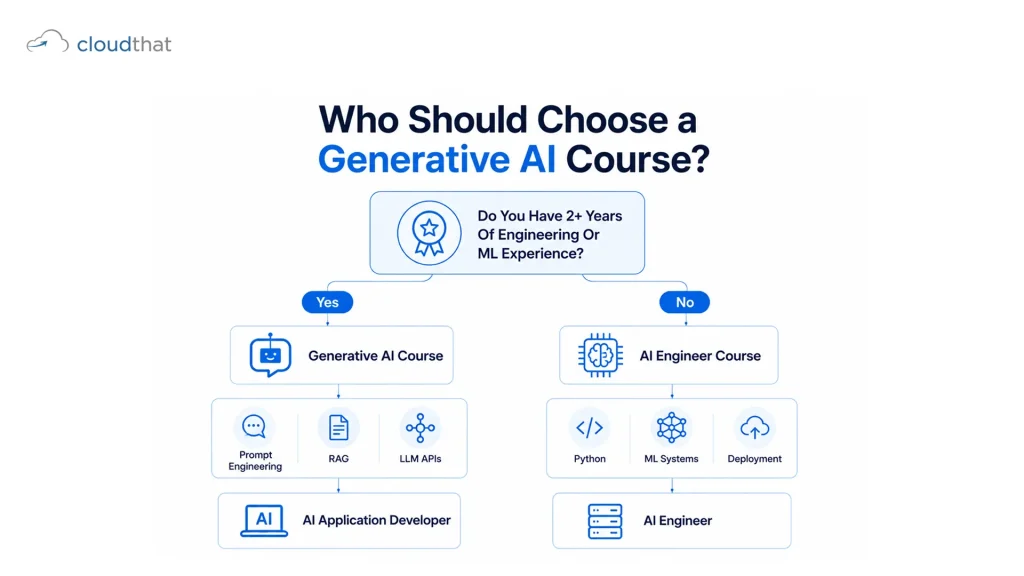
Who Should Choose a Generative AI Course
You are already an engineer. You have Python, you understand APIs, and you have worked with cloud platforms before. You do not need six months of foundation content; you need the GenAI-specific layer.
You are in a job that is being reshaped by AI right now. Developer, data analyst, ML engineer, DevOps professional. Your team is being asked to build or integrate AI features. You need to be the person who can actually do that, not the one who watched a webinar about it.
You want to move fast. A focused generative AI certification course runs 8 to 16 weeks with the right program. You get a credential that maps to real AWS or Azure GenAI competencies, and you can go into an interview with working code.
The NVIDIA training partner programs at CloudThat fall into this category. If your goal is to work specifically on LLM fine-tuning, inference optimization, or GenAI model deployment, the NVIDIA track gives you specialization depth that a general AI engineer program does not.
To prepare for real-world GenAI roles, learners can also explore the AWS GenAI Interview Guarantee Program, which builds practical AWS GenAI skills through interview-focused training.
Who Should Choose an AI Engineer Course
You are switching careers. You come from a non-ML background, and the terms “loss function,” “gradient descent,” and “overfitting” still feel abstract. A generative AI course assumes you already know this. If you do not, you will hit a wall fast.
You want long-term career flexibility. The AI engineer title opens doors across NLP, computer vision, MLOps, data engineering, and GenAI. The title “generative AI specialist” is powerful today, but it is narrower. If you are thinking 5 to 10 years ahead, the broader foundation gives you more room to move.
You want a job guarantee or structured placement support. Programs like CloudThat’s Integrated Program in AI and Data Science are built for outcome-driven learners who need a clear path from enrollment to employment, not just a certificate.
The Skills Employers Are Screening For Right Now
In 2026, every AI job interview has some version of the same test: can you actually build something?
For generative AI roles, that means demonstrating hands-on experience with prompt chaining, building agents using frameworks like LangChain or AWS Bedrock Agents, working with vector databases like Pinecone or OpenSearch, and evaluating LLM output quality in production. AWS’s official documentation on Bedrock Agents gives you the architecture foundation; a good training program gives you the labs.
For AI engineer roles, it means showing you can design and deploy an end-to-end ML pipeline, manage model versioning and monitoring, and work within cloud-native architectures. Microsoft Learn’s Azure AI Engineer path maps out exactly what Microsoft expects from certified engineers in this space.
The one thing that eliminates candidates at every level: theory without proof. GitHub projects, real inference costs tracked, documented tradeoffs. Employers can tell the difference between someone who did labs and someone who watched videos.
Why CloudThat Is Your Best Starting Point for GenAI Training
CloudThat is the only Indian training institution that runs both a live AWS Bedrock and an agentic AI training practice and an enterprise GenAI consulting arm through its GenAI Innovation Center. The engineers teaching the generative AI courses are the same engineers building RAG pipelines and multi-agent systems for enterprise clients. That matters when you are learning to build production-grade AI, not toy demos.
As an AWS Premier Tier Services Partner and NVIDIA Training Partner, CloudThat’s generative AI programs map directly to the certifications and competencies that cloud employers in India and globally screen for. The AI/ML training catalog includes 23 courses covering AWS Bedrock, MLOps, Agentic AI, and SageMaker, and every course runs with 50 to 60% hands-on lab time. You are not watching someone else build things.
For corporate teams, the Capability Development Framework takes this further: skill assessment before training, role-specific learning paths, and Experiential Learning simulations that test whether engineers are project-ready after the program ends. CloudThat has run this for 850 plus corporate clients. The model works because it is built around the gap between training and deployment, not just the training itself.
Conclusion
If you are an experienced engineer who wants to add GenAI capabilities fast, go with the generative AI course. If you are building from scratch or want the broadest career path, go with the AI engineer program. The salary upside is strong on both tracks in 2026. What determines which one is right is not the job market. It is where you are today and how fast you need to move.
Explore CloudThat’s generative AI and AI/ML training programs and find the path that fits where you actually are.
Key Takeaways:
- A generative AI course is a specialization track. It works best if you already have engineering or ML foundations.
- An AI engineer course builds from the ground up and offers broader career flexibility across AI, NLP, and MLOps roles.
- Generative AI engineers in India earn INR 20 to 70 LPA at mid- to senior-level roles in 2026, with entry-level roles starting at INR 8 to 12 LPA.
- The skill gap in GenAI is real and is currently driving salary premiums above general software engineering benchmarks.
- Employer screening now prioritizes demonstrated hands-on experience over certifications alone. Working code matters.
Become an AI Engineer with AWS GenAI Training
- Mock Interviews
- AWS Expert Trainers
- Career Support
About CloudThat
FAQs
1. Can I do a generative AI course without a machine learning background?
ANS: – You can, but you will struggle with anything beyond prompt engineering. Most quality programs assume Python proficiency and some exposure to APIs or data concepts. If you are starting from zero, an AI engineer course builds the foundation you need before specialising
2. Which certification is more valued by employers in 2026: GenAI-specific or AI engineer?
ANS: – Both carry weight. AWS Certified Machine Learning Specialty and Azure AI Engineer are recognised broadly. GenAI-specific credentials tied to Bedrock, NVIDIA, or Azure OpenAI carry a premium right now because the talent gap is real. The right answer depends on the job description you are targeting.
3. How long does a generative AI course take to complete?
ANS: – A focused program runs 8 to 16 weeks with live instructor-led delivery. Self-paced courses can stretch longer. CloudThat’s GenAI programs include hands-on labs and run on a live instructor model, so the pace is structured rather than self-directed.
4. Is the salary premium for GenAI roles sustainable?
ANS: – Probably for 3 to 5 more years, given the current demand-supply gap. After that, as training programs scale and the talent pool deepens, premiums will normalise. The engineers who will remain in the high-salary bracket are those with production experience, not just certifications.
5. What is the difference between an LLM engineer and a generative AI engineer?
ANS: – LLM engineer is a subset of the generative AI engineer role. LLM engineers focus specifically on large language model fine-tuning, inference optimisation, and evaluation. Generative AI engineers work across a broader set of modalities and tools, including diffusion models, multimodal systems, and agentic AI frameworks.
6. Do I need a computer science degree to enroll in a generative AI course?
ANS: – No. Hands-on experience with cloud platforms, programming, or data work is a more reliable signal of readiness than a specific degree. CloudThat’s programs accept learners from diverse engineering and IT backgrounds

WRITTEN BY Himisha Raval
Himisha Raval is a Digital Marketing Manager at CloudThat with a strong command of search engine optimization, web analytics, link building, and content strategy. She brings a data-driven approach to digital marketing, helping IT companies strengthen their online presence, improve search rankings, and generate consistent leads across channels. Beyond execution, she plays an active role in ideation, campaign strategy, and website performance optimization. Outside of work, she balances her analytical side with a love for travel, nature painting, and dancing.


 PREV
PREV











Comments