

 Login
Login


 May 25, 2026
|
Voiced by Amazon Polly |
Overview
Identity-Aware Proxy (IAP) authenticates users and authorizes access to applications before traffic reaches backend services. Enterprises place IAP in front of HTTPS workloads behind Cloud Load Balancing instead of extending the corporate network with VPN tunnels. IAP integrates with Google Identity, workforce federation (SAML/OIDC), and IAM, so every request is evaluated against principal, resource, and optional context attributes. For platform teams, IAP implements zero trust at the edge: no implicit trust from IP alone, centralized audit via Cloud Audit Logs, and consistent policy across GKE, Compute Engine, and Cloud Run.
Pioneers in Cloud Consulting & Migration Services
- Reduced infrastructural costs
- Accelerated application deployment
Introduction
Perimeter security assumes users on the corporate network are trustworthy. That model fails when applications run on managed Kubernetes, serverless runtimes, and multi-region load balancers. VPNs add client distribution, split tunneling, and capacity overhead, and often grant broad network access instead of least-privilege access to specific applications.
IAP makes the application URL the security boundary. Users reach an HTTPS endpoint; Google terminates TLS, validates identity, checks IAM and optional access levels, then forwards authorized sessions to backends. Security teams gain one control point for admin consoles and internal tools without exposing SSH or RDP to the internet.
This post covers enterprise IAP architecture, request flow, governance aligned with SOC 2, ISO 27001, and PCI DSS, and practices platform engineers use in production.
Architecture Overview
External or Internal HTTP(S) Load Balancing sits in front of backend services (GKE Ingress, NEG-backed VMs, Cloud Run). IAP is enabled on the backend service or serverless NEG. Authentication uses Google accounts or Cloud Identity/workforce federation (Okta, Azure AD). Authorization uses IAM roles such as roles/iap.httpsResourceAccessor, optionally with Access Context Manager access levels (device posture, geo).
Backends stay private: GKE without node public IPs, VMs on private subnets, Cloud Run with internal-and-LB ingress. Cloud Audit Logs record AuthorizeUser and IAP configuration changes.
Architecture Diagram
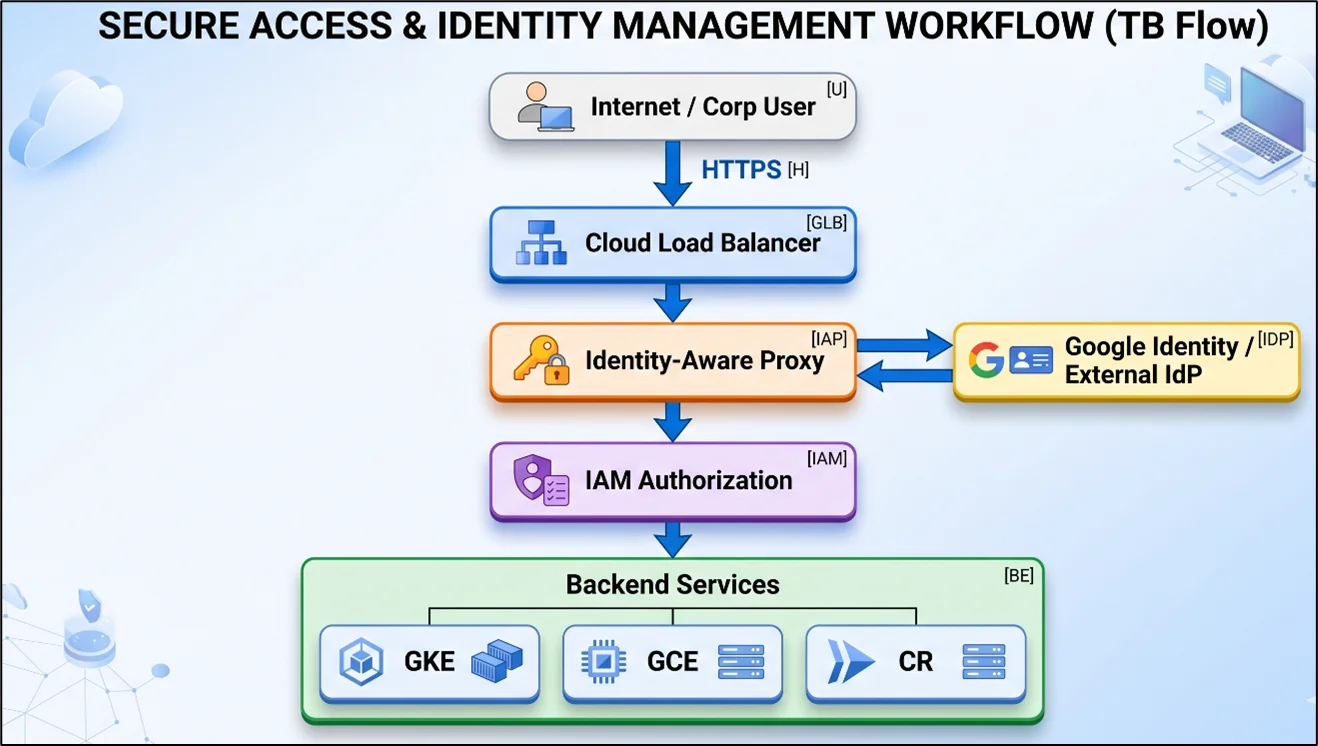
Architecture Flow Explanation
- User requests https://admin.example.com; DNS resolves to the load balancer.
- TLS terminates at the LB; IAP requires HTTPS for web resources.
- Without a valid IAP session, IAP redirects to Google sign-in or to a federated IDP (SAML/OIDC).
- After authentication, IAP maintains a stable user identity (email address, subject).
- IAP evaluates IAM on the protected resource:
|
1 2 3 4 5 |
gcloud iap web add-iam-policy-binding \ --resource-type=backend-services \ --service=admin-backend \ --member='group:platform-admins@example.com' \ --role='roles/iap.httpsResourceAccessor' |
- Access Context Manager or IAM conditions can require a corp device or a time window.
- Authorized requests include X-Goog-IAP-JWT-Assertion; applications must validate JWT aud, iss, exp, and sub—never trust X-Forwarded-User
- AuthorizeUser events feed Admin Activity logs for compliance.
IAP TCP (SSH/RDP) uses gcloud compute ssh with tunneling and roles/iap.tunnelResourceAccessor.
Core Security / Governance Best Practices
- No IP-only trust: Pair IAP with internal load balancers and private backends; use Access Levels as supplementary signals.
- Least privilege IAM: Grant httpsResourceAccessor to groups per backend; avoid allAuthenticatedUsers unless intentional.
- JWT validation in apps: Verify audience /projects/PROJECT_NUMBER/global/backendServices/SERVICE_ID.
- Workforce federation: Enforce MFA at the IdP; map IdP groups to Google groups for IAM bindings.
- Domain restriction: Block personal Gmail via OAuth brand settings where PCI/SOC 2 requires workforce-only access.
- Centralized logging: Sink Admin Activity to a security project; alert on IAP SetIamPolicy and authorization failures.
- Separate admin vs customer paths: Distinct backend services, certs, and IAM groups limit blast radius.
- Prevent bypass: Firewall deny direct instance access; restrict Cloud Run ingress to LB-only paths.
- OAuth hygiene: Separate OAuth clients for prod/nonprod; quarterly Asset Inventory review of IAP resources.
- Compliance mapping: Document logical access (ISO 27001 A.9), authentication (PCI DSS 8), revocation via IdP (SOC 2 CC6.1); retain logs per policy.
Operational Benefits
- Smaller VPN footprint: offboarding is IdP group removal plus IAM.
- One mechanism for GKE UIs, CI tools, and NEG-backed VMs.
- Grant/deny events export to SIEM via log sinks.
- Revoke access by IAM or IdP without regional firewall changes.
Common Challenges and Mitigations
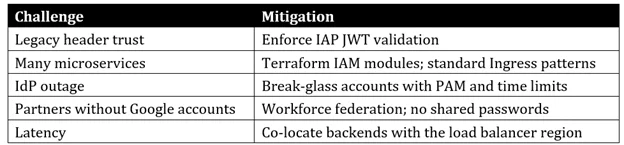
Enterprise Implementation Recommendations
- Enable IAP APIs from landing-zone Terraform; bind Cloud Identity synced groups (gcp-platform-admins).
- Terraform backend service example:
|
1 2 3 4 5 6 7 |
resource "google_compute_backend_service" "admin" { name = "admin-backend" iap { oauth2_client_id = var.oauth_client_id oauth2_client_secret = var.oauth_client_secret } } |
- Staging mirrors prod with separate OAuth clients and audiences.
- PCI cardholder environments: IAP-only paths; annual access reviews per PCI DSS 7 and 8.
Conclusion
IAP delivers zero-trust access for human users to HTTPS applications and for tunneled admin sessions, without a parallel VPN estate. With IAM least privilege, federation, JWT verification, and centralized audit logging, IAP aligns operations with SOC 2, ISO 27001, and PCI DSS access expectations. Treat IAP as mandatory for internal HTTPS tools and verify no backend bypass exists.
Drop a query if you have any questions regarding Google Cloud Identity-Aware Proxy and we will get back to you quickly.
Empowering organizations to become ‘data driven’ enterprises with our Cloud experts.
- Reduced infrastructure costs
- Timely data-driven decisions
About CloudThat
FAQs
1. Does IAP replace VPN entirely?
ANS: – Often for HTTPS and IAP TCP SSH/RDP. Site-to-site or full-subnet needs may still use VPN or Interconnect.
2. Can IAP protect Cloud Run?
ANS: – Yes, behind an external HTTP(S) LB with serverless NEG and IAP on the backend service.
3. How is programmatic access managed?
ANS: – Programmatic access is handled using an OAuth 2.0 client with a properly scoped audience identity token, rather than relying on end-user passwords.


WRITTEN BY Riyazuddin
Riyazuddin works as an Associate Architect – Infra, brings over 15+ years of experience in DevOps, System Design, Networking, and Programming. Skilled in AWS, Azure, Terraform, Docker, Kubernetes, Jenkins, Openshift, Ansible, and Python, he designs scalable, secure systems and drives automation through cloud-native architectures and IaC. Known for his analytical mindset and leadership, he mentors teams and delivers high-impact, enterprise-ready solutions aligned with business goals.


 PREV
PREV










Comments