

 Login
Login


 July 27, 2026
|
Voiced by Amazon Polly |
Introduction
Traditional chatbots were built around predefined conversation flows and rule-based logic. While they worked well for answering frequently asked questions, they often struggled with complex or unexpected user requests. As organizations increasingly require AI to reason, maintain context, access external systems, and automate business processes, intelligent AI agents have become the next step in conversational AI.
To support this shift, Botpress offers the Agent Development Kit (ADK), a code-first framework for building production-ready AI agents using TypeScript. Unlike the low-code Botpress Studio, the ADK is designed for developers who need greater flexibility, custom integrations, workflow orchestration, and modern software engineering capabilities. It also includes features such as hot reloading, structured LLM utilities, testing, observability, and cloud deployment.
Whether you’re building a customer support assistant, an enterprise copilot, or a workflow automation solution, Botpress ADK provides the tools to create scalable, reliable, and maintainable AI agents.
Pioneers in Cloud Consulting & Migration Services
- Reduced infrastructural costs
- Accelerated application deployment
Key Features
- Code-First Development – Build AI agents using TypeScript, giving developers complete control over conversation logic, workflows, and integrations. This approach follows modern software engineering practices, making code easier to maintain, version, and scale.
- Project Scaffolding – Initialize a new AI agent project with a predefined folder structure and configuration using the ADK CLI. This eliminates repetitive setup tasks and helps developers start building immediately. It also ensures consistency across projects.
- Type-Safe APIs – The ADK automatically generates TypeScript types for integrations, interfaces, and workflows. Developers benefit from autocomplete, compile-time validation, and improved code quality. This reduces runtime errors and accelerates development.
- Hot Reloading – Changes made to the source code are reflected instantly in the local development environment. Developers can quickly test prompts, workflows, and agent behavior without restarting the application. This significantly speeds up the development cycle.
- Workflow Orchestration – Create intelligent multi-step workflows that guide users through complex tasks and business processes. Agents can collect information across multiple conversations, make decisions, and execute actions based on user input. This enables automation beyond simple question answering.
- Custom Tools and Integrations – Extend agent capabilities by connecting to external APIs, databases, CRMs, and third-party services. Custom tools enable agents to retrieve live information, execute business operations, and interact with existing enterprise systems. This makes AI agents more practical for real-world applications.
- Zai LLM Utilities – The built-in Zai library simplifies common LLM operations such as information extraction, summarization, validation, and text generation. Instead of manually parsing model responses, developers receive structured, schema-validated outputs. This improves reliability and reduces the need for prompt engineering effort.
- Human-in-the-Loop (HITL) – Not every customer query can be resolved by AI alone. The ADK supports seamless escalation to human agents through integrations with helpdesk platforms such as Zendesk and Intercom.
- Testing and Observability – The ADK includes automated conversation evaluations (Evals) to verify agent behavior before deployment. Detailed execution traces show prompts, tool invocations, model outputs, and workflow execution. These capabilities simplify debugging and improve overall agent reliability.
- Cloud Deployment – Deploy AI agents directly to Botpress Cloud using the integrated command-line interface. The deployment process is streamlined and easily integrates with modern DevOps and CI/CD pipelines. This enables faster releases and simplified production management.
Use Cases
- Intelligent Customer Support – Build AI agents that answer customer queries, retrieve order details, check inventory, create support tickets, and seamlessly escalate complex issues to human agents when needed.
- Enterprise Knowledge Assistants – Develop internal copilots that search company documents, knowledge bases, and SOPs to provide employees with accurate, context-aware answers in real time.
- E-Commerce Virtual Assistants – Create shopping assistants that recommend products, verify stock availability, track orders, compare products, and provide personalized shopping experiences.
- Workflow Automation – Automate multi-step business processes such as employee onboarding, leave requests, approvals, expense management, and IT service requests through conversational workflows.
- IT Helpdesk and Service Desk – Deploy AI agents that troubleshoot common technical issues, reset passwords, create incident tickets, and assist employees with software or infrastructure-related requests.
- HR and Employee Support – Build HR assistants that answer policy-related questions, manage leave applications, provide onboarding guidance, and help employees access company resources.
- Appointment and Booking Systems – Develop AI agents that schedule appointments, manage reservations, send reminders, and update bookings by integrating with calendars and external scheduling platforms.
- CRM and Business Application Integration – Connect AI agents with CRM, ERP, and other enterprise systems to retrieve customer information, update records, generate reports, and automate routine business operations.
- AI Copilots for Business Applications – Embed conversational AI into web or mobile applications to help users navigate features, complete tasks, generate content, and improve overall productivity.
- Enterprise AI Applications – Build production-ready AI agents that integrate with CI/CD pipelines, version control systems, and cloud platforms, making them scalable, maintainable, and suitable for enterprise deployment.
Code Examples
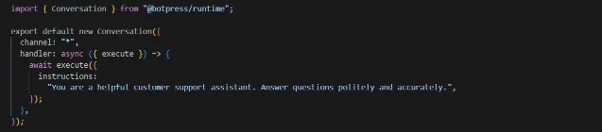
- Creating a Basic AI Agent
The following example creates a simple AI agent that responds to user queries using the execute() method. The instructions define the assistant’s behavior throughout the conversation.
- Creating a Custom Tool
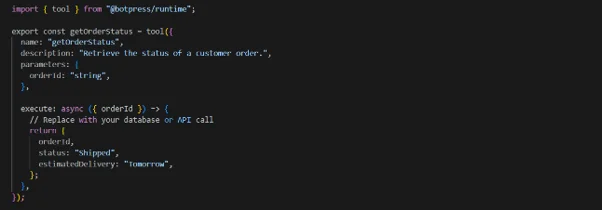
Custom tools enable AI agents to interact with external systems, such as APIs, databases, and internal business services. In this example, a tool returns the status of a customer order.
Conclusion
Botpress ADK empowers developers to build production-ready AI agents using a code-first, TypeScript-based framework.
Whether you’re creating a customer support assistant, an enterprise copilot, or a workflow automation solution, Botpress ADK provides the flexibility and engineering foundation needed to transform AI ideas into enterprise-grade applications.
Drop a query if you have any questions regarding Botpress ADK, and we will get back to you quickly.
Empowering organizations to become ‘data driven’ enterprises with our Cloud experts.
- Reduced infrastructure costs
- Timely data-driven decisions
About CloudThat
FAQs
1. Can Botpress ADK agents access external data and perform real-world actions?
ANS: – Yes. AI agents can integrate with REST APIs, databases, CRMs, ERP systems, and third-party services via custom tools, enabling them to retrieve live data and execute business operations.
2. How does Botpress ADK improve the reliability of AI agents?
ANS: – The framework provides structured LLM utilities (Zai), automated conversation testing (Evals), execution traces, and type-safe APIs, helping developers build more accurate, reliable, and maintainable AI applications.
3. Is Botpress ADK suitable for beginners?
ANS: – Botpress ADK is primarily designed for developers with basic knowledge of TypeScript and AI application development. Beginners can start with Botpress Studio and transition to the ADK as their applications become more complex.


WRITTEN BY Livi Johari
Livi Johari is a Research Associate at CloudThat with a keen interest in Data Science, Artificial Intelligence (AI), and the Internet of Things (IoT). She is passionate about building intelligent, data-driven solutions that integrate AI with connected devices to enable smarter automation and real-time decision-making. In her free time, she enjoys learning new programming languages and exploring emerging technologies to stay current with the latest innovations in AI, data analytics, and AIoT ecosystems.


 PREV
PREV











Comments