

 Login
Login


 May 22, 2026
|
Voiced by Amazon Polly |
Overview
Technical proposals often fail not because of weak technology, but because they lack clarity, conviction, and a strong narrative aligned to the client’s actual business problem. Opinionated presales storytelling shifts the focus from presenting multiple generic options to delivering one well-reasoned recommendation backed by architecture, business outcomes, and execution confidence. This article covers high-converting proposal structures, transformation-focused architecture diagrams, and the demo-first methodology that helps presales teams build trust and win enterprise deals.
Pioneers in Cloud Consulting & Migration Services
- Reduced infrastructural costs
- Accelerated application deployment
Introduction
71% of enterprise buyers say the winning vendor “understood their specific situation better”, not that they had better technology. That’s from RAIN Group’s 2025 B2B sales research, and it explains why technically superior proposals lose to competitors with half the depth but twice the narrative clarity.
The gap between a sound proposal and a winning proposal is the willingness to take a position. To say “we recommend this, not that”, and back it with evidence. Most presales teams present menus. The ones that win present convictions.
The Anatomy of a Winning Technical Proposal
Most proposals follow this structure: Introduction → About Us → Technology Overview → Architecture → Timeline → Pricing. It’s logical. It’s also forgettable.
Proposals that convert follow a different structure:
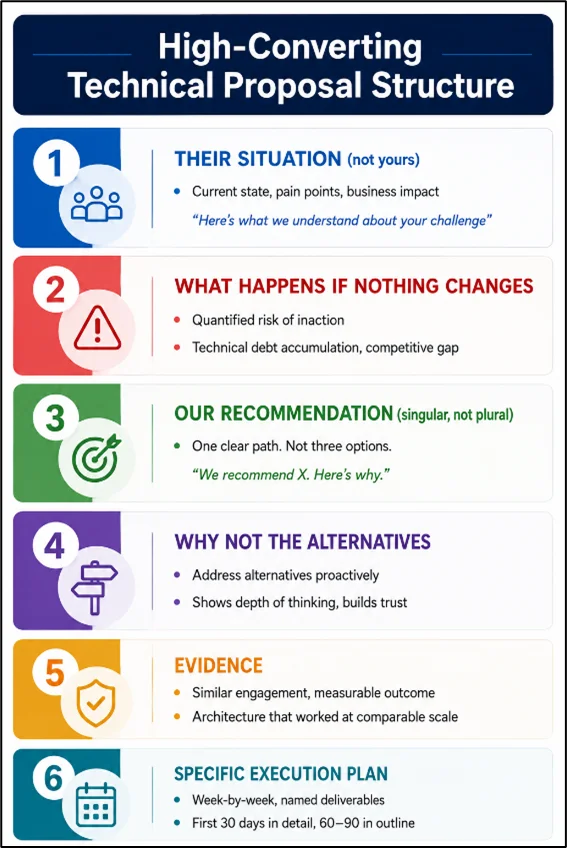
The critical difference: Section 3 is singular. One recommendation. Not “Option A, Option B, Option C, you decide.” Clients hire consultants for judgment, not menus.
Architecture Diagrams That Communicate Intent
Technical diagrams in proposals typically show structure, boxes, and arrows labeled with service names. They answer “what” but not “why” or “what changes.”
Effective presales diagrams communicate transformation:
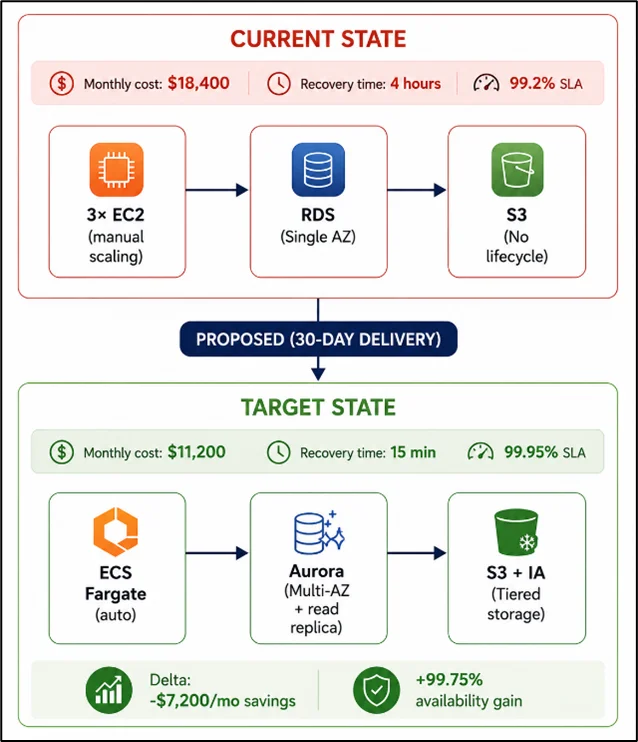
Every element communicates: what changes, what improves, and the measurable outcome.
The Demo-First Methodology
In 2026, the most effective presales teams build before they propose. With managed AWS services and AI-assisted development tools like Kiro, a working proof of concept can be assembled in 2-3 days.
The 3-Day Presales Sprint
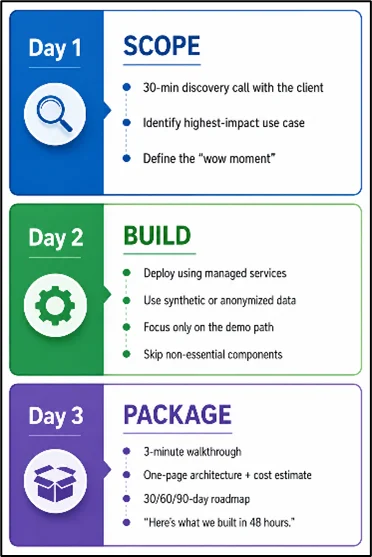
The demo doesn’t need to be production-ready. It needs to prove feasibility and demonstrate understanding.
Writing Proposals That Get Read Completely
Enterprise decision-makers have limited attention. Structure your proposal for how they actually read:
Page 1: Executive Summary — Their problem, your recommendation, expected outcome, timeline.
Pages 2-3: Architecture + Justification — Before/after diagram with business metrics. What you’re explicitly NOT recommending (and why).
Pages 4-5: Execution Plan — Week-by-week for the first 30 days. Named deliverables, not vague phases.
Page 6: Evidence — One relevant case study with measurable outcomes.
Six pages total. Appendices for detail-oriented reviewers, but the decision gets made on the first six pages.
The Opinionated Advantage
Taking a position involves risk. But the alternative, presenting both options equally and letting the client decide, communicates uncertainty.
The approach that builds trust:
“We recommend Aurora PostgreSQL for this workload because your query patterns are relational, your team has SQL expertise, and your data model requires complex joins. Amazon DynamoDB would require significant data modeling changes and introduce eventual consistency challenges for your financial reporting use case.”
This demonstrates: understanding of their context, clear reasoning, awareness of alternatives, and conditions under which you’d change your mind. That’s expertise. That’s what wins.
Conclusion
Stop presenting menus and start making recommendations. Adopt a demo-first approach and build a working proof of concept in 2-3 days to demonstrate feasibility. Structure proposals around the client’s situation, not your capabilities.
Drop a query if you have any questions regarding Presales-Driven Technical Storytelling and we will get back to you quickly.
Empowering organizations to become ‘data driven’ enterprises with our Cloud experts.
- Reduced infrastructure costs
- Timely data-driven decisions
About CloudThat
FAQs
1. How do you balance being opinionated with respecting the client's existing technical decisions?
ANS: – Acknowledge their context explicitly. Frame recommendations as forward-looking rather than critical of past choices. “Given your current investment in X and your team’s expertise, we recommend evolving toward Y because [specific business reason].” You’re not saying they were wrong, you’re saying the landscape has changed.
2. What if the client asks for multiple options in the RFP requirements?
ANS: – Provide them, but lead with your recommendation. “We’ve evaluated three approaches. We recommend Approach A for [reasons]. Approaches B and C are viable alternatives with these trade-offs: [specifics].” You’ve satisfied the RFP requirement while still demonstrating conviction.
3. How do you estimate costs accurately enough for a proposal without a full discovery phase?
ANS: – Use ranges with stated assumptions. “Based on the traffic patterns described in your RFP, monthly infrastructure costs will be $8,000-$12,000. This assumes [specific assumptions]. A 2-week discovery phase in our engagement will refine this to ±10%.” Specificity with transparency beats vague “it depends” responses.
4. Should presales engineers build demos on their own or involve the delivery teams?
ANS: – Involve delivery from day one. The presales engineer scopes and presents; the delivery engineer builds and validates feasibility. This prevents the common failure mode in which presales promises something that delivery can’t execute within the proposed timeline and budget.


WRITTEN BY Vignesh J
Vignesh Jagadeesan is the Head of Presales at CloudThat with 12+ years of experience driving digital transformation for Public Sector, SMB, and Enterprise customers across India and the USA. He specializes in Cloud Consulting, Data Management, MDM, Analytics, and enterprise modernization. Vignesh has led transformation engagements spanning cloud adoption, analytics, managed services, and enterprise solutioning across government, BFSI, healthcare, retail, manufacturing, and energy sectors, partnering with business stakeholders and cloud partners to deliver scalable, outcome-driven solutions.


 PREV
PREV












Comments