

 Login
Login


 March 24, 2026
|
Voiced by Amazon Polly |
Inventory valuation is one of the most critical and often most challenging areas for manufacturing organizations. Raw materials, work in progress (WIP), and finished goods represent a significant portion of a manufacturer’s working capital. Even small inaccuracies in inventory valuation can lead to misstated financial results, incorrect cost of goods sold (COGS), and poor business decisions.
Many manufacturers struggle with questions such as:
- Why does inventory value not match operational reality?
- Why do margins fluctuate unexpectedly at month-end?
- Why is finance constantly reconciling inventory with supply chain data?
Microsoft Dynamics 365 Finance, tightly integrated with Dynamics 365 Supply Chain Management, addresses these challenges by providing structured inventory valuation methods, automated cost postings, and strong financial controls. This blog provides a practical overview of inventory valuation in Microsoft Dynamics 365 Finance for manufacturers.
Start Learning In-Demand Tech Skills with Expert-Led Training
- Industry-Authorized Curriculum
- Expert-led Training
Why Inventory Valuation Is Complex in Manufacturing
Unlike trading or distribution businesses, manufacturers manage inventory across multiple production stages. This includes raw materials used for production, work-in-progress (WIP) currently being processed on the shop floor, and finished goods ready for sale or distribution. Managing these stages effectively helps manufacturers control costs, maintain production flow, and ensure accurate stock visibility.
Inventory value constantly changes due to material price fluctuations, scrap, rework, overhead absorption, and adjustments. Microsoft Dynamics 365 Finance ensures that every inventory movement is accurately tracked and accounted for financially.
Inventory Valuation Methods in Microsoft Dynamics 365 Finance
Microsoft Dynamics 365 supports multiple inventory valuation methods to align with different manufacturing and accounting requirements. Choosing the right method is a critical functional decision.
FIFO (First In, First Out)
FIFO assumes that the earliest purchased or produced inventory is consumed first. FIFO is suitable for industries with volatile material prices and for businesses that need to comply with IFRS or local regulations.
Weighted Average
The weighted average calculates the inventory cost based on the average cost of all receipts.
Weighted average works best for high-volume manufacturing with similar or interchangeable materials, helping smooth price fluctuations and reduce volatility in cost of goods sold (COGS).
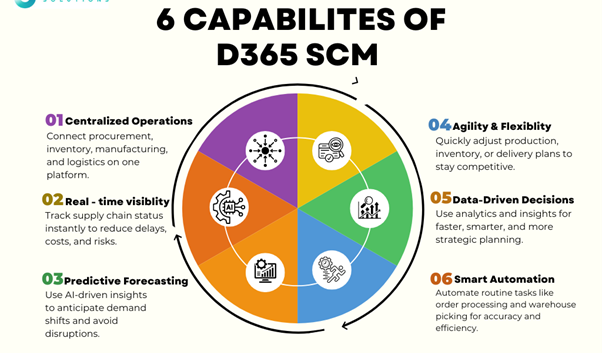
Source: Key Capabilities of D365 SCM
Inventory Valuation Across the Manufacturing Lifecycle
Inventory valuation in Dynamics 365 Finance is not limited to purchasing. It spans the entire manufacturing lifecycle.
Key functional consideration:
Accurate purchase prices and charges are essential, as they directly affect inventory value and future production costs.
Work in Progress (WIP)
WIP, or partially completed production orders, is one of the most sensitive areas for valuation.
Why this matters:
Incorrect WIP valuation can significantly distort financial results, especially in long-running or complex production processes.
Finished Goods Inventory
When production is completed, work-in-progress (WIP) inventory is cleared, and the finished goods inventory is updated to reflect the newly produced items. This ensures accurate stock levels and proper financial accounting for production activities.
The valuation method determines how costs are rolled up into finished goods and later into COGS when the finished goods are sold.
Financial Impact of Inventory Valuation
Inventory valuation directly affects several key financial statements and metrics.
Dynamics 365 ensures that inventory balances are updated in real time based on operational transactions.
Profitability and Margin Analysis
Manufacturers rely on accurate inventory valuation to:
- Analyze product margins – Evaluate profitability for each product to understand contribution to overall earnings.
- Identify loss-making products – Detect products that are underperforming or generating losses.
- Make pricing and sourcing decisions – Use insights to set optimal prices and choose cost-effective suppliers.
Dynamics 365 provides a consistent cost flow from inventory to financial reporting.
Inventory Close and Cost Recalculation
One of the most important processes in Dynamics 365 Finance is the inventory close. Inventory close is essential because daily transactions often post at estimated costs, with adjustments and variances pending. Performing inventory close recalculates costs, settles variances, and finalizes inventory and COGS for the period, preventing inaccurate financial statements, cost errors, and audit issues.
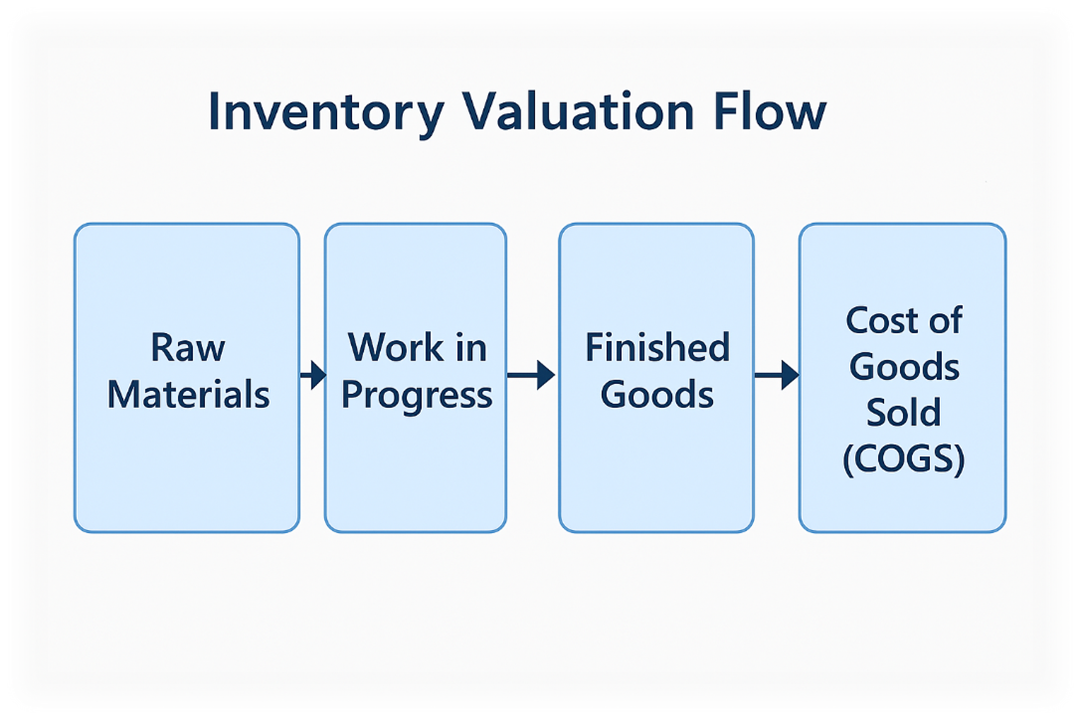
Fig 2: Inventory valuation flow finalized during inventory close in Dynamics 365 Finance.
How Inventory Close Supports Valuation Accuracy
During inventory close, Dynamics 365:
- Recalculates FIFO or weighted average costs
- Settles production and purchase variances
- Updates financial postings
This ensures that inventory values reflect the true cost at period-end.
Controls and Best Practices for Inventory Valuation
When Inventory Valuation Matters Most
Inventory valuation is especially critical for:
- High-value manufacturing – Businesses producing expensive or premium products requiring precise cost control.
- Long production cycles – Operations where manufacturing processes span extended periods, affecting inventory and cost tracking.
- Regulated industries – Sectors with strict compliance requirements, such as pharmaceuticals or aerospace.
- Multi-site manufacturing operations – Companies operating across multiple plants or locations, needing centralized visibility.
- Companies preparing for audits or IPOs – Organizations requiring accurate financials and robust controls for regulatory or investment purposes.
Through practical labs and scenario-based exercises, learners gain experience in:
- Optimizing inventory and warehouse operations using automation and AI-driven insights within Dynamics 365 Supply Chain Management.
- Managing procurement, production, and inventory close processes with real-time visibility and intelligent recommendations.
- Applying role-based security, data governance, and compliance controls is critical for enterprise-scale supply chain systems.
- Integrating Dynamics 365 Supply Chain Management with Microsoft 365 tools (Excel, Outlook, Teams) to enable collaborative, data-driven, and intelligent supply chain operations.
Microsoft Dynamics 365 Finance Summary
Inventory valuation plays a pivotal role in the financial health and operational efficiency of manufacturing organizations. With multiple inventory stages, complex production processes, and fluctuating costs, manufacturers require more than basic accounting tools; they need an integrated system that connects operational activity with financial outcomes.
Upskill Your Teams with Enterprise-Ready Tech Training Programs
- Team-wide Customizable Programs
- Measurable Business Outcomes
About CloudThat


WRITTEN BY Anoop H A
Anoop H A is a Microsoft Certified Trainer (MCT) at CloudThat with over 9+ years of experience in the training industry. He has delivered 600+ sessions and trained more than 4,000 professionals across various domains. Anoop specializes in Microsoft Fabric, Power BI, Azure AI, Dynamics 365, Tableau, and Advanced Excel with Copilot, offering impactful training to clients including Microsoft and other leading corporates. Known for his passionate and learner-centric approach, he stays aligned with the latest tech trends and has conducted numerous seminars and webinars, both online and offline. In recognition of his excellence, he has received the prestigious MCT Quality Award and was named among the Top 100 MCTs globally for 2024–2025.


 PREV
PREV












Comments