

 Login
Login


 March 16, 2026
|
Voiced by Amazon Polly |
Introduction
Fast, secure, and scalable access to analytics data is a requirement in organizations today. Whether it is enabling dashboards or mobile apps, or customer-facing reporting needs, the need to expose analytics via APIs has become a requirement. In the past, this required you to install and manage servers, scale backend infrastructure, and manually provision database connections. The process is much easier when using a serverless approach. With Amazon Redshift, AWS Lambda, and Amazon S3, along with an Analytics API platform built on Amazon API Gateway, businesses can develop this modern analytics offering without managing infrastructure.
Pioneers in Cloud Consulting & Migration Services
- Reduced infrastructural costs
- Accelerated application deployment
Why Go Serverless for Analytics?
In the traditional data analytics architecture, we must provide servers, configure networking between components, scale it, and manage its uptime. All of this creates additional operational overhead and costs.
- With a serverless approach:
- No infrastructure management
- Automatic scaling
- Pay only for what you use
- Built-in high availability
- Faster development cycles
When you use Amazon Redshift with Amazon API Gateway and AWS Lambda, you can build an API driven analytics platform where real-time queries are serviced without the need for your own backend servers.
Architecture Overview
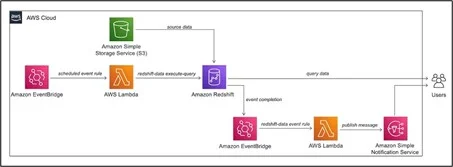
Core Components
- Data Storage – Amazon S3
Amazon S3 is used for actions device information. i.e., it could be logs generated by your app, transaction data, CSV files, or highly structured datasets.
- Data Warehouse – Amazon Redshift
Amazon Redshift ingests data from Amazon S3 and runs sophisticated SQL-based analysis. Amazon Redshift is built for rapid querying of large datasets.
Running queries with Amazon Redshift’s Data API lets you run SQL without managing connections.
- Compute Layer – AWS Lambda
AWS Lambda serves as the backend logic layer. Upon reception of an API request:
- AWS Lambda receives the request
- It executes SQL using the Amazon Redshift Data API
- It processes the results
- It returns a response
No servers, not even ones to manage, AWS Lambda scales automatically with the volume of requests.
- API Layer – Amazon API Gateway
Clients connect to the Amazon API Gateway over HTTPS.
It handles:
- Authentication
- Authorization
- Throttling
- Monitoring
- Request validation
Applications call these APIs to get analytics results in real time.
How the Data Flow Works?
The workloads begin with data ingestion into Amazon S3. Then Amazon Redshift loads the data or statements to analyze. A client application, such as a web dashboard, calls an API endpoint that Amazon API Gateway exposes. The request is picked up by AWS Lambda, which runs the appropriate SQL query in Amazon Redshift using the Data API. The query result is sent back to AWS Lambda, formatted as JSON, and returned as a response via the API. This enables real-time analytics delivery with minimal latency.
Key Advantages
There are several advantages to this serverless analytics architecture. It reduces operational burden without servers to set up and manage. It also becomes more scalable, as AWS Lambda and Amazon API Gateway can automatically handle traffic bursts. It improves security with IAM roles, encrypted communication, and controlled API access. Cost effectiveness is another big advantage, as companies only pay for the compute time used, API calls made, and storage consumed.
In addition, the Amazon Redshift API eliminates the need to maintain a connection pool, making the architecture cleaner and simpler. It is production-ready and suitable for small applications to large analytics platforms.
Use Cases
This design is perfect for a real-time reporting API, SaaS analytics dashboard, internal BI tool, or customer-facing data services. E.g., a retail agency may open APIs for sales by day, revenue by month, or customer segmentation. A SaaS platform that queries Amazon Redshift for usage metrics and returns them securely via API endpoints.
Conclusion
The serverless analytics application with Amazon Redshift, AWS Lambda, and Amazon API Gateway provides a simplified yet powerful way to serve data insights through APIs.
High performance and flexibility are guaranteed, while infrastructure maintenance is eliminated, making this method a solid basis for contemporary cloud-based analytics applications.
Drop a query if you have any questions regarding Serverless Analytics and we will get back to you quickly.
Empowering organizations to become ‘data driven’ enterprises with our Cloud experts.
- Reduced infrastructure costs
- Timely data-driven decisions
About CloudThat
FAQs
1. Do I have to maintain database connections manually?
ANS: – No, managing persistent database connections is not necessary while using the Amazon Redshift Data API.
2. Can this architecture handle a lot of traffic?
ANS: – Yes, Amazon API Gateway and AWS Lambda scale automatically. Additionally, Amazon Redshift Serverless adjusts to demand.
3. Is this appropriate for production workloads?
ANS: – Of course. This architecture is built for enterprise-level analytics applications and is scalable and safe.


WRITTEN BY Sweata Kumari Rauniyar
Sweata works primarily in the field of cloud computing, with additional expertise in data visualization. She has a strong foundation in cloud technologies and specializes in designing scalable, efficient cloud-based solutions. Skilled in SQL and Python, Sweata leverages these tools to support data-driven applications and create impactful visualizations. Passionate about using cloud technologies to solve real-world problems, she stays updated on emerging tools and trends to continually enhance her expertise and deliver innovative solutions.


 PREV
PREV












Comments