

 Login
Login

 March 11, 2026
|
Voiced by Amazon Polly |
In modern cloud environments, securing sensitive data at scale requires strong, centralized, and auditable encryption mechanisms. AWS Key Management Service (AWS KMS) is a fully managed service that enables organizations to create, manage, and control cryptographic keys used to protect their data. One of the most powerful concepts within AWS KMS is Envelope Encryption, a layered approach that enhances performance, scalability, and security for large-scale encryption operations.
This blog gives you how envelope encryption works, the role of key material, the functions of data keys, and why AWS KMS is a foundational component of enterprise-grade security architectures.
Transform Your Career with AWS Certifications
- Advanced Skills
- AWS Official Curriculum
- 10+ Hand-on Labs
Key Benefits of AWS KMS Envelope Encryption
Organizations adopting AWS KMS gain several advantages through envelope encryption:
- Improved Performance – Only minor data keys are encrypted by KMS, while large datasets are encrypted locally, reducing network overhead and improving speed.
- Cost Efficiency – Minimizes KMS calls by enabling cryptographic operations to run locally using data keys.
- Enhanced Security Layering – Adds a dual-key approach in which the data key encrypts the data, and the KMS key protects the data key.
- Centralized Key Management – Provides unified key lifecycle management, audits, key rotation, and compliance through CloudTrail.
- Flexible Integration – Works seamlessly with S3, EBS, RDS, Lambda, and custom applications requiring encryption.
Understanding Core Concepts
- What Is a KMS Key (CMK/Key Material)?
A KMS Key is a logical representation of a cryptographic key within AWS KMS.
It contains the key material, key policies, aliases, grants, and metadata.
Key material can be:
- AWS-owned (AWS Managed Keys)
- Customer-managed Keys (CMKs)
- Imported key material
- External (via AWS KMS External Key Store – XKS)
This key encrypts data keys and protects them throughout their lifecycle, but is never exposed directly to applications or users.
- What Is a Data Key? Who Manages It?
A data key is a temporary symmetric key generated by KMS for encrypting actual data.
- Applications use the plaintext data key locally.
- The plaintext key remains only in memory.
- The encrypted data key is stored alongside the encrypted data.
Management responsibility:
- AWS KMS generates the data key.
- Applications manage the plaintext key temporarily until encryption completes.
- KMS manages the encrypted data key (for decryption and key lifecycle).
How Envelope Encryption Works in AWS KMS (Step-by-Step)
Envelope encryption follows a layered approach:
Step 1: Application Requests a Data Key
Your application sends a Generate Data Key request to AWS KMS using a KMS Key (CMK).
Step 2: KMS Generates Two Copies of the Data Key
KMS returns:
- Plaintext data key – used by the application for encryption.
- Encrypted data key – protected by the KMS Key.
Step 3: Application Encrypts Data Locally
The plaintext data key encrypts files, objects, or application data within memory.
This step is fast, local, and avoids heavy network usage.
Step 4: Application Discards the Plaintext Data Key
Once encryption is complete, the plaintext key is deleted from memory.
Step 5: Store Encrypted Data + Encrypted Data Key Together
Both encrypted elements (data + encrypted key) are stored.
Step 6: Decrypting the Data
To decrypt:
- Application sends the encrypted data key back to KMS.
- KMS decrypts it using the master key.
- KMS sends back the plaintext data key.
- The application uses it to decrypt the data locally.
This ensures that:
- KMS is only involved in protecting the data key.
- Data encryption/decryption is fast and scalable.
Real-World Use Cases
- Secure Storage of Large Files and Backups
Large datasets—such as backups, logs, and reports—are encrypted using local data keys without frequent KMS API calls, improving performance and cost efficiency.
- Encrypted Cloud Storage (S3, EBS, RDS)
AWS services internally use envelope encryption to encrypt objects, volumes, database storage and RDS Snapshot at rest with minimal latency.
- Application-Level Encryption (Client-Side Encryption)
Applications encrypt data before sending it to AWS (e.g., S3 client-side encryption SDK), ensuring zero-trust data protection.
Architecture Overview
The envelope encryption architecture includes:
- A KMS Key serving as the root of trust.
- GenerateDataKey API to create plaintext and encrypted data keys.
- Local cryptographic operations that use the plaintext data key.
- CloudTrail auditing for every KMS key use.
- Encrypted data keys are stored with encrypted application data.
The architecture of AWS KMS ensures secure, auditable, and scalable encryption for both AWS-native and custom applications.
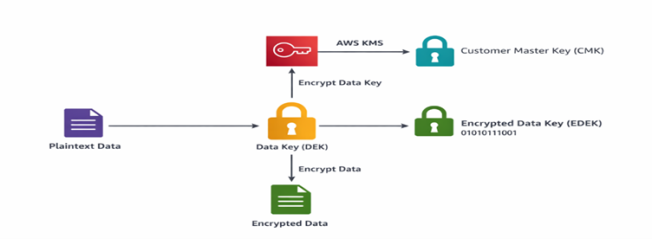
AWS KMS envelope encryption flow from data key generation to encrypted data storage.
Why Enterprises Choose AWS KMS for Envelope Encryption
In comparison to traditional cryptographic systems, AWS KMS provides:
- Centralized, enterprise-wide key governance
- Integrated encryption for all major AWS services
- Automated key rotation and policy-based access control
- High durability and compliance with industry standards (FIPS 140-2)
- Ability to bring your own key material (BYOK) or external key stores (XKS)
With envelope encryption, organizations achieve both performance optimization and military-grade security through a scalable cryptographic framework.
Scalable Cloud Encryption
AWS KMS envelope encryption is a fundamental building block for securing data across modern cloud workloads. By separating key protection (KMS Key) from data encryption (data key), AWS provides a powerful, cost-effective, and highly secure mechanism that supports large-scale applications, hybrid environments, and compliance-driven architectures.
Become AWS-Certified with India’s Leading Training Partner
- Authorized Trainers
- Flexible Training Options
- Interactive Labs
About CloudThat


WRITTEN BY Avinash Singh Bundela
Avinash Singh Bundela is a Subject Matter Expert at CloudThat, specializing in AWS Architecting / AWS DevOps and AWS Security. With 14 years of experience in Training and Consultancy, he has trained over 10000+ professionals/students to upskill in Multiple Technologies. Known for simplifying complex concepts and delivering interactive hands-on sessions, he brings deep technical knowledge and practical application into every learning experience. Avinash’s passion for continuous learning reflects in his unique approach to learning and development.


 PREV
PREV












Comments