

 Login
Login

 December 2, 2025
|
Voiced by Amazon Polly |
Introduction
The Model Context Protocol (MCP) is revolutionizing how AI agents interact with external tools and services. Rather than embedding tool logic directly into agents, MCP provides a standardized way to connect agents with specialized external servers that offer domain-specific functionality.
The Strands Agents SDK provides seamless integration with MCP, enabling developers to quickly extend agent capabilities by connecting to any MCP-compliant server. With just a few lines of code, Strands agents can discover and use tools from external MCP servers, unlocking specialized functionality while maintaining clean architecture and loose coupling.
This integration eliminates the need for custom adapters or complex code for managing tools. Whether you’re building domain-specific assistants, connecting to enterprise services, or creating reusable tool ecosystems, MCP integration with Strands provides the architectural foundation for sophisticated AI systems.
Pioneers in Cloud Consulting & Migration Services
- Reduced infrastructural costs
- Accelerated application deployment
Key Features
- Standardized Tool Interface – MCP defines a universal standard for describing, discovering, and executing tools. Each tool includes metadata like name, description, parameters, and return types. The Strands SDK automatically converts this into standard AgentTools, making MCP and local tools identical to the agent. The unified TOOL_SPEC format ensures consistent integration across all connected servers.
- Multiple Transport Mechanisms – MCPClient supports multiple transport protocols for flexible deployment. Streamable HTTP handles web-based communication, while Stdio transport supports local process interaction for development or single-machine use. This versatility allows seamless MCP integration across both local and cloud environments.
- Automatic Tool Discovery-When initialized, MCPClient automatically queries the MCP server to fetch available tools and their metadata. This dynamic discovery enables agents to update their capabilities in real-time as new tools become available.
- Intelligent Parameter Extraction – MCP tools define inputs through JSON schemas. When the agent invokes a tool, MCPClient automatically extracts and validates parameters from the agent’s context. The agent decides which tool to use and what data to send, while MCP ensures schema compliance and parameter handling.
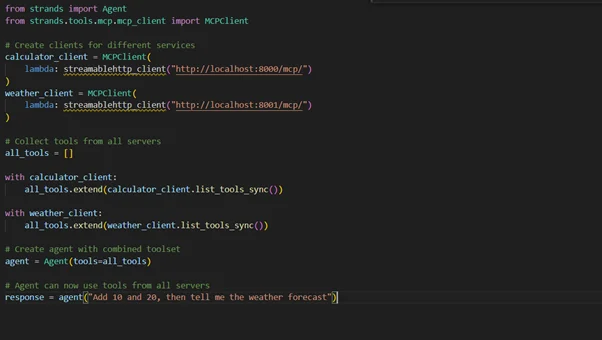
- Seamless Multi-Server Integration – Agents can connect to multiple MCP servers simultaneously, each offering distinct tools. For example, one server may provide calculation tools, another weather data, and another database access. The SDK manages these connections seamlessly, presenting all tools as a single unified toolkit to the agent.
- Real-Time Error Handling – MCP provides strong error handling through structured error responses. When a tool fails, the agent can interpret the error, take corrective action, and continue running. This ensures system reliability and smooth recovery from failures or edge cases.
Code Examples
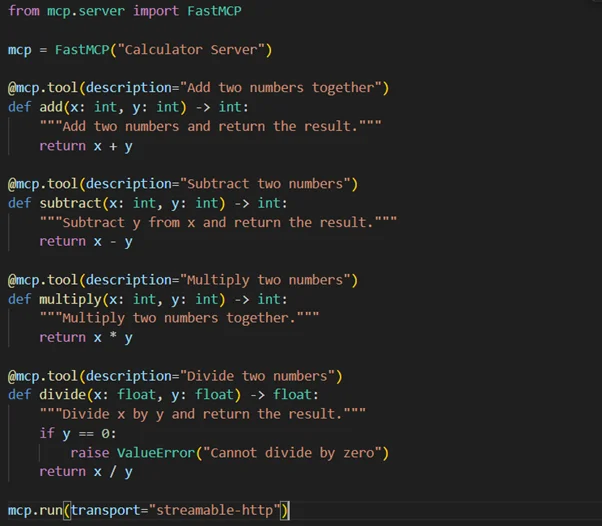
- Creating an MCP Server
Begin by creating an MCP server that provides specialized functionality:
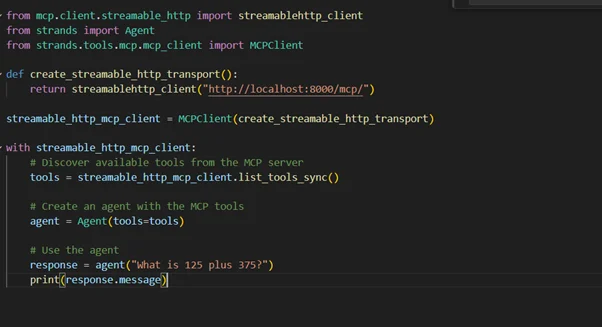
- Connecting an Agent to MCP
Connect a Strands agent to your MCP server:
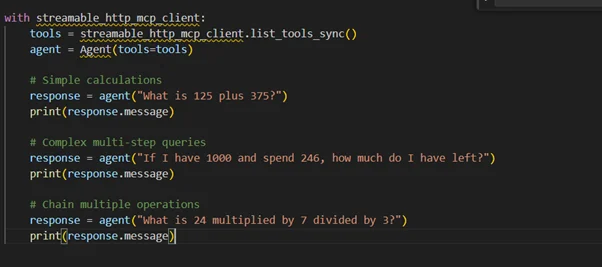
- Natural Language Tool Invocation
Users interact with MCP tools through conversational queries:
- Multiple MCP Server Integration
Connect an agent to multiple specialized servers:
Use Case
- Financial Calculation Services – Financial institutions often use specialized engines for complex calculations. MCP enables agents to securely connect to these systems without revealing internal logic. For example, an investment advisor agent can access portfolio analysis, risk assessment, and market data tools via an MCP server, then use conversational queries to deliver tailored investment insights.
- Healthcare and Medical Information Systems – Healthcare organizations often use separate systems for patient records, diagnostics, treatments, and lab data. MCP allows a unified health assistant agent to access all these through standardized interfaces. For example, a nurse can ask, “What are today’s vitals for the patient in room 301?” and the agent retrieves the data via MCP tools without direct system access.
- E-Commerce and Inventory Management – E-commerce platforms rely on multiple systems for catalog management, inventory tracking, order processing, and shipping. With MCP, a shopping assistant agent can handle all these seamlessly, searching products, checking stock, and processing orders through natural conversation. Different MCP servers power each function, but the agent unifies them into a single conversational experience.
- Weather and Environmental Monitoring – Weather, air quality, and environmental data services can expose their tools via MCP. An environmental assistant agent connects to multiple servers for weather, pollution, and climate data. When users ask questions like “Is tomorrow good for outdoor sports?”, the agent gathers information from all sources, analyzes it, and delivers a clear, informed answer.
- Software Development and DevOps – Development teams use multiple systems for version control, CI/CD, and monitoring. MCP enables a DevOps assistant agent to connect to all of them. Developers can issue commands such as “Deploy the latest version to staging” or “Show the top 10 errors from the last hour,” and the agent executes them through the appropriate MCP tools.
- Enterprise Knowledge Systems – Large organizations often have scattered knowledge bases, documentation systems, and expert directories. An MCP-connected enterprise assistant can unify access to all of them, answering queries like “How do we handle returns?” or retrieving policies, and identifying subject matter experts through connected MCP servers.
Conclusion
Integrating MCP with Strands agents enables flexible, scalable AI solutions by standardizing how agents connect to external tools. MCP turns tool integration from a static setup into a dynamic, runtime process.
Drop a query if you have any questions regarding MCP and we will get back to you quickly.
Empowering organizations to become ‘data driven’ enterprises with our Cloud experts.
- Reduced infrastructure costs
- Timely data-driven decisions
About CloudThat
FAQs
1. How do I secure the connection between Strands agents and MCP servers?
ANS: – MCP supports authentication via custom transport settings. You can add security headers or tokens to your transport, such as including auth tokens in HTTP request headers for Streamable HTTP. The MCP server should validate credentials before granting access. For production, use HTTPS/TLS for secure transport and implement OAuth or API key authentication.
2. What happens if an MCP server becomes unavailable?
ANS: – Connection errors are raised to the agent. Handle them with retries, backups, or failover mechanisms.
3. Can I build MCP servers in languages other than Python?
ANS: – Yes. MCP is language-agnostic and works with any language supporting HTTP or other transport protocols.


WRITTEN BY Livi Johari
Livi Johari is a Research Associate at CloudThat with a keen interest in Data Science, Artificial Intelligence (AI), and the Internet of Things (IoT). She is passionate about building intelligent, data-driven solutions that integrate AI with connected devices to enable smarter automation and real-time decision-making. In her free time, she enjoys learning new programming languages and exploring emerging technologies to stay current with the latest innovations in AI, data analytics, and AIoT ecosystems.


 PREV
PREV









Comments