

 Login
Login

 September 23, 2026
|
Voiced by Amazon Polly |
An AI engineer spends most of the day on data pipelines, evaluation, and deployment, not on training models from scratch. A large share of the week involves integrating models into production systems and testing whether the outputs are good enough to ship; the rest is spent on monitoring, fixing regressions, and cross-functional meetings. This post breaks down where the hours actually go, based on real job-description data and what the role looks like day-to-day.
Start Learning In-Demand Tech Skills with Expert-Led Training
- Industry-Authorized Curriculum
- Expert-led Training
What does an AI engineer actually do all day?
On a typical day, an AI engineer moves between four things: connecting data sources to a model, testing whether the model’s output is good enough to ship, wiring that model into an application, and fixing whatever breaks in production. Writing new model architectures or training foundation models from scratch is rare; most AI engineers work with existing foundation models and spend their time making them reliable in real products.
Why do most job descriptions get this role wrong?
Job postings often list “model training” as a core responsibility, but an analysis of over 1,000 AI engineer job descriptions found model training mentioned in only 6.4% of postings and evaluation in 4.5%, while production-facing tools like PyTorch (22%) and vector databases (10.8%) appeared far more often (AI Shipping Labs, 2026). MIT Professional Education describes AI engineering as sitting at the intersection of software engineering, data engineering, and machine learning, building the systems that make AI usable in production, not just training the models themselves. That intersection is exactly why the daily work looks more like software engineering with an AI layer than pure research.
What does a typical day actually look like?
Broken into rough blocks, a typical day includes:
- Morning: check dashboards for model drift, cost spikes, or failed evaluation runs from overnight jobs.
- Mid-morning: data and pipeline work, cleaning, chunking, or updating the data a model reads from.
- Midday: prompt and context evaluation, testing changes against a fixed set of cases before shipping.
- Afternoon: integration work, wiring a model or agent into an application, handling API limits, retries, and latency.
- Late afternoon: cross-functional syncs with product, data, and security teams.
- End of day: monitoring what shipped and triaging anything that regressed.
What tools and skills does an AI engineer use daily?
Skill demand data show that natural language processing appears in roughly 19.7% of AI engineering job listings, fine-tuning in 14.8%, and prompt engineering in 8.9% (365 Data Science, 2025). Increasingly, that list also includes agent orchestration. Managed services like Amazon Bedrock AgentCore handle memory, tool access, and identity for AI agents running in production and are becoming as central to the daily toolkit as the model itself.
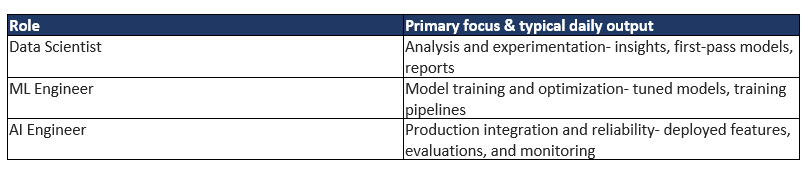
How is an AI engineer different from a data scientist or ML engineer?
The three roles overlap, but the daily output differs:
What does this look like at a real company?
At a retail company piloting an AI shopping assistant, the AI engineer usually isn’t the one choosing which foundation model to use; that’s typically decided early on. Their day is spent ensuring the assistant retrieves the correct product data, stays within a per-session token budget, doesn’t invent return policies, and recovers gracefully when a search returns no relevant results. When the assistant needs to check order status or trigger a return through an internal API, that’s agent-to-tool integration work, the kind covered in structured, hands-on programs like Building Agentic AI with Amazon Bedrock AgentCore.
What separates a strong AI engineer from an average one?
The gap usually isn’t technical depth; it’s discipline around evaluation and cost:

Building Real AI Systems
If you’re moving into AI engineering, the fastest path in is building and shipping something end-to-end, a data pipeline, an evaluated prompt, an agent wired into a real API. Structured programs such as Advanced Generative AI on AWS give you hands-on repetition in a controlled setting before you do it live in production. Start with one small, real integration, measure it, and expand from there.
Upskill Your Teams with Enterprise-Ready Tech Training Programs
- Team-wide Customizable Programs
- Measurable Business Outcomes
About CloudThat
FAQs
1. Does an AI engineer need to know how to train a model from scratch?
ANS: – Rarely. Most AI engineers work with existing foundation models and spend their time on integration, evaluation, and deployment rather than training models from the ground up.
2. What's the difference between an AI engineer and a data scientist?
ANS: – A data scientist focuses on analysis and experimentation to generate insights or a first working model. An AI engineer takes that model, or a foundation model, and makes it reliable, fast, and safe to run in a real product.
3. What's the most time-consuming part of an AI engineer's day?
ANS: – Evaluation and integration work usually takes the most time, testing whether outputs are good enough to ship and wiring the model into an application, rather than model-building itself.
4. Is AI engineering a good career path right now?
ANS: – LinkedIn data shows AI engineer has been the fastest-growing job title for young professionals for two years running, with tens of thousands of new AI engineer roles added in the U.S. between 2023 and 2025 (LinkedIn, via CBS News, 2026).


WRITTEN BY Vijayanand K V
Vijayanand K V is a Senior Research Associate at CloudThat, specializing in Machine Learning. With 4 years of experience in Machine Learning, he has trained over 1000 students to upskill in Machine Learning, Deep Learning, and Generative AI. Known for simplifying complex concepts with hands-on practical, helping students to use technologies to develop creativity, he brings deep technical knowledge and practical application into every learning experience. Vijayanand's passion for learn everyday reflects in his unique approach to learning and development.


 PREV
PREV












Comments