

 Login
Login


 August 25, 2026
|
Voiced by Amazon Polly |
Introduction
Quantum AI combines quantum computing and artificial intelligence to explore new ways to solve complex problems. Understanding how quantum computers differ from classical systems is important, but the next question is: where can this technology actually be used?
This article moves from theory to practical applications. We will explore where quantum computing and AI are being applied, the key areas of current research, and where the field realistically stands today.
The focus is on real-world applications, ongoing research, and how quantum computing may help solve specific problems in the future.
Pioneers in Cloud Consulting & Migration Services
- Reduced infrastructural costs
- Accelerated application deployment
Where Quantum Computing and AI Are Being Applied
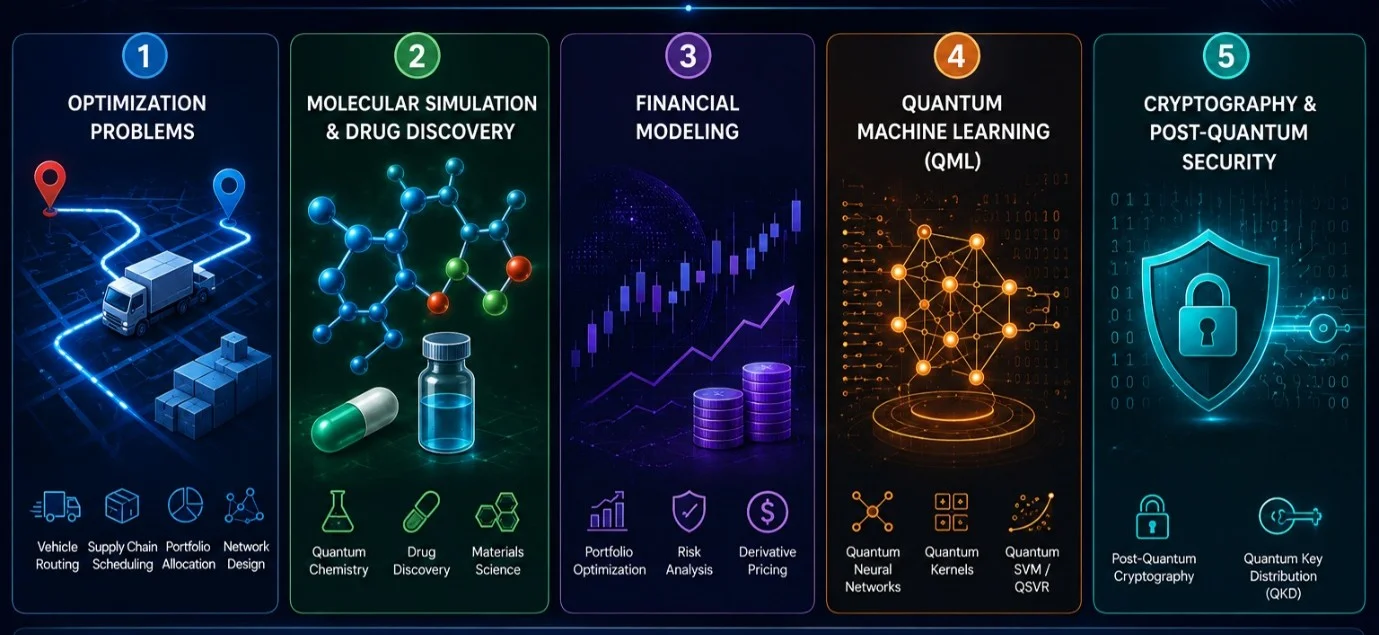
1. Optimization Problems
Many real-world systems come down to searching an enormous space of possible configurations for the best one vehicle routing, supply chain scheduling, portfolio allocation, and network design. As these problems grow, the number of possible solutions can increase rapidly, making them computationally expensive for classical algorithms.
Quantum approaches like QAOA (Quantum Approximate Optimization Algorithm) and quantum annealing attempt to explore that space more efficiently by encoding the problem directly into qubit interactions. Graph-based optimization problems, such as Max-Cut and certain routing or scheduling problems, are active areas of research for quantum optimization algorithms.
- Molecular Simulation and Drug Discovery
Simulating how molecules interact at the quantum level is exponentially hard for classical computers because you are literally trying to model quantum mechanical behavior using classical bits. Because molecules themselves follow quantum mechanics, quantum computers may provide a more natural way to model certain molecular systems.
Companies like IBM and Google are actively pursuing quantum chemistry simulations. The long-term target is drug discovery and materials science, designing molecules and catalysts from first principles rather than through expensive trial-and-error lab work. This remains a future-looking application for fault-tolerant hardware, but near-term hybrid algorithms like VQE (Variational Quantum Eigen solver) are already being used to simulate small molecules today.
- Financial Modeling
Portfolio optimization, risk analysis, and Monte Carlo-based derivative pricing all involve searching large combinatorial spaces or running enormous numbers of simulations. Quantum algorithms for amplitude estimation have been explored to speed up the Monte Carlo sampling that underlies much of financial risk modeling.
Banks, including Goldman Sachs and JPMorgan, have published research exploring quantum approaches to options pricing and portfolio optimization. These are still research-stage results, not production deployments, but the financial sector is one of the more serious early investors in this space because the potential payoff is so large.
- Quantum Machine Learning (QML)
Quantum Machine Learning is one of the areas where quantum computing and AI directly intersect, and it is also closely related to my own research. QML explores whether encoding classical data into quantum states and using parameterized quantum circuits as trainable models can offer any advantage over classical neural networks, particularly on small or structured datasets.
Hybrid quantum-classical neural networks (HQNNs), Quantum kernel methods, and Quantum support vector regressors (QSVR) all fall into this category. The honest state of the field: these show genuine promise on small, structured problems today, not general-purpose deep learning at scale. The theoretical speedups are real in specific settings; demonstrating them on practical datasets at scale remains an open research problem.
- Post-Quantum Cryptography
Quantum computing cuts both ways here. Shor’s algorithm threatens current public-key cryptography, RSA and elliptic curve cryptography both become vulnerable once fault-tolerant quantum hardware at a sufficient scale exists. While large-scale quantum attacks are not yet possible, the long lifetime of sensitive data has made post-quantum migration an important concern today. NIST completed its Post-Quantum Cryptography standardization process in 2024, publishing the first set of quantum-resistant encryption standards. Organizations are already being advised to begin migration planning.
On the defensive side, Quantum Key Distribution (QKD) offers theoretically unbreakable communication channels using quantum mechanics itself to detect eavesdropping. China has deployed QKD along national backbone networks, most notably the Beijing-Shanghai link, though these still rely on trusted intermediate nodes rather than end-to-end quantum security. Research programs in Europe and the US are actively being followed.
Key Areas of Current Quantum Research
Error Correction
A major research focus is reducing quantum errors and building reliable, logical qubits. Google and Microsoft are exploring different approaches to make quantum systems more stable.
Variational Quantum Algorithms
Algorithms such as VQE, QAOA, and QML combine quantum circuits with classical optimization and are designed for today’s noisy quantum hardware. Their practical advantage over classical methods is still an active research question.
Quantum Hardware Diversity
Different technologies, including superconducting qubits, trapped ions, neutral atoms, and photonic systems, offer distinct strengths. There is no single “best” quantum computer; the best choice depends on the problem.
Research Spotlight: My Work in Quantum Computing and QML
My research explores how quantum computing and machine learning can be applied to graph optimization and disaster response. My work includes quantum approaches to shortest-path problems, ML-based evacuation routing, flood prediction, and hybrid quantum-classical neural networks.
The focus is on using quantum components where they may provide an advantage while keeping the overall system grounded in real-world problems, such as evacuation routing.
If you’d like to explore my research projects and published papers in more detail, you can find the links here:
Conclusion
Quantum computing has real applications today, but they are still limited to specific types of problems. Some of the most promising areas include optimization, molecular simulation, financial modeling, quantum machine learning, and cryptography. Graph-based routing and disaster-response optimization are also examples of how classical and quantum methods can work together.
Despite the hype, much of the current research focuses on solving practical challenges such as error correction, better algorithms, and scalable hardware.
Quantum computing is not meant to replace classical computers. Instead, its goal is to help solve specific problems where quantum systems may eventually provide an advantage over classical hardware. Understanding these technologies and their potential applications today can also help developers and organizations become quantum-ready for the future.
Drop a query if you have any questions regarding Quantum computing, and we will get back to you quickly.
Empowering organizations to become ‘data driven’ enterprises with our Cloud experts.
- Reduced infrastructure costs
- Timely data-driven decisions
About CloudThat
FAQs
1. What is Quantum AI used for today?
ANS: – Quantum AI is being explored in optimization, molecular simulation, financial modeling, quantum machine learning, and cryptography. Most applications are still at the research or early experimental stage rather than full production deployment.
2. What is post-quantum cryptography?
ANS: – Post-quantum cryptography refers to encryption algorithms designed to be secure against attacks from future quantum computers. NIST published its first set of post-quantum standards in 2024, and organizations are being advised to begin planning their migration now.


WRITTEN BY Aniket Bembale
Aniket Bembale is Senior Research Associate – Data & AIoT at CloudThat, focusing on Generative AI, Agentic AI solutions and Cloud Computing. He is involved in building scalable AI-driven applications and implementing modern data and AI technologies to solve real-world business challenges.


 PREV
PREV











Comments