

 Login
Login

 August 25, 2026
|
Voiced by Amazon Polly |
Overview
Generative AI technology is moving away from just being chatbots and towards becoming intelligent agents that can reason, retrieve information, use external applications, and perform multi-step tasks. NVIDIA’s product, Nemotron, helps achieve all this through various capabilities, including reasoning, retrieval, agentic AI, multimodal capabilities, and efficient inference.
In the context of business applications, Nemotron can work with live business data and even external applications. For instance, a customer support agent can analyze the query, retrieve company policies, order details, decide on the next step, and provide a tailored response. This article focuses on Nemotron and its significance in agentic AI and RAG.
Pioneers in Cloud Consulting & Migration Services
- Reduced infrastructural costs
- Accelerated application deployment
Introduction
While the first-generation enterprise AI applications were mainly centered around conversations, a user posed a question, and the LLM produced an answer based either on the training data or on the information contained in the prompt.
Enterprise applications, however, usually go beyond producing text. For example, consider a customer who writes:
“My laptop was delivered yesterday, but it has some damage on the screen. Can you replace it?”
To answer such a query correctly, the system needs to parse the question, look up the company’s replacement policy, find information about the customer’s order and the delivery date, and so forth.
It is here that the idea of agentic AI plays an essential role. Unlike systems that produce answers to prompts, agentic AI can reason about the task, use tools, evaluate the result, and carry out the entire workflow.
NVIDIA Nemotron targets such a class of applications.
What Is NVIDIA Nemotron?
NVIDIA Nemotron refers to a group of AI models for reasoning, generative AI, retrieval, and agentic applications. It offers multiple models and technologies to handle various types of AI workloads, rather than a single model.
Nemotron could support an MoE architecture, wherein only certain expert networks need to be active for the specific job, rather than the entire network. This provides high model capacity while enabling efficient inference.
For enterprises, this provides options to balance reasoning capability, latency, throughput, and infrastructure cost according to application requirements.
Nemotron for Agentic AI
Typical workflow for LLM is:
User → Prompt → LLM → Response
Agentic workflow is:
User → Reason → Plan → Tool Call → Observe → Reason → Response
The model can communicate with external systems and does not need to rely solely on the prompt information.
In a customer support case, for instance, the model would be able to access:
- Product documentation
- Order management API
- Customer account systems
- Shipping status API
- Refund and replacements system
- Support ticket platform
It will select the necessary information, call the required tools, interpret their output, and form a response based on the data obtained.
That makes reasoning models especially useful for customer support, enterprise assistants, research agents, coding assistants, and automated enterprise processes.
Example: AI Customer-Support Agent
Consider an online store receiving thousands of customer support queries.
A customer makes a query:
“I got my headphones today, but the left earbud doesn’t seem to work. Can I replace it?”
A Nemotron-based agent may process this query in several ways.
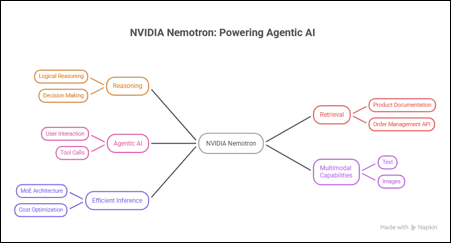
- Intention recognition:
The system recognizes the customer request as a replacement for a defective product.
- Policy retrieval:
The system searches the firm’s knowledge base for relevant policies and determines that defective products are replaceable within 30 days of purchase.
- Checking the business data:
The agent uses the order management API to retrieve the delivery date, product information, and warranty conditions.
- Deciding based on the results:
The system identifies that the product was delivered recently and satisfies the condition for replacement.
- Executing the actions:
Upon customer confirmation, the agent may use the replacement order API.
- Answering the customer:
The system notifies that the product is eligible for replacement.
Nemotron and RAG
Retrieval-augmented generation (RAG) is an essential part of enterprise AI because business information changes frequently. Documentation of products, pricing, warranties, and procedures may become outdated; therefore, it is not appropriate to rely on training data of the LLM only. RAG overcomes that problem by retrieving relevant, up-to-date information at runtime.
Flow of typical RAG process:
Documents -> Processing -> Embeddings -> Vector Database -> Retrieval -> LLM -> Response
The Nemotron ecosystem includes solutions for embeddings, retrieval, and reranking, allowing applications to supply reasoning models with relevant context. In a customer support application, the knowledge base may include manuals, warranties, troubleshooting instructions, and FAQs. The system retrieves the relevant information based on the customer’s query prior to generating the response.
Production Architecture
The production Nemotron-based agent can use the following architecture:
Customer -> API Gateway -> Agent Orchestrator -> Nemotron
The agent can connect to a knowledge base via Retriever and Vector Database, whereas the business tools, such as Order, Customer, Shipping, and Support APIs, supply data in real time. The model performs reasoning and response generation, whereas enterprise systems serve as an authoritative source of business data.
Furthermore, the NVIDIA NIM helps to deploy Nemotron-based solutions by offering the AI inference service optimized for NVIDIA infrastructure.
Benefits of Nemotron
The following list summarizes some possible uses of Nemotron in enterprise AI:
- Reasoning – Helps enterprise AI systems perform multiple reasoning steps.
- Agentic workflows – Allow for the integration of APIs, databases, search engines, and other tools.
- RAG support – Helps applications access enterprise information before responding.
- Flexible deployment options – For those organizations looking for greater control over their AI infrastructure.
- Efficient inference – NVIDIA’s GPUs and inference platform can help organizations optimize the performance of production applications.
Organizations may also employ a model routing strategy in which simple queries are routed to smaller, faster models, while complex tasks are routed to more advanced reasoning models. It will allow for optimal balancing of cost and latency.
Conclusion
NVIDIA Nemotron marks a step away from conventional conversational AI toward agentic AI, in which reasoning, retrieval, tool use, and inference efficiency are all considered for enterprise applications. In a customer support application, the agent can retrieve policies, fetch real-time order information, conduct eligibility checks, call business APIs, and create personalized responses. It is evident that as more companies employ AI agents, reasoning, RAG, tool calling, and efficient deployment of models will be crucial.
Drop a query if you have any questions regarding NVIDIA Nemotron, and we will get back to you quickly.
Empowering organizations to become ‘data driven’ enterprises with our Cloud experts.
- Reduced infrastructure costs
- Timely data-driven decisions
About CloudThat
FAQs
1. Is it possible to use Nemotron for creating AI agents?
ANS: – Yes. Nemotron is compatible with agent-based models in which the model understands the task and works with external components, including APIs, databases, knowledge bases, and enterprise systems. As a result, Nemotron is suitable for customer support agents, enterprise assistants, research processes, etc.
2. Is it possible to use Nemotron with RAG?
ANS: – Yes. The Nemotron ecosystem contains technologies designed for retrieval, including embedding, retrieval, and reranking. These capabilities, combined with reasoning models, can be used to build RAG applications.


WRITTEN BY Akanksha Choudhary
Akanksha works as a Research Associate at CloudThat, specializing in data analysis and cloud-native solutions. She designs scalable data pipelines leveraging AWS services such as AWS Lambda, Amazon API Gateway, Amazon DynamoDB, and Amazon S3. She is skilled in Python and frontend technologies including React, HTML, CSS, and Tailwind CSS.


 PREV
PREV










Comments