

 Login
Login

 December 17, 2025
|
Voiced by Amazon Polly |
What is Fabric Data Agent
The Data Agent in Microsoft Fabric is a recently introduced feature that enables you to create custom conversational Q&A experiences powered by generative AI. A Fabric data agent makes organizational data insights easier to access and act upon. It allows your team to ask plain-English questions about data stored in Fabric OneLake and receive relevant, accurate answers. This empowers even those without technical expertise in AI or deep knowledge of data structures to obtain precise, context-rich insights.
Even here, you can customize the Fabric data agent by adding organization-specific instructions, examples and guidance. This helps ensure its responses align with your business objectives, making it easier for everyone to interact with data effectively.
To use the Fabric Data Agent, enable it in your Microsoft Fabric workspace and link it to your data sources, such as Lakehouse, Warehouse, Power BI datasets or KQL databases. After setup, you can start asking questions in natural language directly through the Fabric interface or connected applications.
The prerequisite for using this feature is that you must have paid F2 or higher Fabric capacity, or a Power BI Premium per capacity (P1 or higher) with Microsoft Fabric enabled, Fabric data agent tenant settings enabled, Cross-geo processing for AI enabled and Cross-geo storing for AI enabled.
Start Learning In-Demand Tech Skills with Expert-Led Training
- Industry-Authorized Curriculum
- Expert-led Training
How the Fabric data agent works
- User asks a question in natural language.
- The agent parses and validates the question: The Fabric data agent leverages Azure OpenAI Assistant APIs as its core engine to interpret and process user queries.
- It identifies the most relevant data source: The Fabric data agent uses the user’s credentials to access the data source schema, ensuring it retrieves only the structure information the user is authorized to view. It then evaluates the query across all available sources, including relational databases (Lakehouse and Warehouse), Power BI semantic models and KQL databases.
- Generates and executes the query securely: After identifying the correct data source, the Fabric data agent reformulates your question to make it clear and structured. Then it uses the right tool to create a query:
- Converts Natural language to SQL for Lakehouse or Warehouse.
- Converts Natural language to DAX for Power BI datasets.
- Converts Natural language to KQL for KQL databases.
- Returns structured, human-readable answers: After validation, the Fabric data agent runs the query on the selected data source. It then formats the results into an easy-to-read response, which can include tables, summaries or key insights.
Step-by-step guidelines to create a Fabric data agent
- Create a new Fabric data agent
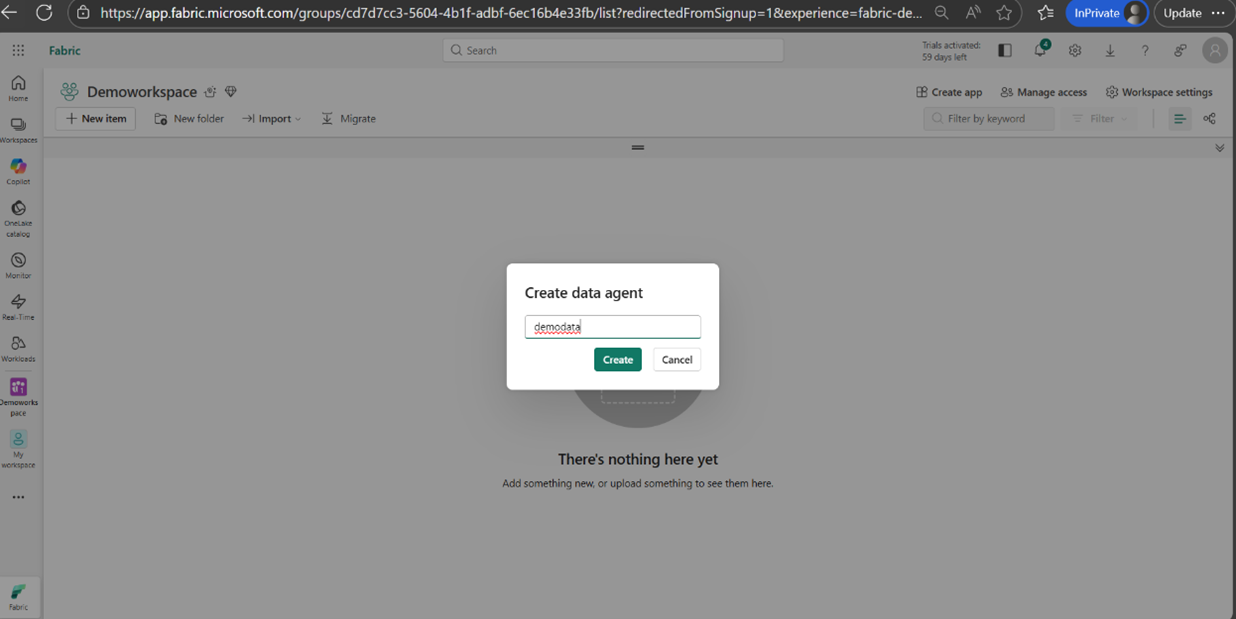
Creating a data agent in Microsoft Fabric to manage and automate data workflows.
- Select data source
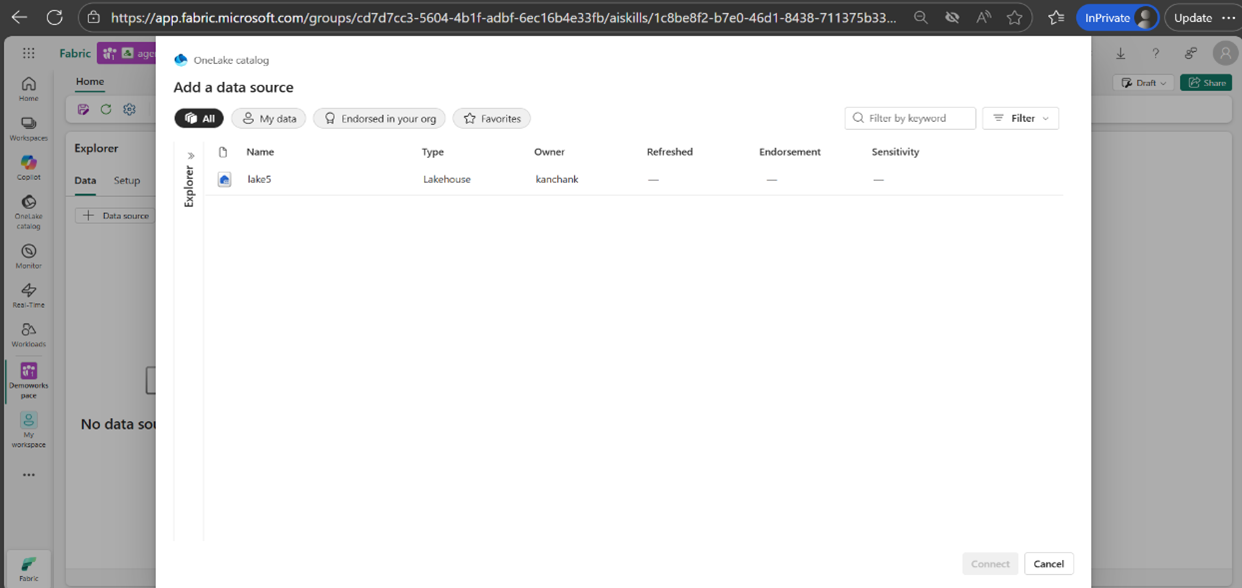
Adding a Lakehouse data source in Microsoft Fabric using OneLake catalog for seamless data integration.
- Ask questions
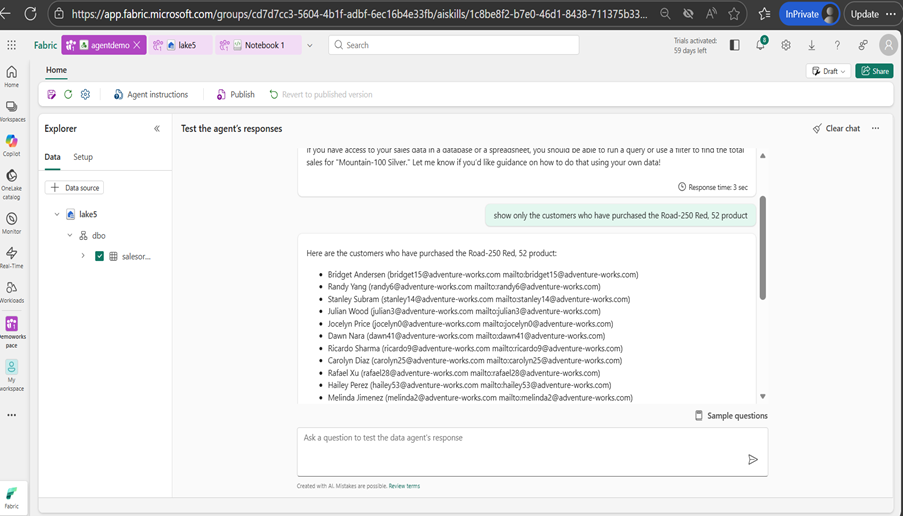
Testing a data agent in Microsoft Fabric to retrieve customer details based on product purchase queries.
Real-World Use Cases
- Business Intelligence: Teams can ask questions in plain English, eliminating the need to write SQL or DAX.
- Executive Dashboards: Executives can get instant summaries of KPIs and trends without navigating complex dashboards.
- Healthcare: Agent can be used to analyze patient records and wearable data.
If you want to learn more about Microsoft Fabric and Generative AI, check out courses like DP-700: Implementing Data Engineering Solutions Using Microsoft Fabric and others on Gen AI.
Conversational Data Intelligence
The Fabric Data Agent is a game-changer for organizations looking to simplify data access. By combining generative AI with secure, role-based connectivity to multiple data sources, users can ask questions in natural language and receive accurate, actionable insights. This eliminates the need for technical expertise, speeds up decision-making and promotes a data-driven culture. As AI adoption grows, Fabric Data Agent provides a practical approach to making analytics more intuitive and impactful.
Upskill Your Teams with Enterprise-Ready Tech Training Programs
- Team-wide Customizable Programs
- Measurable Business Outcomes
About CloudThat


WRITTEN BY Kanchan Kale
Kanchan R Kale is a Microsoft Certified Trainer and working as Subject Matter Expert at CloudThat, specializing in Microsoft Azure Data services. With 12+ years of experience in Data domain, she has successfully delivered 150+ impactful corporate training sessions on Azure data services, empowering over 2500+ professionals from Fortune 500 companies like Accenture, TCS, Capgemini, Deloitte, IBM, Cognizant, Persistent, Infosys and KPMG. Kanchan is well known for simplifying complex concepts, hands-on teaching, industry insights. She brings deep technical knowledge and practical application into every learning experience. Kanchan's passion for teaching trending technologies reflects in her unique approach to learning and development


 PREV
PREV











Comments