

 Login
Login


 August 24, 2026
|
Voiced by Amazon Polly |
Overview
Amazon Bedrock AgentCore Payments is a new capability that allows AI agents to access and pay for premium APIs, web content, Model Context Protocol servers, data services, and other agents during task execution. The feature is currently available in preview and is being developed with payment infrastructure from Coinbase and Stripe.
Until now, an AI agent could discover information, call tools, and complete multi-step workflows, but paying for an external service usually required custom billing integrations. Developers had to manage payment credentials, wallets, provider-specific APIs, transaction failures, budgets, audit records, and security controls.
AgentCore Payments brings these responsibilities into a managed AWS capability. It gives developers a consistent payment interface while introducing infrastructure-level controls over how much an agent can spend, which payment instrument it can use, and how every transaction is recorded.
Pioneers in Cloud Consulting & Migration Services
- Reduced infrastructural costs
- Accelerated application deployment
Introduction
AI agents are moving beyond conversational assistance. A modern agent may search several data sources, call APIs, use an MCP server, interact with another agent, and combine the results into a completed task.
Amazon Bedrock AgentCore Payments addresses this gap by allowing an agent to make controlled microtransactions as part of its normal execution flow. Instead of stopping and asking a developer to configure a new provider relationship, the agent can receive a payment request, authorize the transaction within a defined budget, and continue its task.
Amazon Bedrock AgentCore Payments
AgentCore Payments is a managed capability within Amazon Bedrock AgentCore for enabling autonomous payment workflows. It is designed for paid APIs, MCP services, digital content, other agents, and machine-consumable services.
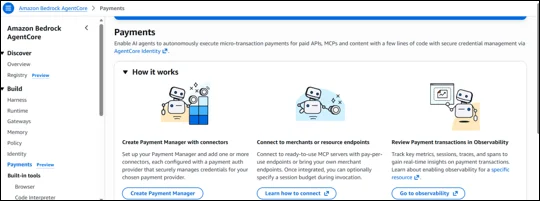
The preview supports stablecoin-based microtransactions and uses the x402 protocol for HTTP-native payments. It also connects with the broader AgentCore platform, including Identity, Gateway, Runtime, and Observability.
The purpose is not simply to attach a wallet to an agent. The service manages the complete payment lifecycle, including:
- Connecting to a supported payment provider
- Creating a payment instrument for the user
- Establishing a controlled payment session
- Processing merchant payment requirements
- Enforcing spending limits
- Generating payment proof
- Recording logs, metrics, and traces
This gives enterprises a governed way for agents to spend money without exposing unrestricted financial access to the model.
How the Agent Payment Flow Works?
The payment process begins when an agent calls a paid endpoint. The merchant responds with an HTTP 402 “Payment Required” message containing the payment instructions.
AgentCore Payments interprets those instructions, checks the available session budget, authenticates with the configured wallet, signs and completes the payment, and returns cryptographic proof. The agent then retries the original request with that proof and receives a response indicating payment for the content or service.
From the agent’s perspective, the process remains part of a single execution loop:
- Request a resource.
- Receive a payment requirement.
- Process the payment.
- Retry with proof.
- Continue the task.
AgentCore abstracts differences between protocol versions, payment providers, and transaction networks. Developers continue to use the same payment interface, while the orchestration layer selects the appropriate connector and protocol handler.
Payment Managers, Connectors, and Instruments
AgentCore Payments organizes the payment environment through several managed components.
A payment manager is the top-level resource that groups the configuration needed to process payments. A payment connector links AgentCore to a provider such as Coinbase or Stripe. The connector handles provider-specific communication while presenting a consistent interface to the application.
A payment instrument is the wallet or payment mechanism used by the agent. In the preview workflow, an embedded crypto wallet can be created for an end user. The user funds the wallet and grants signing authorization before the agent can spend from it. Supported funding paths include transfers from an existing crypto wallet and hosted experiences for fiat-to-crypto funding.
The AI model does not need direct access to wallet secrets. AgentCore Identity stores provider credentials in a secure token vault and makes short-lived authorization available only to permitted roles. Raw payment credentials are not exposed to the agent during execution.
Built-In Spending Controls
Autonomous spending poses a serious risk: an agent could repeat a tool call, misunderstand a requirement, enter a loop, or execute multiple transactions simultaneously.
AgentCore Payments addresses this through payment sessions. A payment session is a time-bound context with a predefined spending limit. Every transaction is checked against the remaining budget before funds are transferred.
The service uses a three-stage process:
Reserve: The requested amount is atomically deducted from the available session budget.
Process: The payment is sent through the configured provider.
Commit or roll back: A successful transaction is committed. When it fails, the reserved amount is restored.
This approach is designed to prevent overspending even when several payment requests are processed concurrently against the same budget.
For example, a research agent could receive a $10 budget. It may spend $0.50 on market data, $1.20 on a supply-chain report, and $0.80 on industry benchmarks. The agent can complete all three transactions while remaining within the approved limit.
Discovering Paid Services Through the Gateway
Agents also need a way to find payment-enabled resources. AWS is making the Coinbase x402 Bazaar MCP server available through AgentCore Gateway. The Bazaar provides a curated catalog of x402-compatible endpoints that an agent can search when it needs an external capability.
This means developers do not necessarily need to hardcode every paid service into the agent. An agent can discover a suitable provider, review the payment requirement, use the service within its allowed budget, and continue working.
Gateway remains the controlled connection layer through which the agent discovers and invokes tools. Payments extend this model by allowing some of those tools to be commercially accessed on demand.
Observability and Auditability
Every autonomous transaction must be explainable. Organizations need to know what the agent purchased, why it was purchased, which session initiated the payment, how much was spent, and whether the transaction succeeded.
AgentCore Payments emits structured logs, metrics, and distributed traces into the customer’s AWS environment. Payment-specific telemetry can include the transaction amount, remaining budget, provider processing details, request identifiers, and signing chain performance. OpenTelemetry-compatible tracing supports end-to-end correlation across the agent and payment workflow.
This information can be used to investigate unexpected spending, calculate cost per completed task, evaluate provider performance, and establish a complete transaction audit trail.
Conclusion
The feature remains in preview, so organizations should carefully validate regional availability, supported providers, compliance requirements, transaction limits, and operational controls before adopting it for critical workloads.
Drop a query if you have any questions regarding Amazon Bedrock AgentCore, and we will get back to you quickly.
Empowering organizations to become ‘data driven’ enterprises with our Cloud experts.
- Reduced infrastructure costs
- Timely data-driven decisions
About CloudThat
FAQs
1. What is Amazon Bedrock AgentCore Payments?
ANS: – It is a managed AgentCore capability that lets AI agents process payments for premium APIs, MCP servers, web content, data, and other services during execution.
2. Is AgentCore Payments generally available?
ANS: – No. AgentCore Payments is currently available in preview.
3. Can an agent spend without limits?
ANS: – No. Developers create payment sessions with defined spending limits. The service checks and reserves the required amount before processing each transaction.


WRITTEN BY Yerraballi Suresh Kumar Reddy
Suresh is a highly skilled and results-driven Generative AI Engineer with over three years of experience and a proven track record in architecting, developing, and deploying end-to-end LLM-powered applications. His expertise covers the full project lifecycle, from foundational research and model fine-tuning to building scalable, production-grade RAG pipelines and enterprise-level GenAI platforms. Adept at leveraging state-of-the-art models, frameworks, and cloud technologies, Suresh specializes in creating innovative solutions to address complex business challenges.


 PREV
PREV












Comments