

 Login
Login


 June 19, 2026
|
Voiced by Amazon Polly |
As businesses expand across multiple branch offices, retail stores, healthcare centers, hotels, and franchise locations, maintaining secure and scalable connectivity becomes increasingly complex. Organizations often rely on VPN connectivity to connect remote locations to cloud infrastructure, but managing hundreds of independent VPN connections can introduce operational overhead and unnecessary costs.
To address this challenge, AWS introduced AWS Site-to-Site VPN Concentrator, a feature that simplifies multi-site connectivity by centralizing VPN management through AWS Transit Gateway.
Start Learning In-Demand Tech Skills with Expert-Led Training
- Industry-Authorized Curriculum
- Expert-led Training
What is AWS Site-to-Site VPN Concentrator?
AWS Site-to-Site VPN Concentrator is a specialized attachment type for AWS Transit Gateway that allows multiple remote locations to share centralized VPN connectivity into AWS.
Traditionally, each branch office required its own standalone VPN attachment, even when bandwidth requirements were relatively small. This resulted in Underutilized VPN capacity, higher cost per site.
VPN Concentrator addresses these issues by enabling multiple sites to connect through a shared concentrator attached to a Transit Gateway.
Why Organizations Need a VPN Concentrator
VPN Concentrator is ideal for enterprises operating 25 or more branch locations, where each site typically requires 50–100 Mbps of bandwidth for retail chains. VPN Concentrator enables organizations to share aggregate bandwidth across multiple remote sites, reduce per-site VPN costs through centralized connections, scale connectivity based on actual traffic, and ensure high availability by deploying redundant endpoints across two Availability Zones.
Key Benefits of AWS VPN Concentrator
1. Centralized Multi-Site Connectivity
Instead of creating isolated VPN architectures for every branch office, organizations can consolidate connectivity into a single AWS Transit Gateway attachment. This simplifies Network management, Route propagation, Monitoring, and Troubleshooting
2. Better Bandwidth Utilization
In traditional VPN architectures, each location receives dedicated VPN bandwidth regardless of actual usage.
With VPN Concentrator, multiple sites share aggregate bandwidth
3. Simplified Scaling
Adding new branch locations becomes easier because existing concentrator infrastructure can be reused, and routing remains centralized
4. High Availability
VPN Concentrator automatically provisions redundant endpoints across Availability Zones for improved resilience and fault tolerance. Each VPN connection continues to use dual tunnels for redundancy.
How AWS VPN Concentrator Works
VPN Concentrator integrates directly with AWS Transit Gateway.
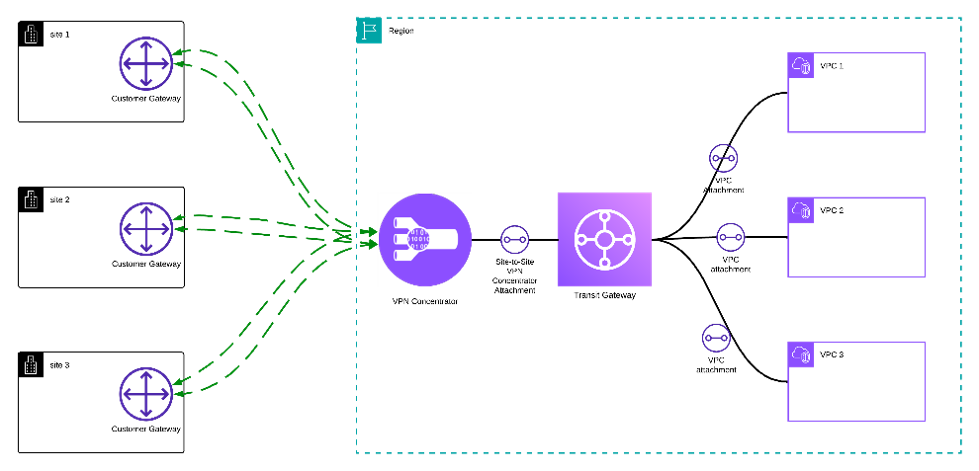
Fig 1: AWS VPN concentrator enabling secure multi‑site connectivity via Transit Gateway
The diagram above illustrates how multiple remote branch locations connect to AWS via a single VPN Concentrator attached to an AWS Transit Gateway, enabling connectivity to several VPCs. Each branch site establishes a Site-to-Site VPN connection with dual tunnels to ensure high availability and resilience, as in standard VPN deployments. The VPN Concentrator efficiently distributes shared bandwidth across all connected locations. For the latest service limits and quotas, refer to the AWS Site-to-Site VPN quotas documentation.
Core Components for VPN Concentrator
- AWS Transit Gateway: The AWS Transit Gateway serves as the central routing hub for the enterprise network architecture. It provides scalable connectivity between multiple Virtual Private Clouds (VPCs), on-premises locations, and VPN connections. By acting as a transit point, the Transit Gateway simplifies network management by eliminating the need for complex VPC peering configurations.
- Customer Gateway configuration for each remote site: Each remote office or branch location is configured with a Customer Gateway (CGW) device, which serves as the on-premises VPN endpoint. These devices establish secure IPsec tunnels to AWS Site-to-Site VPN endpoints attached to the Transit Gateway.
- BGP Routing protocol configuration: Border Gateway Protocol (BGP) is configured between AWS VPN endpoints and Customer Gateway devices to enable dynamic route exchange. BGP eliminates the need for manual route management and provides automatic failover between redundant VPN tunnels.
Deployment Steps
Step 1: Create a VPN Concentrator
Using the AWS Management Console:
- Open the VPC Console
- Navigate to Virtual Private Network
- Select Site-to-Site VPN Concentrators
- Choose Create VPN Concentrator
- Associate it with your Transit Gateway
AWS automatically creates redundant concentrator endpoints across Availability Zones.
Step 2: Create VPN Connections
For each branch location:
- Create a Site-to-Site VPN connection
- Select the VPN Concentrator as the target
- Configure the Customer Gateway
- Enable BGP routing
- Configure pre-shared keys
- Choose IPv4 or IPv6
Optional features include VPN acceleration and AWS Secrets Manager integration
Step 3: Configure Routing
After the VPN tunnels become active, routes are propagated automatically into the AWS Transit Gateway route table. This enables seamless communication between branch locations and AWS VPC resources. BGP dynamically exchanges routing information, allowing automatic route updates, simplified network management, efficient traffic forwarding, and rapid failover during connectivity disruptions.
Monitoring and Operations
The AWS VPN Concentrator integrates seamlessly with AWS monitoring and logging services to provide comprehensive visibility into network performance and security. Amazon CloudWatch collects metrics such as tunnel status, data throughput, and connection health, enabling proactive monitoring and alerting. VPC Flow Logs capture network traffic information for troubleshooting and analysis, while VPN Logs provide detailed connection and event records for operational monitoring, auditing, compliance, and incident investigation
Performance and Scalability
The VPN concentrator architecture is designed for high-performance connectivity, with each concentrator capable of handling up to 5 Gbps of aggregate throughput. This capacity is sufficient for typical branch office and enterprise workloads. As bandwidth demand grows, additional concentrators can be deployed, with remote sites distributed across them. This approach improves load balancing, enhances fault isolation, supports future growth, and ensures consistent network performance.
Future-Ready Cloud Connectivity
AWS Site-to-Site VPN Concentrator streamlines connectivity for organizations operating across multiple remote locations. By aggregating branch connectivity through a single AWS Transit Gateway attachment, businesses can simplify network management, reduce operational overhead, and improve cost efficiency while continuing to benefit from the secure, highly available architecture of AWS Site-to-Site VPN. When considering a VPN Concentrator, organizations should assess their existing network topology, bandwidth consumption, and routing requirements. This solution is especially beneficial for enterprises with many distributed sites that require centralized connectivity management and efficient shared bandwidth utilization
Upskill Your Teams with Enterprise-Ready Tech Training Programs
- Team-wide Customizable Programs
- Measurable Business Outcomes
About CloudThat


WRITTEN BY Sheeja Narayanan
Sheeja Narayanan is Champion Amazon Authorized Instructor, Microsoft Certified trainer and Senior Subject Matter Expert at CloudThat, specializing in AWS infra and Migration. With 19 years of experience in Training and consulting, she has trained over 2500 professionals/students to upskill in Networking, Windows and Linux administration, AWS, Azure and Vmware. Known for simplifying complex concepts and delivering highly hands-on sessions, she brings deep technical knowledge and practical expertise into every learning experience. Sheeja's passion for training delivery reflects in her unique approach to learning and development.


 PREV
PREV












Comments