

 Login
Login


 August 19, 2026
|
Voiced by Amazon Polly |
Introduction
Retrieval-Augmented Generation (RAG) has become a common approach for grounding Large Language Models (LLMs) with enterprise data. It performs well for fact-based lookups by retrieving the most relevant document chunks before generating a response. However, enterprise use cases such as financial due diligence, regulatory compliance, legal analysis, and risk assessment often require reasoning across hundreds of documents. In these scenarios, traditional RAG may miss important relationships because the required information is distributed across multiple documents rather than a few semantically similar chunks.
Task-Aware Knowledge Compression (TAKC) addresses this challenge by pre-processing enterprise knowledge into task-specific compressed representations, enabling faster and more comprehensive reasoning while significantly reducing token consumption.
Pioneers in Cloud Consulting & Migration Services
- Reduced infrastructural costs
- Accelerated application deployment
What is Task-Aware Knowledge Compression?
TAKC is an AI technique that compresses enterprise knowledge for a predefined business task rather than creating a generic summary.
For example, the same annual report can be compressed differently depending on the objective:
- Financial analysis retains revenue, cash flow, margins, and debt metrics.
- Compliance reviews preserve regulatory references and policy violations.
- Legal analysis focuses on contracts, liabilities, and litigation risks.
Rather than retrieving a handful of document fragments during every query, TAKC creates compressed knowledge representations offline and stores them for future use. At runtime, the application retrieves the compressed version best suited for the requested task, allowing the model to reason over a much larger portion of the knowledge base.
Multi-Rate Compression
Not every question requires the same amount of context. TAKC addresses this by maintaining multiple compression levels for every task.
- 8× Compression – Best for complex analytical reasoning.
- 16× Compression – Suitable for moderate business analysis.
- 32× Compression – Optimized for factual questions.
- 64× Compression – Ideal for classification and keyword-based lookups.
A query complexity analyzer automatically selects the appropriate compression level based on query length, complexity, and intent. Simple questions use highly compressed data, while analytical queries receive richer context without requiring users to make manual choices.
AWS Reference Architecture
The AWS implementation uses a fully serverless architecture with separate ingestion and query pipelines.
Ingestion Pipeline
When documents are uploaded to Amazon S3, an S3 event triggers AWS Lambda to split the documents into manageable chunks. Amazon Bedrock then generates task-specific compressed representations at multiple compression levels.
The compressed outputs are stored in Amazon ElastiCache Serverless for low-latency access and backed up in Amazon S3 for durability.
Query Pipeline
Users authenticate via Amazon Cognito and submit requests via Amazon API Gateway, which AWS WAF protects.
AWS Lambda function evaluates query complexity, retrieves the appropriate compressed representation from ElastiCache, and sends the compressed context along with the user query to Amazon Bedrock for inference.
Because compression occurs only during ingestion, runtime processing mainly involves cache retrieval and inference, resulting in lower latency and reduced operational cost.
Benefits of TAKC
Task-Aware Knowledge Compression provides several advantages over traditional retrieval-based systems:
- Preserves relationships across large document collections.
- Reduces context size by up to 64×, lowering token usage.
- Improves response quality for analytical and reasoning-heavy workloads.
- Enables task-specific optimization without modifying source documents.
- Supports scalable serverless deployment using AWS managed services.
TAKC vs. Traditional RAG
TAKC is not intended to replace RAG entirely. Instead, both techniques solve different types of problems.
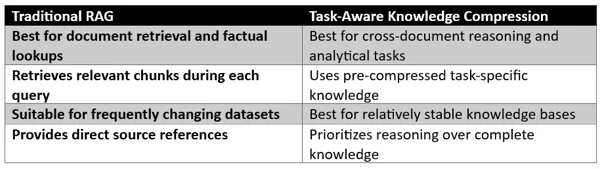
Many enterprise AI systems can benefit from combining both approaches. RAG can provide traceable source citations, while TAKC enables deeper reasoning across the entire knowledge base.
When Should You Use TAKC?
TAKC is particularly valuable for enterprise workloads involving:
- Financial due diligence
- Regulatory compliance reviews
- Legal document analysis
- Risk assessment
- Internal knowledge assistants
- Enterprise research across large document repositories
Organizations with relatively stable datasets and repeated analytical queries can achieve significant reductions in inference costs while improving response quality.
Conclusion
As enterprise AI moves beyond simple document retrieval, systems need better ways to reason across large and interconnected knowledge bases. Task-Aware Knowledge Compression extends the capabilities of traditional RAG by transforming documents into task-specific, compressed knowledge representations before inference.
For organizations building advanced analytical assistants, TAKC represents an important evolution beyond conventional RAG architectures.
Drop a query if you have any questions regarding RAG, and we will get back to you quickly.
Empowering organizations to become ‘data driven’ enterprises with our Cloud experts.
- Reduced infrastructure costs
- Timely data-driven decisions
About CloudThat
FAQs
1. What is Task-Aware Knowledge Compression (TAKC)?
ANS: – TAKC compresses enterprise documents into task-specific knowledge representations to enable faster, more accurate AI reasoning.
2. Does TAKC replace RAG?
ANS: – No. TAKC complements RAG, with RAG handling retrieval and TAKC improving cross-document reasoning.
3. How does TAKC reduce inference costs?
ANS: – By compressing task-specific knowledge in advance, TAKC reduces the number of tokens processed during inference, thereby lowering latency and cost.


WRITTEN BY Daniya Muzammil
Daniya works as a Research Associate at CloudThat, specializing in backend development and cloud-native architectures. She designs scalable solutions leveraging AWS services with expertise in Amazon CloudWatch for monitoring and AWS CloudFormation for automation. Skilled in Python, React, HTML, and CSS, Daniya also experiments with IoT and Raspberry Pi projects, integrating edge devices with modern cloud systems.


 PREV
PREV











Comments