

 Login
Login


 August 19, 2026
|
Voiced by Amazon Polly |
Introduction
Data powers modern organizations today, but getting access to it is hard for nontechnical people. Analysts, product owners, and executives must turn to their data science teams to write SQL queries even for trivial business questions. This hinders decision-making, leads to inefficiencies, and makes it impossible for companies to unlock the full value of their data.
NL2SQL systems seek to resolve that issue by enabling users to ask questions in natural language and generate SQL queries on the fly. Without having to write long and complex SQL statements, a user could ask, “Who are our top 10 customers by revenue?” and get the answer.
Even though modern LLMs make the development of NL2SQL systems more accessible than ever before, developing a production-grade solution goes far beyond just plugging an AI model into the system. Enterprise solutions must cope with challenges of schema ambiguity, complex queries, security, validation, and consistency. This blog will walk you through the architecture of NL2SQL systems.
Pioneers in Cloud Consulting & Migration Services
- Reduced infrastructural costs
- Accelerated application deployment
Abstract
Conversion from natural language to SQL forms the basis for linking human language with structured databases by translating the business question into a valid SQL query. Although this may look like an easy task, enterprise-level deployment requires intelligent query routing, an understanding of the database schema, secure SQL generation, and proper validation mechanisms.
A good NL2SQL system should not only produce SQL statements but also be cost-efficient, keep sensitive data safe, and enable conversations. With the help of AI-based language understanding, deterministic business rules, and proper security measures, this can be achieved.
Why Building an NL2SQL System Is Challenging
One of the key challenges in NL2SQL is interpreting business terminology. An end-user requesting “revenue” can refer to any of the database fields, such as net_revenue, gross_revenue, or invoice_amount. Likewise, the business entities “customer” and “client” can mean the same thing but differ in names in the actual database table.
The complexity of the query is yet another challenge. Some queries can be simple, like displaying a list of customers, but others can be complex, such as year-over-year analysis, ranking, and other operations that require multi-table joins.
Security is an important aspect as well. The generated SQL queries cannot change the production database in any way or disclose sensitive information. All queries should be checked, run in read-only mode, and secured with restrictions such as row limits, timeouts, and schema checks.
Without such constraints, even the most advanced language models would not be able to provide the necessary reliability.
Building a Production-Ready NL2SQL Architecture
An enterprise NL2SQL solution should consist of multiple intelligent components working together, rather than relying on a single LLM prompt.
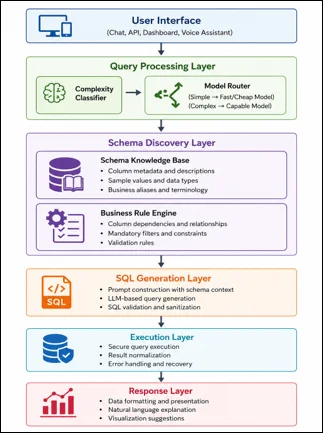
The first stage is query complexity classification. Instead of sending every request to the same model, the system decides if a question is simple, moderate, or complex. Faster and cheaper models can handle simple requests. More complex analytical queries go to more capable reasoning models. This method reduces response time and significantly lowers operational costs.
The next step is schema discovery and column selection. Rather than showing the entire database schema to the model, the system pulls only the relevant tables and columns based on their meaning. Keeping metadata, which includes column descriptions, aliases, business definitions, and sample values, greatly helps the model understand user intent.
Once the relevant schema is identified, the LLM creates a SQL query using well-structured prompts. These prompts include schema context, business rules, and organizational standards to ensure consistent query generation. By limiting the available schema and giving clear instructions, the system helps reduce errors and improve SQL accuracy.
Before execution, every generated query must pass through a validation layer. The system checks that only approved tables and columns are used, confirms the query is read-only, applies result limits, and blocks any potentially risky operations. This validation layer acts as a safeguard before any query reaches the database.
Finally, the response is normalized into a consistent format. This step holds regardless of the underlying database technology. Standardized outputs make downstream processing easier and improve the overall user experience.
Best Practices for Enterprise NL2SQL Systems
Building an effective NL2SQL solution requires balancing AI flexibility with deterministic business logic.
Classification of queries is a practice in which queries are classified before processing. Pattern matching without AI algorithms will help identify the simplest queries, making the process faster and more cost-efficient.
Combining semantic search with deterministic validation is another practice. In semantic search, AI is very good at understanding what the user intends, but the business rules need to be deterministic. By verifying table names, column mappings, and required filters, the system’s generated queries will always be precise and compliant with business rules.
There needs to be layered security, with read-only database credentials, SQL validation, execution timeouts, response size limitations, and proper error handling, all of which together form a secure execution environment. Using one mechanism is not sufficient to be secure, multiple mechanisms help in minimizing operational risks.
Conversation management is also a critical factor. Usually, users don’t ask only one question. Queries like “Show only top five” or “Filter for last quarter” are examples of follow-up questions that need to track previous queries and modify accordingly.
Conclusion
NL2SQL could revolutionize how companies engage with their data and make analytics accessible to both tech and non-tech users. But developing a production-quality product is not just about creating SQL from the LLM.
Whatever platform the technology is built on, Amazon Bedrock, OpenAI, Anthropic, or any other language model, the key architectural concepts stay the same. By combining AI and engineering best practices, businesses can create highly scalable NL2SQL applications.
Drop a query if you have any questions regarding NL2SQL, and we will get back to you quickly.
Empowering organizations to become ‘data driven’ enterprises with our Cloud experts.
- Reduced infrastructure costs
- Timely data-driven decisions
About CloudThat
FAQs
1. Why can't an LLM generate SQL directly from a database schema?
ANS: – Though LLMs can generate SQL, enterprise databases consist of hundreds of tables and thousands of columns. Other components, such as schema discovery, business rules, and validation, are needed to ensure that the generated SQL is valid, safe, and relevant to the business.
2. How can the accuracy of NL2SQL systems be improved?
ANS: – Accuracy increases by providing descriptions, aliases, sample values, and business definitions to schema metadata. The addition of semantic search, along with deterministic validation, minimizes the risk of incorrect columns and SQL statements.
3. What about security while executing AI-generated SQL?
ANS: – Security is ensured by using read-only credentials, verifying generated SQL, limiting access to selected tables, imposing a result limit, configuring timeouts, and blocking all modifications.


WRITTEN BY Akanksha Choudhary
Akanksha works as a Research Associate at CloudThat, specializing in data analysis and cloud-native solutions. She designs scalable data pipelines leveraging AWS services such as AWS Lambda, Amazon API Gateway, Amazon DynamoDB, and Amazon S3. She is skilled in Python and frontend technologies including React, HTML, CSS, and Tailwind CSS.


 PREV
PREV











Comments