

 Login
Login

 August 24, 2026
|
Voiced by Amazon Polly |
Introduction
As organizations continue to modernize their applications and infrastructure, one of the biggest challenges they face is technical debt. Legacy applications built on outdated frameworks, unsupported runtimes, and aging architectures often become difficult to maintain, expensive to operate, and slow to innovate.
Traditionally, application modernization has required significant manual effort, involving code analysis, dependency mapping, migration planning, testing, and validation. These activities can take months or even years for large enterprise applications.
To address this challenge, AWS has introduced AWS Transform, an AI-powered modernization service designed to accelerate application transformation at scale. By leveraging generative AI and AWS expertise, AWS Transform helps organizations modernize legacy applications faster, reduce technical debt, and improve developer productivity.
Pioneers in Cloud Consulting & Migration Services
- Reduced infrastructural costs
- Accelerated application deployment
AWS Transform
AWS Transform is a generative AI-powered service that helps organizations modernize legacy applications and workloads. It analyzes existing codebases, identifies modernization opportunities, generates migration plans, and automates large portions of the transformation process.
The service is designed to help enterprises move away from outdated technologies and adopt modern cloud-native architectures with significantly less manual effort.
AWS Transform combines the power of generative AI with AWS best practices to streamline modernization projects and reduce the risks typically associated with large-scale migrations.
Why Technical Debt Matters?
Technical debt accumulates when organizations continue to build on older systems without addressing underlying architectural limitations. Over time, this can result in:
- Increased maintenance costs
- Slower development cycles
- Security vulnerabilities
- Reduced scalability
- Difficulty adopting modern technologies
- Higher operational overhead
Modernizing these systems is essential for long-term business agility, but the complexity involved often delays transformation initiatives.
AWS Transform aims to bridge this gap by automating many of the tasks that traditionally require extensive manual effort.
Key Features of AWS Transform
- AI-Powered Application Analysis
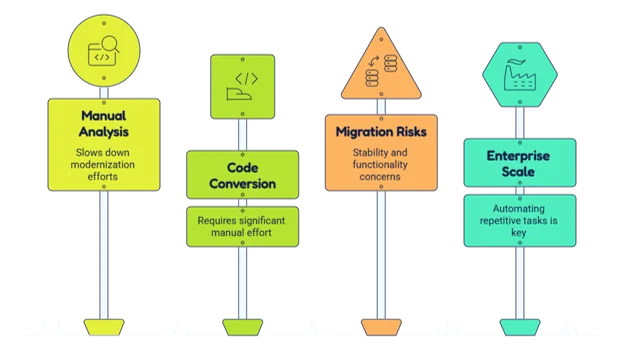
AWS Transform automatically analyzes existing applications, source code, dependencies, and architecture patterns to understand how the application works.
This helps development teams quickly identify modernization opportunities without spending weeks performing manual assessments.
- Automated Modernization Recommendations
Based on its analysis, AWS Transform provides intelligent recommendations for migrating applications to modern architectures and AWS services.
These recommendations align with AWS best practices and help teams make informed modernization decisions.
- Accelerated Code Transformation
One of the most powerful capabilities of AWS Transform is its ability to automate portions of the code conversion process.
Instead of manually rewriting large codebases, developers can leverage AI-generated transformations that significantly reduce migration effort and accelerate delivery timelines.
- Reduced Risk During Migration
Large modernization projects often introduce risks related to application stability and functionality.
AWS Transform helps mitigate these risks by providing structured modernization workflows, guided recommendations, and automated validation processes.
- Enterprise-Scale Modernization
The service is designed to support large enterprise environments where hundreds of applications may require modernization.
By automating repetitive modernization tasks, organizations can transform applications at a much larger scale than traditional approaches allow.
Real-World Use Cases
Use Case 1: Modernizing Legacy Java Applications
Many enterprises continue to run applications on older Java versions and frameworks.
AWS Transform can analyze these applications, identify modernization opportunities, and assist developers in upgrading codebases to newer frameworks and supported runtimes.
Use Case 2: Migrating Monolithic Applications
Organizations looking to move from monolithic architectures to microservices can use AWS Transform to identify service boundaries and generate modernization recommendations.
This reduces the complexity associated with large architectural changes.
Use Case 3: Cloud Migration Initiatives
Companies moving workloads to AWS can leverage AWS Transform to streamline migration planning and automate portions of the modernization process.
This helps accelerate cloud adoption while minimizing disruption.
Use Case 4: Reducing Technical Debt Across Large Portfolios
Enterprises with multiple legacy applications often struggle to prioritize modernization efforts.
AWS Transform provides insights into application complexity and modernization opportunities, helping organizations focus on the areas that deliver the highest business value.
Benefits of Using AWS Transform
Faster Modernization
AI-assisted analysis and code transformation dramatically reduce the time required to modernize applications.
Improved Developer Productivity
Developers spend less time performing repetitive migration tasks and more time focusing on business logic and innovation.
Lower Costs
Reducing manual modernization effort helps organizations lower project costs and achieve faster returns on investment.
Enhanced Application Quality
AWS best practices and AI-driven recommendations help improve application reliability, maintainability, and scalability.
Accelerated Cloud Adoption
Organizations can move applications to AWS faster while minimizing migration risks and operational challenges.
Best Practices for Successful Modernization
To maximize the benefits of AWS Transform:
- Start with applications that have the highest technical debt.
- Validate AI-generated recommendations before deployment.
- Establish automated testing throughout the modernization process.
- Modernize incrementally rather than attempting large-scale rewrites at once.
Limitations to Consider
While AWS Transform significantly accelerates modernization efforts, organizations should keep the following in mind:
- Human review remains essential for business-critical applications.
- Complex legacy systems may still require manual intervention.
- AI-generated transformations should be thoroughly tested before production deployment.
Getting Started with AWS Transform
- Access AWS Transform through the AWS Management Console.
- Connect your existing application repositories.
- Allow AWS Transform to analyze your applications.
- Review AI-generated modernization recommendations.
- Validate transformation plans and begin modernization.
- Test and deploy modernized applications using established CI/CD processes.
Conclusion
AWS Transform represents a major advancement in application modernization. By combining generative AI with AWS expertise, organizations can reduce technical debt, accelerate cloud adoption, and modernize legacy applications more efficiently than ever before.
As enterprises continue to face increasing pressure to innovate while maintaining existing systems, tools like AWS Transform provide a practical path toward modernization. Rather than spending years manually rewriting applications, organizations can leverage AI-powered assistance to accelerate transformation projects and focus on delivering business value.
Drop a query if you have any questions regarding AWS Transform, and we will get back to you quickly.
Empowering organizations to become ‘data driven’ enterprises with our Cloud experts.
- Reduced infrastructure costs
- Timely data-driven decisions
About CloudThat
FAQs
1. What is AWS Transform?
ANS: – AWS Transform is an AI-powered modernization service that helps organizations analyze, modernize, and migrate legacy applications using generative AI.
2. How does AWS Transform reduce technical debt?
ANS: – It automates application analysis, provides modernization recommendations, and accelerates code transformation, reducing the effort required to modernize legacy systems.


WRITTEN BY Utsav Pareek
Utsav works as a Research Associate at CloudThat, focusing on exploring and implementing solutions using AWS cloud technologies. He is passionate about learning and working with cloud infrastructure and services such as Amazon EC2, Amazon S3, AWS Lambda, and AWS IAM. Utsav is enthusiastic about building scalable and secure architectures in the cloud and continuously expands his knowledge in serverless computing and automation. In his free time, he enjoys staying updated with emerging trends in cloud computing and experimenting with new tools and services on AWS.


 PREV
PREV





Comments