

 Login
Login


 August 24, 2026
|
Voiced by Amazon Polly |
Introduction
Every AWS bill tells a story, but traditional cost tools only show you the numbers. Cost Explorer confirms a spike happened; it cannot explain why, whether it was justified, or what to do about it. Reserved Instance optimization requires spreadsheet modeling that most teams never complete. Right-sizing recommendations ignore application context and break workloads when followed blindly. A Gen AI Cost Optimization Agent closes that gap. It reads the same billing data a FinOps engineer would, but correlates it with deployments, traffic patterns, and business context to explain spending in plain English, forecast future costs, and generate implementation-ready savings plans. This guide covers the architecture, core capabilities, and guardrails for building one on AWS.
Pioneers in Cloud Consulting & Migration Services
- Reduced infrastructural costs
- Accelerated application deployment
What Is a Gen AI Cost Optimization Agent?
A traditional cost tool shows dashboards and fires alerts after a budget breach. A Gen AI cost agent adds a reasoning layer: it ingests Cost and Usage Reports, CloudWatch metrics, pricing APIs, resource tags, Savings Plan inventory, and Spot pricing history, then uses a foundation model to interpret what the numbers mean together. A threshold tells you that spending crossed a line; the agent tells you which deployment caused it, whether the spend delivers business value, and generates a Terraform change to fix it. It models commitment strategies across Reserved Instances, Savings Plans, Spot, and On-Demand to find the optimal mix. It predicts budget breaches 7 days before they occur, along with mitigation options. Because it only recommends changes and never modifies infrastructure without approval, it is a safe, high-value application of generative AI in cloud financial management.
Core Capabilities with AWS Scenarios
Cost Anomaly Detection and Explanation
When Cost Anomaly Detection flags a spike, traditional tools indicate that data transfer increased by 340 percent. The Gen AI agent gathers context, recent deployments, configuration changes, traffic patterns, and historical baselines, then explains the root cause: a new video transcoding pipeline deployed on July 8 pulls source files from us-east-1 but processes in ap-south-1, generating $5,760 per day in cross-region transfer fees. It assesses whether the spend is justified or wasteful, recommends an immediate fix (enable S3 Cross-Region Replication for $50 per month, eliminating $172,000 per month in transfer costs), and offers to generate the Terraform change. Every anomaly gets a root cause, a business assessment, an immediate action, a long-term recommendation, and the projected monthly impact if left unaddressed.
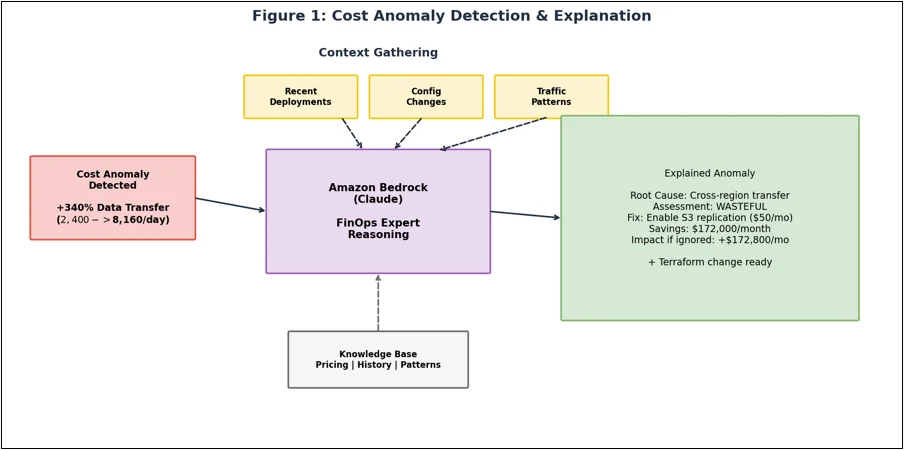
Figure 1. Cost anomaly detection gathers deployment and traffic context to explain WHY costs spiked and recommends specific fixes.
Intelligent Right-Sizing
Basic right-sizing tools look at peak CPU and recommend a smaller instance. The Gen AI agent considers fourteen days of CPU, memory, network, and disk metrics alongside application context: workload type (stateless API versus stateful database), auto-scaling group membership, burst frequency and duration, SLA requirements, and Graviton compatibility. A stateless API running at an average CPU usage of 15 percent, with occasional bursts to 82 percent, is safe to move to a smaller Graviton instance because the ASG provides burst capacity. A traditional tool would recommend a t3.medium that breaks under load. The agent recommends m6g.xlarge with a confidence level, risk assessment, and projected 50 percent savings while maintaining SLA.
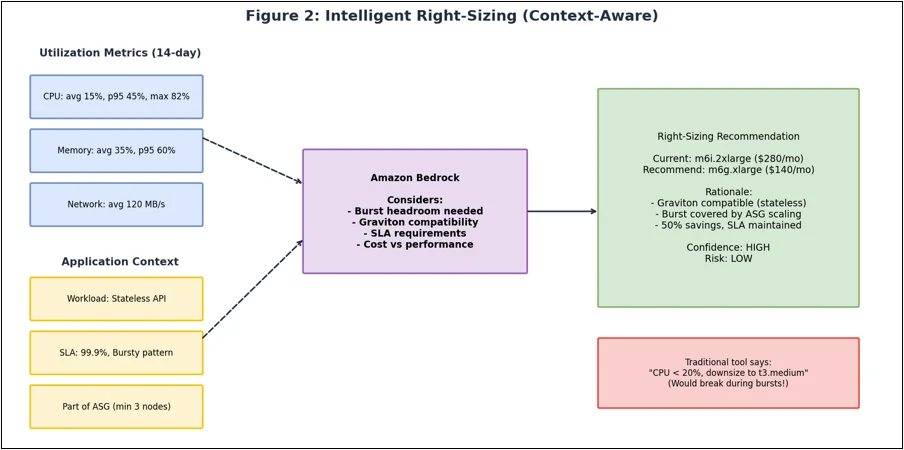
Figure 2. Intelligent right-sizing considers burst patterns, SLA requirements, and Graviton compatibility before recommending changes.
Commitment Strategy Optimization
The optimal mix of On-Demand, Savings Plans, Reserved Instances, and Spot is a complex optimization problem most teams solve with gut feeling. The agent analyzes 90 days of usage by instance family, separates baseline (always running), peak (business hours), and burst (unpredictable) capacity, evaluates Spot interruption history, and designs a commitment strategy that maximizes savings while preserving flexibility. It generates a financial model showing current versus optimized monthly cost, expected savings percentage, risk assessment for usage drops, break-even timeline, and a phased purchase plan. For a typical $ 96,000-per-month On-Demand spend, the agent designs a mixed strategy that saves $38,000 per month, with a 4.2-month break-even.
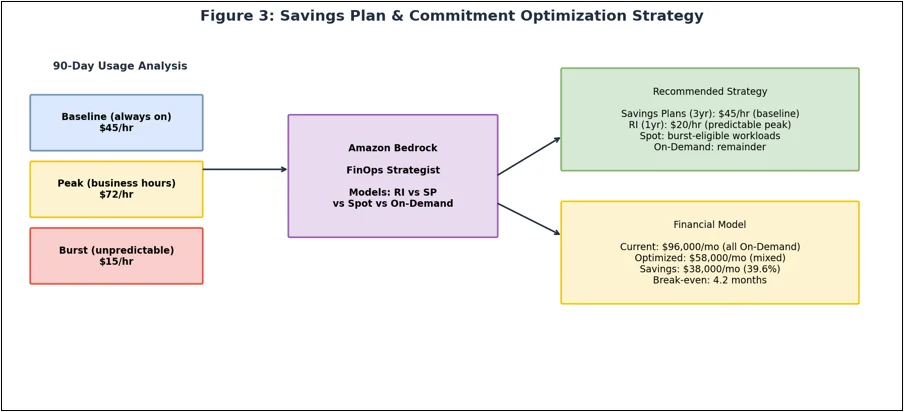
Figure 3. Commitment optimizer models the ideal RI/Savings Plan/Spot/On-Demand mix with break-even analysis.
Waste Elimination and Architecture Optimization
The agent continuously scans for waste across nine categories: idle resources with zero utilization for seven-plus days, oversized instances with average CPU below 20%, unattached EBS volumes and Elastic IPs, old snapshots beyond the retention policy, idle load balancers, over-provisioned RDS instances, and excessive NAT Gateway traffic. Beyond resource-level waste, it identifies architecture-level savings: replacing NAT Gateway traffic with VPC endpoints (saving sixty to eighty percent on eligible traffic), migrating to Graviton (twenty to forty percent savings), converting stateless workloads to Spot (forty to seventy percent), and applying S3 lifecycle policies. Each opportunity is prioritized by effort versus reward, risk level, and dependencies — grouped into This Week, This Sprint, This Quarter, and Backlog.
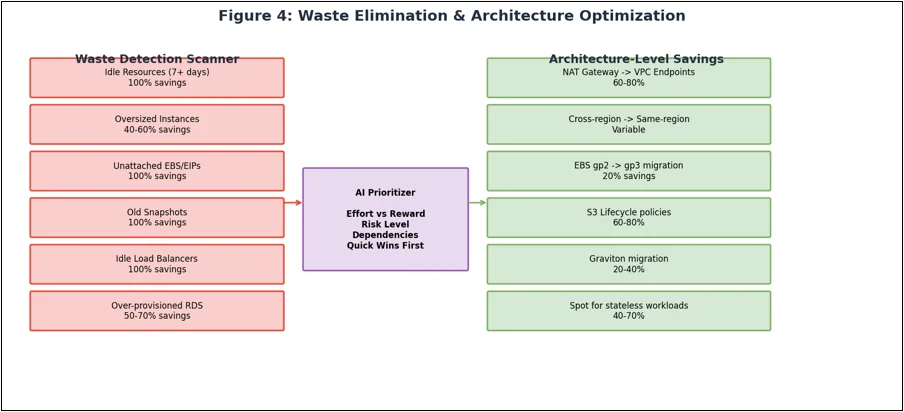
Figure 4. Waste elimination and architecture optimization opportunities prioritized by effort, reward, and risk.
AWS Architecture for the Cost Pipeline
Cost data from nine sources — CUR Reports in S3, Cost Explorer API, Trusted Advisor, CloudWatch metrics, Pricing API, resource tags, AWS Organizations, Savings Plans inventory, and Spot pricing history — flows through an AWS Glue ETL pipeline into an S3 data lake in Parquet format. Amazon Athena provides the SQL query layer over this lake, while DynamoDB stores real-time state for anomaly tracking and recommendation status. The AI Analysis Engine, powered by Amazon Bedrock with Claude, performs anomaly detection, right-sizing analysis, commitment optimization, and cost forecasting, grounded in a knowledge base of pricing models, historical decisions, architecture patterns, team budgets, and seasonal factors, stored in S3 and indexed via OpenSearch Serverless.
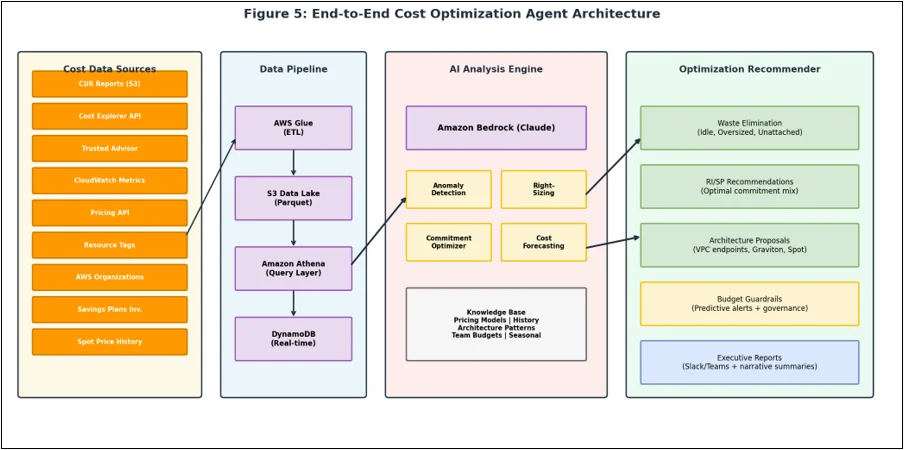
Figure 5. End-to-end architecture from nine cost data sources through AI analysis to prioritized optimization recommendations.
The Optimization Recommender outputs five categories of action: waste elimination with implementation scripts, RI and Savings Plan purchase recommendations with financial models, architecture proposals with Terraform modules, predictive budget guardrails that alert before breach, and narrative executive reports delivered via Slack or Teams.
End-to-End Pipeline Steps
- CUR data lands in S3 hourly; Glue ETL normalizes and partitions it into a queryable Parquet data lake.
- EventBridge triggers a daily Lambda that queries Athena for cost-by-service trends and detects anomalies exceeding 20% deviation from the 7-day average.
- Detected anomalies prompt Bedrock to use deployment context, traffic patterns, and historical baselines to generate root-cause explanations and fix recommendations.
- Weekly optimization scans analyze utilization metrics, commitment coverage, and waste categories, producing a prioritized savings report grouped by effort and risk.
- Budget guardrails run daily projections; if projected spend exceeds the budget by 10%, the agent explains why and recommends corrective actions before the month ends.
Guardrails, KPIs, and Cost
The agent operates read-only by default, it recommends but never modifies infrastructure without explicit approval. Recommendations carry confidence scores and risk ratings. High-risk changes (commitment purchases, architecture modifications) always require human sign-off. All recommendations are logged in an audit trail, with full reasoning for post hoc review. Forecasts include confidence intervals and explicitly state assumptions.
Typical targets: twenty to thirty-five percent spend reduction identified within ninety days, over seventy percent of identified savings implemented, cost anomaly detection under four hours (from days), budget forecast accuracy within plus or minus five percent (from twenty-five), tag compliance above ninety-five percent, and commitment utilization above ninety percent. The combined AWS services —Bedrock, Athena, Glue, Lambda, DynamoDB, S3, EventBridge, typically run two to four thousand dollars per month, against savings of fifty to one hundred forty thousand per month for a $350K monthly AWS environment. ROI: sixteen to seventy times.
What’s Next
The Cost Optimization Agent is the third pillar in the Gen AI Ops suite. Part 4 covers the Disaster Recovery Agent, which reuses the same infrastructure awareness and Bedrock reasoning to validate backup integrity, test failover procedures, and maintain recovery readiness. Together, the monitoring, security, cost, and DR agents form a complete AI-powered operations layer for AWS infrastructure.
Drop a query if you have any questions regarding Gen AI, and we will get back to you quickly.
Empowering organizations to become ‘data driven’ enterprises with our Cloud experts.
- Reduced infrastructure costs
- Timely data-driven decisions
About CloudThat
FAQs
1. Does this replace AWS Cost Explorer or Trusted Advisor?
ANS: – No, it sits on top of them, adding reasoning and actionable recommendations. Cost Explorer and Trusted Advisor remain the data sources; the agent adds interpretation, forecasting, and implementation-ready fixes.
2. Can it accidentally reduce performance by downsizing?
ANS: – The agent only recommends, it never resizes instances without approval. Every recommendation includes workload context, burst analysis, SLA impact assessment, and a confidence score. High-risk or low-confidence suggestions are flagged explicitly.
3. How does it handle multi-account environments?
ANS: – It uses AWS Organizations and CUR data across all member accounts to provide a unified cost view. It identifies cross-account optimization opportunities that per-account tools miss, like consolidating commitments or sharing reserved capacity.


WRITTEN BY Bineet Singh Kushwah
Bineet Singh Kushwah works as an Associate Architect at CloudThat. His work revolves around data engineering, analytics, and machine learning projects. He is passionate about providing analytical solutions for business problems and deriving insights to enhance productivity. In his quest to learn and work with recent technologies, he spends most of his time exploring upcoming data science trends and cloud platform services, staying up to date with the latest advancements.


 PREV
PREV





Comments