

 Login
Login


 March 13, 2026
|
Voiced by Amazon Polly |
Introduction
Building sophisticated AI applications traditionally requires extensive coding, complex integrations, and deep technical expertise. Langflow changes this paradigm by democratizing AI development through visual programming.
Langflow is a powerful platform for building and deploying AI-powered agents and workflows. It combines an intuitive visual interface for rapid prototyping with robust API infrastructure for production deployments. Whether creating chatbots, document analysis systems, or complex agentic applications, Langflow delivers the tools needed without extensive boilerplate code.
What distinguishes Langflow is its dual nature: it functions as both an IDE for designing flows and a runtime callable through APIs using Python, JavaScript, or HTTP. This allows visual workflow design with seamless integration into any application stack.
Pioneers in Cloud Consulting & Migration Services
- Reduced infrastructural costs
- Accelerated application deployment
Key Features
- Visual Flow Builder – Langflow’s drag-and-drop interface lets developers build complex AI workflows by connecting component nodes in a visual workspace. Each component represents a specific task, from serving AI models to connecting data sources, and can be configured with just a few clicks. This visual approach dramatically reduces development time while maintaining full control over your application’s logic.
- Comprehensive Component Library – The platform comes with batteries included, supporting all major Large Language Models (LLMs), vector databases, and a growing library of AI tools. Components are organized into Core components for generic functionality and Bundles for provider-specific integrations. This extensive library means you can quickly build sophisticated applications without writing custom integrations for every service.
- Built-in Agent Capabilities – Langflow provides robust agent orchestration, including conversation management and tool-calling. The Agent component can intelligently select and use multiple tools based on query context, enabling the creation of autonomous AI agents capable of performing complex multi-step reasoning tasks. The platform also supports Model Context Protocol (MCP) servers, allowing flows to be exposed as tools for MCP-compatible clients.
- Interactive Playground – Test and refine your flows immediately with the integrated Playground feature. This interactive environment provides step-by-step control and visibility into your flow’s execution, including detailed agent reasoning processes. You can monitor tool calls, outputs, and the entire decision-making process, making debugging and optimization straightforward.
- Flexible Deployment Options – Langflow offers multiple deployment strategies to suit different needs. You can deploy as a REST API for traditional integrations, export flows as JSON for Python applications, or expose them as MCP servers. The platform supports containerization with Docker, Kubernetes orchestration for production-grade deployments, and cloud provider integrations including Google Cloud Platform and Hugging Face Spaces.
- API-First Architecture: Every flow you create in Langflow is automatically accessible through a comprehensive API. The platform provides automatically generated code snippets in Python, JavaScript, and curl, making integration into existing applications seamless. The API supports streaming responses, conversation continuity, and runtime parameter overrides through “tweaks.”
- Customization and Extensibility – While Langflow provides extensive pre-built components, it also offers complete source code access, allowing you to customize any component using Python. You can create custom components, modify existing ones, and contribute to the growing Langflow ecosystem. This extensibility ensures that Langflow can adapt to your specific requirements as they evolve.
Code Example
Here’s a practical example of how to interact with a Langflow flow through its API:
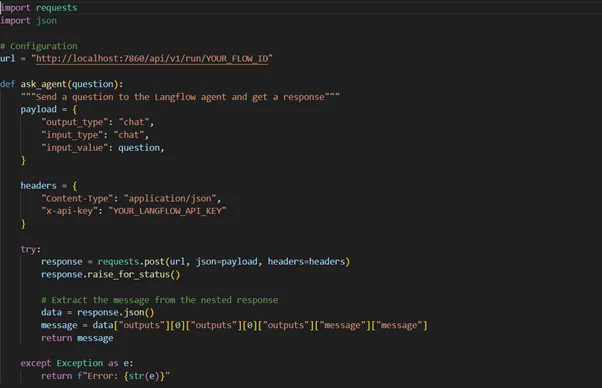
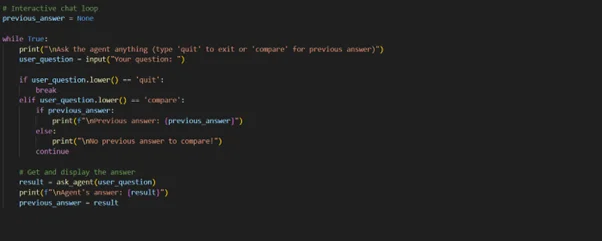
This example demonstrates how to create a simple question-and-answer chat that maintains conversation history. The code is straightforward, you make a POST request to the /run endpoint with your question, and Langflow handles all the complexity of executing your flow and returning the results.
You can also use tweaks to override flow parameters at runtime temporarily:
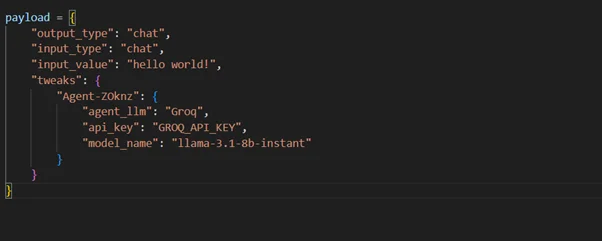
This feature lets you experiment with different models, parameters, or configurations without modifying the underlying flow, making A/B testing and optimization incredibly efficient.
Real-World Use Cases
- Customer Support Chatbot – E-commerce companies use Langflow to build intelligent customer support agents that can answer product questions, check inventory, process returns, and escalate complex issues to human agents. By connecting the Agent component to product databases through vector stores and integrating with CRM systems, these chatbots provide accurate, context-aware responses while reducing support ticket volume by up to 40%
- Document Analysis Pipeline – Law firms and financial institutions leverage Langflow to create automated document review systems. These flows ingest contracts, financial statements, or legal briefs, extract key information using LLMs, categorize documents, flag potential issues, and generate summary reports. The visual builder makes it easy to customize extraction rules and review workflows without extensive programming.
- Content Generation Engine – Marketing teams use Langflow to build multi-stage content creation workflows that generate blog posts, social media content, and email campaigns. By chaining together prompt templates, multiple LLM calls for drafting and editing, and integration with content management systems, teams can maintain a consistent brand voice while dramatically increasing content output.
- Research Assistant – Academic researchers and analysts build Langflow-powered research assistants that can query multiple data sources, synthesize information from scientific papers, generate literature reviews, and answer complex domain-specific questions. The URL component allows these agents to fetch current information from the web, while vector databases enable semantic search across large document collections.
- Data Enrichment Workflows – Data science teams deploy Langflow to automate data enrichment processes. These workflows take raw data inputs, use LLMs to extract structured information, validate and clean the data, enrich it with additional context from external APIs, and output standardized datasets ready for analysis. The ability to visualize the entire pipeline makes debugging and optimization straightforward.
Conclusion
Langflow bridges rapid prototyping and production deployment through visual flow programming and powerful APIs.
The active open-source community ensures continuous evolution in the AI landscape. Whether you’re a solo developer or an enterprise team, Langflow provides the tools and flexibility you need.
Drop a query if you have any questions regarding Langflow and we will get back to you quickly.
Empowering organizations to become ‘data driven’ enterprises with our Cloud experts.
- Reduced infrastructure costs
- Timely data-driven decisions
About CloudThat
FAQs
1. Do I need to know Python or machine learning to use Langflow?
ANS: – No. The visual flow builder lets you create AI applications by dragging and dropping components. However, Python knowledge helps with advanced customization.
2. How does Langflow handle API authentication and security?
ANS: – Langflow uses API key-based authentication. Create keys through Settings and include them in requests via the x-api-key header. Production deployments support HTTPS, environment variables, and role-based access controls.
3. Can I use Langflow with my preferred LLM provider?
ANS: – Absolutely. Langflow supports OpenAI, Anthropic, Google, Groq, and others out of the box. You can switch between models without rebuilding flows or connect custom models.


WRITTEN BY Livi Johari
Livi Johari is a Research Associate at CloudThat with a keen interest in Data Science, Artificial Intelligence (AI), and the Internet of Things (IoT). She is passionate about building intelligent, data-driven solutions that integrate AI with connected devices to enable smarter automation and real-time decision-making. In her free time, she enjoys learning new programming languages and exploring emerging technologies to stay current with the latest innovations in AI, data analytics, and AIoT ecosystems.


 PREV
PREV











Comments