

 Login
Login


 September 24, 2026
|
Voiced by Amazon Polly |
This guide shows you exactly how to build a skills gap report for leadership that gets read in the room, not filed away. Deloitte’s Global Boardroom Program surveyed nearly 500 directors and C-suite executives across more than 50 countries and found that 78% consider skills and talent availability a major source of risk, yet only 36% believe their board’s discussions on the topic go far enough. That gap between concern and clarity is exactly what a well-built report closes. You’ll get the four sections every report needs, the format that gets funded, and the exact cadence for keeping it current. We’ll also cover how to translate the findings into numbers that your Chief Financial Officer (CFO) will act on. By the end, you’ll have a repeatable template, not a one-time exercise.
Start Learning In-Demand Tech Skills with Expert-Led Training
- Industry-Authorized Curriculum
- Expert-led Training
Why Do Executives Need to See a Skills Gap Report at All?
Executives need to start looking at the skills gaps report mainly because it fixes the gaps they see, using the numbers they understand. Training ROI is something decision-makers care about. It also helps by pinpointing the bottlenecks in terms of skills gap.
Start by identifying skill gaps in your team role by role, since the analysis has to be right before the report matters. It also helps to frame the findings the way decision-makers already think, in terms of training return on investment (ROI), not just training completed. LinkedIn Learning’s 2025 Workplace Learning Report, based on a global survey of Learning and Development (L&D) professionals, found that 49% of respondents agreed that their executives are concerned that employees lack the skills to execute the company’s strategy. A skills gap report replaces that concern with evidence that leadership can act on.
That gap between what leadership suspects and what they can prove shows up in two specific ways:
- They can’t name which skill, on which team, is the actual blocker.
- They can’t defend a training budget request without guessing at the return.
A report fixes both problems by attaching a number to the gap and a number to the fix.
What Should a Skills Gap Report Include for Executive Stakeholders?
A skills gap report for your executive team must include four things: the current skill level relative to what the role requires, the business risk of leaving that gap open, the cost of inaction, and one recommended action with a timeline attached. Leave the raw skill matrix out of the summary and put it in an appendix instead.
- Risk, ranked by urgency: The Chartered Institute of Personnel and Development’s Learning at Work 2023 survey, based on 1,108 L&D respondents, found only 59% felt able to respond quickly to changing skills needs, down from 69% two years earlier. Rank gaps by urgency instead of listing them alphabetically.
- Leadership’s own gaps, not just the team’s: Based on research conducted by General Assembly, a tech training and workforce upskilling organization, found that while 62% of leaders have attended some artificial intelligence (AI) training, fewer than half of companies, 47%, offer leadership-specific AI training. Add a line for leadership’s own skill gaps, not just frontline staff, or you’re leaving out the group approving your budget.
- Cost of Inaction: Something that should be on the page is the revenue that’s lost because of the skill gap.
- One clear recommendation per gap: Not five options weighed against each other. One recommendation, with a cost and a timeline attached.
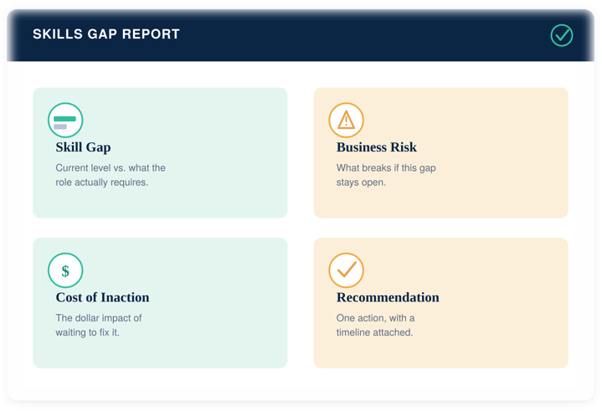
Fig 1: Key elements executives need in an effective skills gap report.
How Do I Present a Skills Gap Report to My Leadership Team?
Presenting a skills gap report to leadership only works when you focus on the existing business problem and its solution, highlight the major findings, address the cost of failing to adapt, and provide a clear plan of action.
Most reports fail here because the leadership team will sit through a five-minute walkthrough but not a fifteen-slide deck, so the format matters as much as the numbers inside it. Five rules to keep a report on the agenda instead of in an inbox:
- One page or one slide per major finding. A report that needs scrolling loses the room in the first ten seconds.
- Lead with the business risk, not the training plan. Leadership wants to know what breaks before they want to know how you’ll fix it.
- Tie every gap to something already on the roadmap. A gap tied to ‘Q3 cloud migration’ gets funded faster than one tied to ‘general upskilling.’
- Bring one number that people can repeat afterward. A single memorable figure travels further in a budget conversation than a slide full of percentages.
- Provide a clear plan of action with a practical timeline attached.
How Do You Turn a Skills Gap Report Into Numbers a CFO Cares About?
You turn your report into numbers a CFO cares about by attaching a dollar figure to the gap instead of a skill rating. Use the same benefit-minus-cost formula finance already trusts for every other investment decision, and point it at the cost of the gap instead of the cost of the fix. Do that, and the report stops reading like an L&D wishlist and starts reading like a business case.
The cost of ignoring a skills gap is easier to estimate than most L&D teams assume, and closing the IT skills gap starts with putting a real number on that cost. The International Data Corporation (IDC) found that IT skills shortages could cost the global economy up to $5.5 trillion by the end of 2026 due to product delays, quality issues, and lost revenue, and expects more than 90% of organizations worldwide to be affected. Your own number will be smaller and specific to your business but pricing out a single delayed project makes the report land very differently than a slide full of skill percentages.
A single line, such as ‘this gap delayed our last cloud migration by six weeks, at an estimated cost of $X,’ does more work than an entire page of skill-proficiency percentages.
How Often Should You Update a Skills Gap Report for Leadership?
Update a skills gap report at a cadence that matches how quickly underlying skills change, rather than on a fixed annual schedule. Fast-moving technical skills need quarterly reviews, slower-changing skills need only two reviews a year, and major organizational changes call for an update right away, regardless of where you are in the cycle. Knowing how often to update a skills gap analysis matters as much as building it correctly the first time.
- Quarterly: cloud computing, AI, and other fast-moving technical skills, where a single product launch can open a new gap within weeks.
- Twice a year: leadership, communication, and other skills that change slowly.
- Immediately: after a major reorganization, product launch, or new platform rollout, regardless of the normal schedule.
The IDC data cited above is why cloud and AI skills need a tighter cycle: IDC expects the impact of these shortages to intensify through 2026, a pace that outpaces any annual review.
What’s the Takeaway for L&D Teams Building Skills Gap Report?
The takeaway is simple: give leadership a decision to make, not just information to absorb. Proving a skills gap exists isn’t the hard part – getting leadership to act on it is, and that comes down to whether you built the report for a decision or just to inform. Most L&D teams already have the underlying data; what they’re missing is the four-part structure that turns raw findings into something a busy executive can approve in one sitting. Give leadership four things: the risk, the cost, one recommendation, and a number they will remember, and the budget conversation gets shorter every time.
Upskill Your Teams with Enterprise-Ready Tech Training Programs
- Team-wide Customizable Programs
- Measurable Business Outcomes
About CloudThat
FAQs
1. What is a skills gap analysis and why does it matter to executives?
ANS: – A skills gap analysis compares the skills your team currently has against what their roles actually require, so you can see the shortfall instead of guessing at it. It matters to executives because Deloitte’s Global Boardroom Program found that 78% of business leaders regard skills and talent availability as a major organizational risk, yet only 36% think their board’s discussions on the topic go far enough.
2. How do you present a skills gap analysis to leadership?
ANS: – Keep it short, visual, and tied to a business goal leadership already cares about, since one page beats a ten-tab spreadsheet every time. Give leadership four things: the risk, the cost, one recommendation, and a number they will remember, and the budget conversation gets shorter every time. Lead with what the gap is costing the business today, then show the fix, not the other way around.
3. How is a skills gap report different from a skills gap analysis?
ANS: – A skills gap analysis is the underlying data: the comparison between current and required skill levels. A skills gap report is what you build from that data for leadership, adding business risk, cost of inaction, and a specific recommendation so the analysis becomes something they can actually approve.
4. How do you identify which skills are missing on your team?
ANS: – The clearest signal is usually a stalled project or a task that keeps getting escalated to the same one or two people, since that is almost always where the real gap sits. Compare each role’s current skill level against what the role actually requires today, not what it required two years ago.
5. How do you know if your skills gap report is actually working?
ANS: – A working report gets a decision attached to it within one review cycle, whether that decision is approved budget, a hiring plan, or a training vendor selection. If the same gap shows up unresolved in your next quarterly update with no action taken, the report format needs fixing, not just the data behind it.


WRITTEN BY Shahab M
Shahab Muhammed is the Vertical Head of Power BI Team at CloudThat, specializing in Power BI & Data Analysis trainings. With 10 years of experience in training industry, he has trained over 5000 professionals to upskill in technologies like Power BI, Excel and other Power Platform technologies. With an industry experience as a BI Consultant, he brings deep technical knowledge and practical application into every learning experience. Shahab's passion for training and development reflects in his unique approach to learning and development.


 PREV
PREV












Comments