

 Login
Login


 September 23, 2026
|
Voiced by Amazon Polly |
What is generative AI tokenomics?
Generative AI tokenomics is the financial model behind how generative AI systems consume and charge for tokens. Enterprise cost depends on how many tokens enter the model, how many it generates, and which supporting services the application uses.
OpenAI defines tokens as the building blocks of text, such as characters, parts of words, full words, punctuation, or spaces, depending on the language and context. A useful rule of thumb: 1 token ≈ 4 English characters; 100 tokens ≈ 75 words. Tokenomics matters because modern AI applications are billed each time they process input, generate output, call tools, retrieve data, or store context.
For enterprise leaders, the “real cost” is not just the model price. The cost stack includes input tokens, output tokens, cached tokens, reasoning tokens, embeddings, RAG retrieval, vector storage, tool calls, and sometimes provisioned capacity. Gartner’s 2025 enterprise generative AI guidance warns that GenAI TCO can exceed initial expectations due to hidden costs, including compliance reviews, model retraining, and internal overhead.
Teams building production workloads will also want to review the Generative AI in Production course, which covers GenAIOps, RAG pipelines, CI/CD, security, and cost-aware architecture for live LLM systems.
Start Learning In-Demand Tech Skills with Expert-Led Training
- Industry-Authorized Curriculum
- Expert-led Training
How do tokens turn into real enterprise AI costs?
Tokens become costly when a model processes input, generates output, or reuses cached context. Most providers publish prices per 1 million tokens, but the final bill also includes search, embeddings, provisioned throughput, and tool execution.
Core billing formula: Monthly AI cost = Requests × [(input tokens × input price) + (output tokens × output price) + cache writes/reads + tool fees + retrieval/embedding/storage costs] ÷ 1,000,000 + fixed capacity costs.
OpenAI’s pricing page lists separate rates for input, cached input, cache writes, and output tokens. Azure OpenAI pricing includes Standard on-demand billing, provisioned throughput units (PTUs), and a Batch API that offers a 50% discount for workloads that can accept completions within 24 hours.
Output tokens matter most to your bill: OpenAI’s GPT-5.6 Terra runs $2 input / $12 output per 1M tokens, while Google’s Gemini 3.6 Flash runs $1.50 / $7.50. The chart below shows why output control is a financial lever, not just a prompt-engineering detail.
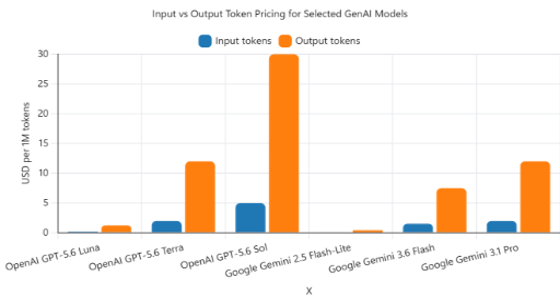
Fig 1: Published input vs. output token prices per 1M tokens (OpenAI & Google, 2026). Output tokens can cost 4–6× more than input tokens, making response length a primary cost lever.
Why do context windows and output tokens change the bill?
Context windows change the bill because longer prompts push more input tokens into the model and can trigger higher long-context pricing tiers. Output tokens change the bill because the model generates them sequentially; they are priced higher, and they directly drive latency.
A context window is the maximum combined input and output a model can consider in one request. OpenAI’s 2026 pricing shows long-context rates for GPT-5.6 Sol stepping up from $5/$30 to $10 input / $45 output per 1M tokens.
Latency follows the same economics. Microsoft’s Azure OpenAI performance guidance defines total response time as TTLT = TTFT + (TBT × Tokens Generated), with output token count as the primary driver of time-to-last-token. OpenAI’s latency optimization guide states that cutting output tokens by 50% may cut latency by roughly 50%.
Enterprise rule of thumb: budget the context window, do not fill it by default. Use retrieval filters, summarise older conversation turns, set output limits, and separate short-answer workloads from deep-reasoning workloads.
How do RAG, embeddings, and fine-tuning add costs?
RAG incurs costs for ingestion, embeddings, vector storage, retrieval, and generation. Fine-tuning adds cost through training, hosting, and separate inference meters; it should only be chosen when it delivers repeatable quality or cost gains over prompt engineering.
Retrieval-Augmented Generation (RAG) is a pattern where a system retrieves relevant enterprise data, injects it into the prompt, and asks the model to answer. It is valuable because it includes proprietary, up-to-date information, cites sources, and applies access controls at retrieval time.
- Embedding charges: documents are chunked and converted to vector embeddings. Google’s Gemini Embedding is priced at $0.15 per 1M text tokens.
- Context inflation: retrieved chunks become input tokens; without filtering, RAG can inflate prompt size and cost.
- Vector storage: OpenAI’s File Search is $0.10/GB/day after 1 GB free; Azure is similarly priced.
For a concrete example of RAG architecture on AWS, the “Building a Voice-Enabled Chatbot Using Amazon Bedrock on AWS” blog shows how retrieval, embeddings, and Bedrock inference combine in a production-ready system, with cost implications at every layer.
How can enterprises calculate generative AI costs?
Calculate cost per request, per workflow, and per business outcome. The best model is not the one with the lowest token price; it is the one that delivers the required quality at the lowest total cost for the workload.
Example scenario: A customer support assistant receives 100,000 requests per month, averaging 1,200 input and 300 output tokens per request, on OpenAI’s GPT-5.6 Terra, with published pricing ($2 input / $12 output per 1M tokens). Applying standard optimization levers, 30% input pruning, and 40% output limiting, reduces the bill by 36% without changing the model:

That $216/month saving is a budgeting illustration based on published rates, not a provider quote. Savings scale linearly with request volume: at 1M requests/month, the same optimization saves $2,160/month.
Beyond the model line, enterprise cost models should also capture traffic patterns, token profile, architecture profile, and business outcomes, such as cost per resolved ticket, generated report, or compliance review. McKinsey’s 2023 research estimated that generative AI could add $2.6 trillion to $4.4 trillion annually across enterprise use cases, which is why tokenomics must be tied to business KPIs, not just cloud invoices.
How can enterprises reduce generative AI token spend?
The biggest cost levers are model routing, prompt caching, batch processing, output limits, and RAG filtering. Test each lever with real production prompts, cost, quality, and latency trade-offs vary by workload.
- Model routing: route classification, extraction, and simple Q&A to lower-cost models; reserve premium reasoning models for tasks that genuinely need them.
- Prompt caching: when prompts share stable prefixes, system instructions, policy documents, and tool schemas, caching cuts input costs significantly. OpenAI’s prompt caching is automatic for eligible prompts; Azure OpenAI requires the first 1,024 tokens to match for a cache hit; AWS Bedrock’s prompt caching may price cache writes separately from cache reads.
- Batch processing: for non-real-time tasks, Azure OpenAI, Google Gemini’s Batch API, and AWS Bedrock batch inference each offer roughly a 50% discount for workloads completed within 24 hours.
- Output limits and context pruning: set maximum output tokens for each workload class, summarise older conversation turns, and use chunk-level relevance scoring in RAG to exclude low-signal context.
What governance model keeps AI spending under control?
AI cost control requires FinOps, platform engineering, and AI governance working together. Track usage by product, team, use case, model, token type, and business outcome, not just by total cloud bill.
IBM’s 2024 Global AI Adoption Index reported that 42% of enterprise-scale organizations had actively deployed AI, with limited AI skills, data complexity, and high price cited as top barriers. Deloitte’s 2024 enterprise generative AI survey of more than 2,800 leaders found text generation adopted by 85% of respondents, followed by code generation and image tools.
A practical governance model includes five pillars:
- Budgets by use case– each function with its own spend envelope.
- Chargeback by token type- so each team sees its real consumption.
- Guardrails by workload– model allowlists, context limits, and approval gates.
- Dashboards– cost, cache hit rate, latency, and business KPIs tracked together.
- Review cadence– monthly for production; post-pilot before scale-up.
Gartner’s 2025 guidance recommends maintaining a comprehensive tracker for GenAI expenses, one that captures compliance reviews, model retraining, and internal overheads, not just API invoice lines.
Key Takeaways
- A token is the basic processing and billing unit for most text-based GenAI workloads.
- Output tokens cost several times as much as input tokens in published provider pricing.
- Long context windows improve capability but trigger higher input and output cost tiers.
- RAG improves grounding but adds embedding, retrieval, vector storage, and a larger prompt context.
- Batch processing and prompt caching can cut costs by up to 50% for eligible workloads.
- FinOps dashboards must track token type, use case, model, team, and business outcome together.
Practical Next Steps for Enterprise Teams
Create a token budget before production, measure usage during pilots, and optimize prompts and model selection before scaling. The fastest wins come from output limits, context pruning, model routing, and caching.
- Create a baseline calculator- request volume, tokens, model rate, RAG, embeddings, storage, and tool fees.
- Log token usage per request using provider metadata, and set default output limits while flagging outliers.
- Separate workloads- real-time, batch, background, regulated, and experimental.
- Apply model routing and enable prompt caching for repeated content.
- Review cost per outcome monthly, not just your total cloud bill.
For hands-on implementation of production GenAI cost controls, explore the Generative AI in Production course and the Designing Intelligent Agents with Generative AI on Azure blog for end-to-end architectural guidance.
What is the Real Cost of Generative AI?
The real cost of generative AI is the cost of every architectural decision: which model to call, how much context to send, what to retrieve, how many tokens to generate, and how to observe usage. Enterprises that treat GenAI as a metered production system, not a simple API subscription, will control spend and extract measurable value.
Investment continues to accelerate because the value potential is real, while Gartner’s 2025 TCO guidance explains why governance must begin before production rollout. The winning approach is not “use the cheapest model.” It is about using the right model, context, retrieval, caching, and controls for each business outcome.
Upskill Your Teams with Enterprise-Ready Tech Training Programs
- Team-wide Customizable Programs
- Measurable Business Outcomes
About CloudThat
FAQs
1. What is tokenomics in generative AI?
ANS: – Tokenomics in generative AI is the study of how token usage creates cost. It covers input tokens, output tokens, cached tokens, reasoning tokens, embeddings, retrieval, tool calls, and fixed capacity charges.
2. Why are output tokens more expensive than input tokens?
ANS: – Output tokens are priced higher because the model must generate them sequentially during inference, a compute-intensive process. Published prices from OpenAI and Google show output-token rates 4–6× higher than input-token rates for the same model.
3. Does RAG reduce generative AI cost?
ANS: – RAG can reduce costs by sending only the most relevant context chunks rather than full documents. It can increase cost when retrieval returns too many chunks and inflates prompt tokens, or when embedding and storage fees outweigh inference savings.
4. Is fine-tuning cheaper than prompt engineering?
ANS: – Fine-tuning is cheaper only when it reliably replaces long prompts, repeated examples, or premium model calls across many requests. It introduces training, hosting, and inference costs, so enterprises should model the total cost before choosing it.
5. How can CIOs control generative AI spending?
ANS: – CIOs can control spending by enforcing model routing, context budgets, output limits, prompt caching, batch processing, and chargebacks by use case, while tracking full GenAI TCO, including compliance, retraining, and internal overheads.
6. Where can my team learn to build production GenAI applications?
ANS: – CloudThat offers two relevant programs: Unlock the Power of Generative AI for fundamentals and prompt engineering, and Generative AI in Production for GenAIOps, RAG, CI/CD pipelines, and cost-aware production LLM systems.


WRITTEN BY Rajesh KVN
Dr. K. V. N. Rajesh is a Microsoft Certified Trainer & Senior Subject Matter Expert at CloudThat (Microsoft Gold Partner), specializing in Azure cloud security and AI. With over 20 years of experience in training, research, and development, he has trained thousands globally on Microsoft certifications and best practices. Known for simplifying complex security concepts and practical, hands‑on guidance, Dr. Rajesh brings deep technical insight. His passion for mentoring and writing fuels every learning journey. He is a Microsoft global award winner.


 PREV
PREV











Comments