

 Login
Login


 June 22, 2026
|
Voiced by Amazon Polly |
Introduction
As organizations increasingly embrace cloud-native technologies, Kubernetes has become the preferred platform for deploying and managing containerized applications. While Kubernetes provides scalability, flexibility, and resilience, managing application deployments manually can be complex and time-consuming. Development teams require a reliable mechanism to automate application building, testing, and deployment while maintaining consistency across multiple environments.
Continuous Integration and Continuous Deployment (CI/CD) practices help address these challenges by automating software delivery processes. Drone CI is a modern, container-native CI/CD platform that simplifies pipeline automation and integrates seamlessly with Kubernetes environments.
Unlike traditional CI/CD tools that rely heavily on dedicated build servers or virtual machines, Drone CI executes each pipeline step inside isolated containers. This approach ensures consistency, improves scalability, and aligns naturally with Kubernetes-based workflows. In this blog, we will explore how Drone CI can be leveraged to automate Kubernetes deployments, improve development efficiency, and support modern DevOps practices.
Pioneers in Cloud Consulting & Migration Services
- Reduced infrastructural costs
- Accelerated application deployment
Overview
Drone CI is an open-source CI/CD platform designed specifically for containerized environments. Built around a lightweight architecture, Drone CI uses Docker containers to execute every stage of the software delivery pipeline. This ensures that builds run in predictable and isolated environments, eliminating many of the “works on my machine” issues commonly encountered during development.
When integrated with Kubernetes, Drone CI becomes a powerful automation platform capable of managing the entire application lifecycle. Developers can automate source code validation, unit testing, security scanning, container image creation, image publishing, and application deployment using a single pipeline.
Drone CI pipelines are defined in a declarative YAML configuration file named .drone.yml, stored alongside the application source code. This approach allows teams to manage deployment workflows as code, improving transparency, version control, and collaboration.
The platform supports deployment to various Kubernetes environments, whether running on-premises or in cloud platforms such as AWS EKS, Azure AKS, and Google Kubernetes Engine (GKE). Its flexibility and scalability make it suitable for organizations ranging from small startups to large enterprises that manage complex microservice architectures.
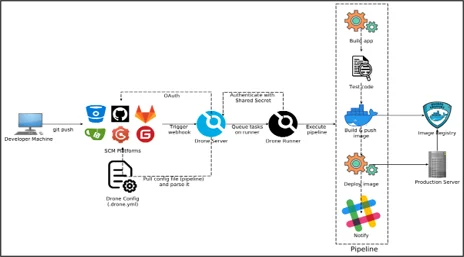
Source – Click here
Key Features of Drone CI for Kubernetes
- Automated Container Image Builds
One of the most important steps in a Kubernetes deployment pipeline is building container images. Drone CI automatically triggers builds whenever code changes are pushed to the source repository. This ensures that application images are consistently generated and packaged according to organizational standards.
By automating image creation, development teams can eliminate manual intervention and reduce the likelihood of deployment inconsistencies.
- Kubernetes Deployment Automation
Drone CI can directly deploy applications to Kubernetes clusters using deployment manifests, Helm charts, or custom deployment scripts. Once a build completes successfully, the deployment stage can automatically update applications running in Kubernetes.
This enables organizations to implement Continuous Delivery practices and significantly reduce release times.
- Pipeline as Code
Drone CI uses a YAML-based configuration approach that allows pipelines to be defined, reviewed, and version-controlled alongside application code.
Benefits include:
- Improved transparency
- Easier collaboration between teams
- Simplified change tracking
- Faster pipeline maintenance
Since deployment logic is stored within the repository, teams can easily replicate and standardize deployment processes across multiple projects.
- Integration with Container Registries
Drone CI supports integration with various container registries, including:
- Docker Hub
- Amazon Elastic Container Registry (ECR)
- Google Artifact Registry
- Azure Container Registry (ACR)
- Harbor
After building a container image, Drone CI can automatically push the image to a registry, making it available for deployment across multiple Kubernetes environments.
- Multi-Environment Deployment Support
Most organizations maintain separate development, testing, staging, and production environments. Drone CI allows teams to create environment-specific pipelines and deployment rules while maintaining consistency across all stages.
This approach reduces configuration drift and ensures applications behave consistently throughout the software delivery lifecycle.
- Security and Secrets Management
Modern deployment pipelines often require access to sensitive information such as API keys, database credentials, and cloud provider access tokens.
Drone CI provides built-in secrets management capabilities that allow sensitive data to be securely stored and injected into pipelines only when needed. This helps organizations maintain strong security practices while automating deployments.
Drone CI Deployment Workflow vs Manual Deployment
While Kubernetes simplifies application orchestration, manual deployment processes can still introduce operational challenges. Drone CI helps organizations overcome these limitations through automation.
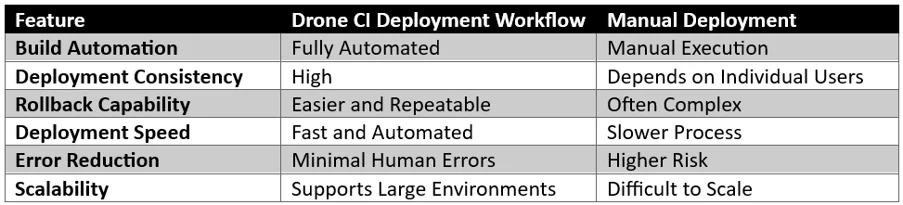
By replacing repetitive manual tasks with automated workflows, Drone CI improves deployment reliability and operational efficiency.
Conclusion
As Kubernetes adoption continues to grow, organizations need efficient tools to automate software delivery and reduce operational complexity. Drone CI provides a modern, container-native CI/CD platform that integrates seamlessly with Kubernetes and supports automated application deployment at scale.
For teams looking to streamline Kubernetes deployments while embracing DevOps best practices, Drone CI offers a lightweight, flexible, and highly scalable solution that aligns perfectly with modern application delivery requirements.
Drop a query if you have any questions regarding Drone CI, and we will get back to you quickly.
Empowering organizations to become ‘data driven’ enterprises with our Cloud experts.
- Reduced infrastructure costs
- Timely data-driven decisions
About CloudThat
FAQs
1. Can Drone CI deploy applications directly to Kubernetes?
ANS: – Yes. Drone CI can deploy applications directly to Kubernetes clusters using deployment manifests, Helm charts, or custom deployment scripts. It can automate the entire deployment process from code commit to production release.
2. Does Drone CI support cloud-managed Kubernetes services?
ANS: – Absolutely. Drone CI can integrate with managed Kubernetes platforms such as Amazon EKS, Azure AKS, and Google Kubernetes Engine (GKE), enabling organizations to automate deployments across cloud environments.
3. How does Drone CI improve deployment consistency?
ANS: – Since every pipeline step runs in containers and deployment workflows are defined as code, Drone CI ensures deployments are executed consistently across environments.


WRITTEN BY Akshay Acharya
Akshay Acharya works as a Research Associate at CloudThat. He possesses strong analytical thinking and problem-solving skills, knowledge of AWS cloud services, migration, infrastructure setup, and security, as well as the ability to quickly adopt new technologies and learn.


 PREV
PREV












Comments