

 Login
Login


 August 6, 2026
|
Voiced by Amazon Polly |
Introduction
Both paths pay well. Both have strong job markets. Both lead to senior roles. But they’re completely different careers targeting different personalities. Data engineers build pipelines. Operations engineers keep systems running. Data engineers are data-first, infrastructure-second. Operations engineers are infrastructure-first, everything-else-second. Data engineers make $140K+ but spend weekends on pipeline bugs. Operations engineers make $125K+ and have more predictable schedules. Choose based on what excites you, not what pays more. The path you love is the path you’ll excel at.
You’re an AWS Solutions Architect. Or a DevOps engineer. Or a systems administrator. You know your way around cloud infrastructure. And suddenly you realize something. You’re at a fork in the road.
One path goes deep into data. ETL pipelines. Data warehousing. Real-time streams. Building the infrastructure that turns raw data into business insights. The path is glamorous. People talk about it. Salaries are higher. And it’s incredibly technical.
The other path goes deep into operations. Infrastructure as code. CI/CD optimization. Cost management. Reliability engineering. Building systems that don’t break at 3 AM. The path is less visible. Fewer job postings mention it by name. But every company desperately needs people who can do it well.
Both are real. Both are valuable. Both lead to six-figure salaries. But here’s what nobody tells you: choosing the wrong path doesn’t just waste time. It wastes years of career momentum. You spend three years learning data engineering, then realize you hate pipelines and love infrastructure. Now you’re starting over.
That’s why this decision matters. If the data path is calling, Azure Data Engineering (DP-203) training puts you through scenario-based labs before you commit years to it. If it’s the ops path instead, DevOps Engineering on AWS or the AZ-400 track for Azure DevOps does the same thing, giving you a real taste of CI/CD pipelines, infrastructure as code, and reliability work before you find out three years in whether it’s actually for you.
Already in IT? Switch to Cloud & Earn 55% More
- Weekend Batches
- Dedicated Career Support
- Official AWS Labs
Path One: AWS Data Engineer
Data engineers build the plumbing that moves data. You design ETL pipelines. You choose between S3, Redshift, Glue, Lambda, Kinesis. You understand data lakes. You know when to batch and when to stream. You optimize for cost and speed. You’re constantly asking: how do we ingest this data, transform it, and make it usable for analysts?
The skills stack: Python or Scala. SQL deep knowledge. Understanding of data models. Lambda expertise. S3 proficiency. Glue jobs. Experience with Spark. Airflow or similar orchestration. Eventually, you’re building production data systems handling billions of records.
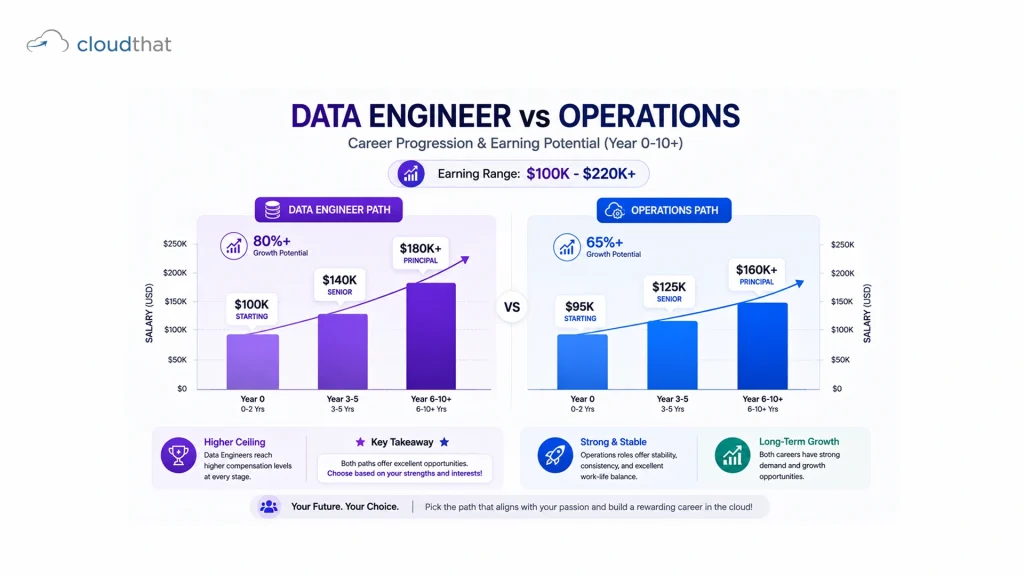
The salary: Starting $100K. Senior data engineer $140-180K. Principal $180K+.
The job market: Extremely strong. Tech companies, finance firms, healthcare systems, e-commerce. Everyone needs data engineers. LinkedIn has thousands of open roles.
The work-life balance: Depends on your company. Startups can be intense. Enterprises more predictable. But data pipelines failing at 11 PM on Saturday is not theoretical. You’ll own your deployments.
The growth ceiling: High. You can move into analytics leadership. Machine learning. Chief data officer. Or stay as an individual contributor making $200K+.
The catch: You need to love data. If you don’t care about how data flows through systems, you’ll hate this career.
Path Two: Cloud Operations Engineer
Operations engineers keep systems alive. You design for reliability, not features. You optimize costs. You build runbooks. You implement monitoring that actually works. You’re constantly asking: what breaks here? How do we prevent it? If it breaks anyway, how do we recover in seconds?
The skills stack: Infrastructure as code (Terraform, CloudFormation). Deep AWS knowledge across 15+ services. CI/CD pipelines. Monitoring and logging. Incident response. Automation scripting. Cost optimization. Security at every layer. You’re the person who can design an architecture that doesn’t wake you up at 3 AM.
The salary: Starting $95K. Senior operations engineer $125-160K. Principal $160-200K.
The job market: Strong but different from data engineering. Every company needs reliable infrastructure. But they don’t always advertise for “cloud operations engineer.” They advertise for “DevOps engineer” or “site reliability engineer” or “infrastructure engineer.”
The work-life balance: More predictable than data. Your systems are designed not to fail. When they do, you have runbooks. You’re still on-call sometimes. But incidents are fewer and response times faster.
The growth ceiling: High. You can move into infrastructure leadership. Platform engineering. Chief technology officer. Or stay as an individual contributor making $200K+.
The catch: You need to care about reliability obsessively. If you just want to build cool features, operations will feel like thankless maintenance.
Direct Comparison: Salary, Growth, Job Market
First-Year Salary: Operations $95K, Data Engineer $100K (data wins by 5%)
Senior Salary (5-7 years): Operations $125-160K, Data Engineer $140-180K (data wins by 10-15%)
Principal/Staff Salary (10+ years): Operations $160-200K, Data Engineer $180-220K (data wins by 10%)
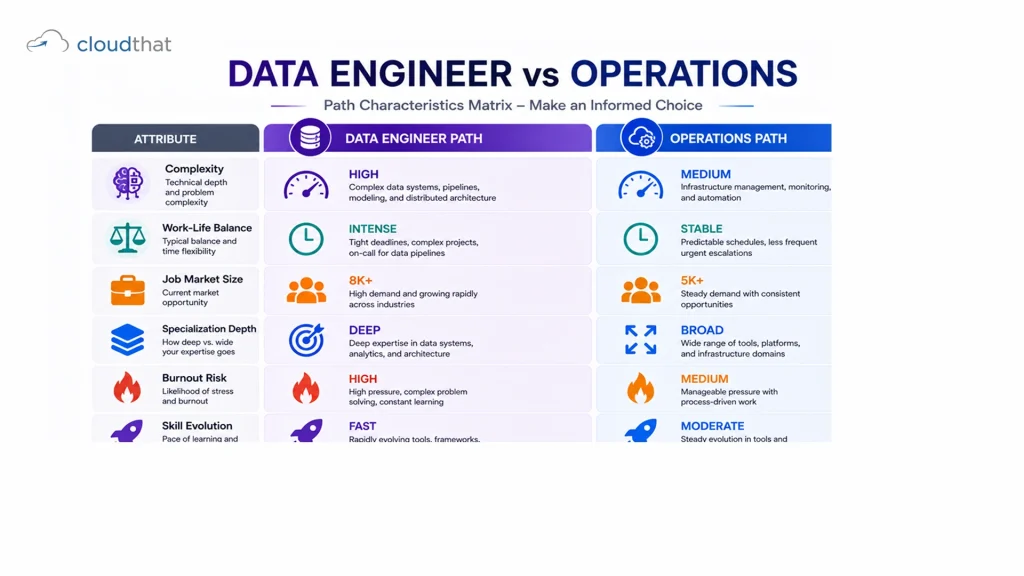
Job Openings: Data Engineer 8,000+, Operations 5,000+ (data engineer wins significantly)
Competition: Data Engineer high (everyone wants in), Operations medium (fewer applicants)
Career Mobility: Both high, but different directions. Data engineers move toward analytics and ML. Operations engineers move toward platform and architecture.
Seniority Speed: Data Engineer typically reaches senior in 4-5 years. Operations typically 5-7 years.
Specialization Depth: Data engineer becomes very specialized (specific to data). Operations engineer generalizes across infrastructure.
Burnout Risk: Data Engineer higher (complex problems, always-on data pipelines). Operations Engineer moderate (incident-driven).
Skill Shelf-Life: Data Engineer faster evolution (tools change yearly). Operations Engineer slower evolution (concepts stable).
The data engineer path is higher ceiling, faster growth, but more intense. Operations is more stable, slightly lower ceiling, but more predictable.
Decision Framework: Which Path Fits You
Ask yourself these questions honestly:
Do you love data or infrastructure? Not “both.” Which one makes you actually excited? Data engineers live for data quality and pipeline optimization. Operations engineers live for system reliability and efficiency.
What’s your tolerance for ambiguity? Data problems are often fuzzy. The data pipeline works, but is it the right architecture? Operations problems are clearer. Either the system is up or it’s down.
Do you want to be specialized or generalized? Data engineers go deep in one domain. Operations engineers stay broad across infrastructure.
What’s your lifestyle preference? Data-intensive for weekends debugging. Operations more 9-to-5 (until incidents).
Do you want to manage people or systems? Both paths lead to management. But data engineers typically manage data teams. Operations engineers typically manage infrastructure teams. Different people.
What excites you at a conference? Talks about machine learning and data pipelines? Or talks about scale, reliability, and incident response? Your choice there is your answer.
Why CloudThat Accelerates Your Specialization
Here’s the reality: you can’t learn both paths well at the same time. Trying to become a data engineer and operations engineer at the same time is like trying to learn two languages in half the time. You’ll be mediocre at both.
CloudThat forces you to choose and go deep. The AWS Data Engineer Mastery Track takes you from AWS fundamentals through data engineering specialization. You’re learning Glue, Redshift, Lambda pipelines, and data optimization. You’re building real systems.
For operations, the DevOps Mastery Pass and AWS-focused cloud operations programs teach you CI/CD, infrastructure automation, and cost optimization. You’re building systems that don’t break.
The difference: guided specialization versus wandering the internet trying to figure out which certifications matter. CloudThat’s instructors have built production systems in both domains. They tell you exactly what matters for your chosen path.
For teams needing both specializations, CloudThat’s corporate training customizes programs. You’re not learning generic skills. You’re learning to solve your company’s specific infrastructure and data challenges.
The ROI is real: six months of structured learning versus two years of self-study. Your salary increase pays for the training within the first raise.
Why CloudThat Is Your Career Path Accelerator
Choosing between data engineering and operations is just step one. Actually becoming great at your chosen path is where most people fail. They start learning, get confused by the breadth, realize there’s no clear path, and give up.
CloudThat removes that confusion by forcing the choice and providing the path. You decide: data or operations. Then you get a structured curriculum that takes you from foundations through senior-level expertise.
AWS Data Engineer certification programs teach you to build production data systems on AWS. You’re learning from instructors who’ve built real pipelines at scale. The curriculum isn’t theoretical. It’s “here’s what you need to build in actual production.”
DevOps and cloud operations training teaches you to build infrastructure that scales reliably. You’re learning from instructors who’ve responded to 3 AM production incidents. The curriculum is “here’s how to prevent the emergencies that happen to everyone.”
For teams building both capabilities, CloudThat’s corporate programs ensure everyone’s learning the right specialization, not wasting time on adjacent skills.
The real value: you’re not choosing alone. You’re choosing with guidance from people who’ve made the choice themselves. That confidence compounds when you know your decision is right.
Conclusion
You’re at a fork. Data or operations. Both lead to great careers. Neither is objectively better. But one is better for you.
Spend time on the decision framework. Imagine yourself five years in each career. Which one excites you? Which one sounds like something you’d do even without the paycheck? Your answer there is your answer.
Then commit. Learn deeply. Become excellent. In either path, excellence pays extremely well.
Ready to choose and commit? Start with CloudThat’s comprehensive AWS certification and specialization programs where you’ll get clear guidance on your chosen path, structured learning, and actual production experience. Three months in, you’ll know you chose correctly.
Key Takeaways
- Both paths lead to senior roles and six-figure salaries. The difference isn’t money, but what excites you.
- Data engineers build systems that turn data into insights. They’re paid more, but the problems are complex, and on-call can be brutal.
- Operations engineers build systems that stay reliable. They’re paid slightly less, but sleep better knowing systems are optimized.
- The job market is stronger for data engineers. But operations has less competition, making advancement sometimes faster.
- Career mobility differs. Data engineers move toward analytics and ML. Operations engineers move toward platform engineering.
- Specialization is crucial. Trying to learn both simultaneously hurts both. Choose, then go deep.
- Your personality matters more than salary. Love data more than you love reliability? Data engineering. Love reliability more? Operations.
- Skills are not interchangeable. A data engineer learning operations starts near-scratch. Choose your path early.
- Getting certified accelerates your career either way. But certification in the wrong path wastes time. Choose wisely.
- First-year salary favors data engineers slightly. Long-term growth similar. The difference is in the journey, not the destination.
- The right path is the one you’ll stay passionate about for five years. That’s the one to choose.
No Job After Graduation? Cloud Engineering is Your Answer
- Beginner Friendly
- 92% Placement Rate
- Live Instructor-Led
About CloudThat
FAQs
1. Can I start in operations and move to data engineering later?
ANS: – Yes, but it’s generally more challenging than choosing the data engineering path from the beginning. Many operations skills don’t directly translate to data engineering, so you’ll need to learn several new concepts and tools. Moving from data engineering to operations is often a bit easier because of the broader technical foundation.
2. Do I need AWS certifications for either path?
ANS: – No. Certifications aren’t mandatory, but they can strengthen your resume and improve your chances of getting interviews. AWS certifications are especially valuable if you’re targeting cloud-focused data engineering or operations roles.
3. Which path is easier to learn?
ANS: – It depends on your interests and strengths. Operations focuses on maintaining systems, monitoring, and reliability, while data engineering involves building data pipelines and working with evolving tools and technologies. If you enjoy analytical problem-solving and data, data engineering may feel more natural. If you prefer infrastructure and systems, operations might be the better fit.
4. Which path has better remote work opportunities?
ANS: – Both offer strong remote work opportunities. Data engineering and operations engineering are commonly available as fully remote roles, making remote work a strength of both career paths.
5. Can I do both certifications and split my career?
ANS: – You can, but it’s usually better to build deep expertise in one area first. Once you’ve established yourself, it’s much easier to expand into related domains than to divide your focus too early.
6.
ANS: –

WRITTEN BY Himisha Raval
Himisha Raval is a Digital Marketing Manager at CloudThat with a strong command of search engine optimization, web analytics, link building, and content strategy. She brings a data-driven approach to digital marketing, helping IT companies strengthen their online presence, improve search rankings, and generate consistent leads across channels. Beyond execution, she plays an active role in ideation, campaign strategy, and website performance optimization. Outside of work, she balances her analytical side with a love for travel, nature painting, and dancing.


 PREV
PREV








Comments