

 Login
Login


 August 24, 2026
|
Voiced by Amazon Polly |
Introduction
The global energy industry is undergoing a major transformation as organizations seek practical ways to reduce carbon emissions and transition to lower-carbon energy sources. Biofuels are emerging as an important part of this transition, but scaling sustainable biofuel production introduces significant operational and regulatory challenges.
From tracking feedstock origins and sustainability certifications to managing production, transportation, and compliance, biofuel supply chains generate large volumes of data across multiple systems and locations.
AWS provides cloud technologies that can help energy companies turn this fragmented data into actionable intelligence, improving visibility, efficiency, and sustainability across the supply chain.
Pioneers in Cloud Consulting & Migration Services
- Reduced infrastructural costs
- Accelerated application deployment
The Challenge of Sustainable Biofuel Supply Chains
Sustainable biofuel operations must balance operational efficiency with strict sustainability and regulatory requirements.
Organizations need to:
- Track the origin and sustainability of feedstocks
- Manage certifications and regulatory requirements
- Monitor production, transportation, and blending
- Optimize logistics and reduce operational costs
- Maintain accurate sustainability and compliance records
This information can come from laboratories, production facilities, transportation systems, storage locations, and certification organizations. When data is distributed across disconnected systems, gaining a unified view of the supply chain becomes difficult.
A cloud-based data architecture can help bring these sources together and make the information available for analytics, automation, and machine learning.
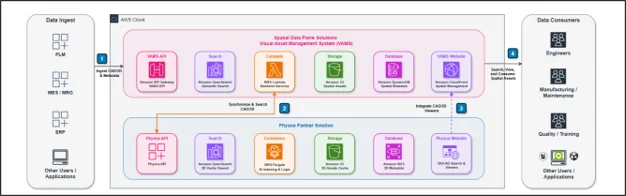
Figure 1: Solution architecture for Physna and VAMS on AWS. CAD models and component data flow from enterprise sources into VAMS, sync to Physna’s geometric AI models for analysis, and return to engineering and procurement workflows. VAMS also embeds the Physna viewer so engineers can inspect native CAD files directly in the browser.
Building a Data-Driven Biofuel Supply Chain with AWS
An AWS-based architecture can provide a scalable foundation for managing structured and unstructured supply chain data.
Data lakes can centralize information such as operational metrics, certification documents, production records, shipment data, and sensor information. Data integration and transformation pipelines can then standardize information from different sources, improving data quality and enabling reliable analytics.
This foundation allows organizations to move from fragmented data toward a connected view of their operations.
Using AI and Machine Learning for Optimization
Once supply chain data is centralized, machine learning can help organizations identify patterns, forecast demand, and optimize operations.
For example, predictive analytics can support:
- Demand forecasting: Historical production, inventory, and shipment information can help organizations anticipate demand and improve production planning.
- Production optimization: Machine learning can analyze production trends to identify opportunities to improve processes, resource utilization, and fuel yield.
- Logistics optimization: Analytics can help evaluate transportation routes, inventory levels, and shipment schedules to improve delivery efficiency and reduce unnecessary costs.
- Predictive planning: Organizations can use data-driven insights to identify potential supply chain disruptions and prepare proactive responses.
These capabilities can help transform supply chain data from a reporting resource into a decision-making tool.
Automating Document Processing and Compliance
Biofuel operations depend heavily on documentation, including sustainability certificates, shipping records, and compliance reports.
Manually reviewing and extracting information from these documents can consume significant time as operations scale.
Intelligent document processing can automate information extraction and make relevant data available for compliance workflows, reporting, auditing, and operational analysis.
This can reduce manual effort while helping organizations process compliance information more efficiently.
Improving Traceability and Sustainability
Traceability is critical for sustainable biofuel production.
Organizations need visibility into the movement of feedstocks from their origin through processing, storage, transportation, and distribution.
A connected cloud architecture can help establish this visibility by linking information across different stages of the supply chain.
For example:
Feedstock origin → Processing → Production → Storage → Transportation → Distribution
This connected view can help organizations verify sustainability requirements, improve transparency, and simplify sustainability reporting.
From Data to Real-Time Insights
Dashboards and monitoring capabilities can provide stakeholders with visibility into important operational metrics, including:
- Production volumes
- Shipment status
- Inventory levels
- Logistics performance
- Compliance metrics
- Sustainability information
Instead of manually collecting information from multiple systems, managers can use centralized insights to identify bottlenecks and respond more quickly to operational issues.
Key Benefits
An AWS-enabled biofuel supply chain can help organizations achieve:
- Improved supply chain visibility
- Faster compliance and sustainability reporting
- Better demand forecasting
- Reduced operational costs
- Enhanced sustainability tracking
- More informed operational decision-making
These capabilities can help energy companies scale renewable fuel operations while maintaining operational efficiency and regulatory transparency.
Building a Scalable Foundation for Sustainable Fuels
Digital transformation also requires careful attention to data quality, legacy-system integration, security, compliance, and team enablement.
Organizations need reliable data pipelines and secure cloud architectures that can scale as production and data volumes increase. Integrating existing systems with cloud technologies is equally important for enabling transformation without disrupting ongoing operations.
The transition to sustainable fuels is not only an environmental challenge. It is also a data and operational challenge.
By combining data integration, scalable storage, analytics, machine learning, automation, and monitoring, AWS can help energy companies build more connected and intelligent biofuel supply chains.
As the energy sector continues moving toward lower-carbon solutions, data-driven technologies can play an important role in creating supply chains that are more efficient, transparent, and resilient.
Drop a query if you have any questions regarding Sustainable Fuels, and we will get back to you quickly.
Empowering organizations to become ‘data driven’ enterprises with our Cloud experts.
- Reduced infrastructure costs
- Timely data-driven decisions
About CloudThat
FAQs
1. How can AWS help optimize biofuel supply chains?
ANS: – AWS can help organizations centralize supply chain data and apply analytics and machine learning for demand forecasting, production planning, logistics optimization, compliance, and sustainability tracking.
2. How does AI support sustainable biofuel operations?
ANS: – AI and machine learning can analyze production and supply chain data to forecast demand, optimize logistics, identify operational patterns, and support more efficient decision-making.


WRITTEN BY Utsav Pareek
Utsav works as a Research Associate at CloudThat, focusing on exploring and implementing solutions using AWS cloud technologies. He is passionate about learning and working with cloud infrastructure and services such as Amazon EC2, Amazon S3, AWS Lambda, and AWS IAM. Utsav is enthusiastic about building scalable and secure architectures in the cloud and continuously expands his knowledge in serverless computing and automation. In his free time, he enjoys staying updated with emerging trends in cloud computing and experimenting with new tools and services on AWS.


 PREV
PREV












Comments