

 Login
Login


 February 12, 2026
|
Voiced by Amazon Polly |
Introduction
Modern applications are no longer confined to on-premises servers or single-deployment environments. With the rapid adoption of cloud computing, organizations are increasingly moving toward cloud-native architectures that emphasize scalability, resilience, and automation. Spring Boot microservices deployed on AWS and Kubernetes are among the most powerful and widely adopted approaches for building such systems.
Spring Boot simplifies Java application development, while AWS provides a robust cloud infrastructure, and Kubernetes offers container orchestration at scale. Together, they enable organizations to design highly available, fault-tolerant, and scalable microservice architectures that efficiently handle real-world production workloads.
In this blog, we will explore how Spring Boot microservices integrate with AWS services and Kubernetes, discuss key architectural components, deployment strategies, benefits, challenges, and best practices for building enterprise-grade cloud-native systems.
Pioneers in Cloud Consulting & Migration Services
- Reduced infrastructural costs
- Accelerated application deployment
Understanding Spring Boot Microservices in a Cloud-Native Context
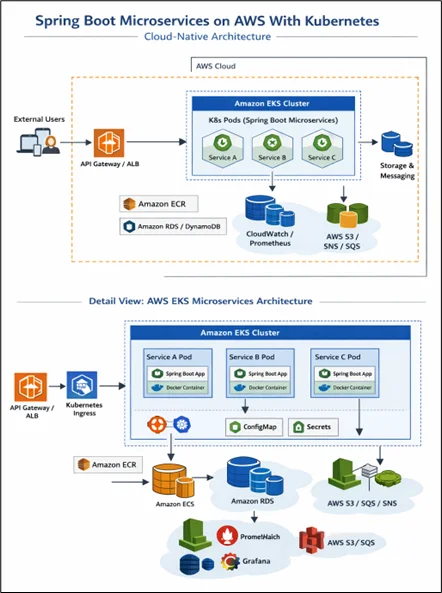
In a cloud-native microservices architecture, each Spring Boot application runs as an independent service, packaged as a container (typically Docker) and deployed to Kubernetes clusters. These services communicate via REST APIs or event-driven messaging systems and are dynamically managed by Kubernetes.
Key cloud-native principles include:
- Containerization
- Dynamic orchestration
- Infrastructure as code
- Automated scaling and self-healing
Spring Boot aligns naturally with these principles, making it an ideal framework for microservices on AWS and Kubernetes.
Role of AWS in Spring Boot Microservices Architecture
AWS provides the foundational infrastructure and managed services required to run microservices at scale.
- Compute and Container Services
- Amazon EC2: Used for running Kubernetes worker nodes.
- Amazon EKS (Elastic Kubernetes Service): A fully managed Kubernetes service that simplifies cluster management.
- AWS Fargate: Enables serverless container execution without managing Amazon EC2 instances.
Spring Boot microservices are typically packaged into Docker images and deployed to Amazon EKS clusters for orchestration.
- Container Registry
- Amazon ECR (Elastic Container Registry) stores Docker images securely and integrates seamlessly with Amazon EKS.
Each Spring Boot microservice has its own Docker image, versioned and stored in Amazon ECR, enabling consistent, repeatable deployments.
- Networking and Load Balancing
- Application Load Balancer (ALB) routes external traffic to Kubernetes services.
- AWS VPC provides network isolation and security.
- Ingress Controllers manage external access to Kubernetes services.
This setup ensures secure and efficient traffic flow between users and microservices.
Kubernetes as the Orchestration Layer
Kubernetes plays a central role in managing Spring Boot microservices.
- Pods and Deployments
Each Spring Boot microservice runs inside a Pod, managed by a Deployment. Kubernetes ensures:
- Desired number of replicas is running
- Automatic restarts in case of failures
- Rolling updates with zero downtime
- Service Discovery and Networking
Kubernetes provides built-in service discovery using:
- ClusterIP services
- DNS-based service resolution
This eliminates the need for external service discovery tools such as Eureka in many Kubernetes-based setups.
- Auto Scaling
- Horizontal Pod Autoscaler (HPA) automatically scales microservices based on CPU, memory, or custom metrics.
- Amazon CloudWatch metrics can be integrated for advanced scaling strategies.
This ensures optimal resource utilization during traffic spikes.
Configuration and Secrets Management
Securely managing configuration is critical in distributed systems.
- ConfigMaps store non-sensitive configuration.
- Secrets store sensitive data, such as database credentials.
- AWS Systems Manager Parameter Store or AWS Secrets Manager can be integrated for enhanced security.
Spring Boot supports externalized configuration, allowing services to adapt to different environments without code changes.
Data Management and Persistence
In AWS-based microservices:
- Each Spring Boot service owns its database (database-per-service pattern).
- Common database services include:
- Amazon RDS
- Amazon DynamoDB
- Amazon Aurora
This approach improves fault isolation and scalability while avoiding tight coupling between services.
Observability: Monitoring and Logging
Observability is crucial for production microservices.
Monitoring
- Amazon CloudWatch for logs and metrics
- Prometheus and Grafana for Kubernetes-native monitoring
Logging
- Centralized logging using:
- Amazon CloudWatch Logs
- ELK Stack (Elasticsearch, Logstash, Kibana)
Spring Boot Actuator provides health checks and metrics endpoints that integrate seamlessly with monitoring tools.
Security in AWS & Kubernetes Microservices
Security must be enforced at multiple layers:
- AWS IAM Roles for Service Accounts (IRSA) to securely grant AWS permissions to microservices
- Network Policies to restrict inter-service communication
- TLS encryption for data in transit
- Amazon API Gateway or ALB authentication
Spring Security is commonly used to secure REST APIs within Spring Boot services.
CI/CD and Deployment Automation
A typical CI/CD pipeline includes:
- Code commit to the Git repository
- Build and test a Spring Boot application
- Create Docker image
- Push image to Amazon ECR
- Deploy to Amazon EKS using Helm or Kubernetes manifests
Tools commonly used:
- GitHub Actions
- Jenkins
- AWS CodePipeline
Automation ensures faster and more reliable releases.
Conclusion
Spring Boot microservices deployed on AWS and Kubernetes represent a mature, scalable, and production-ready architecture for modern applications. Spring Boot simplifies service development, AWS provides reliable cloud infrastructure, and Kubernetes ensures efficient orchestration, scaling, and resilience.
Drop a query if you have any questions regarding Spring Boot microservices and we will get back to you quickly.
Empowering organizations to become ‘data driven’ enterprises with our Cloud experts.
- Reduced infrastructure costs
- Timely data-driven decisions
About CloudThat
FAQs
1. Why use Kubernetes instead of traditional VM-based deployment for Spring Boot microservices?
ANS: – Kubernetes provides automated scaling, self-healing, rolling deployments, and service discovery, which are difficult to achieve efficiently with traditional VM-based deployments.
2. Is Spring Cloud still needed when using Kubernetes on AWS?
ANS: – In many cases, Kubernetes-native features can replace components like Eureka or Config Server. However, Spring Cloud can still be useful for advanced resilience, configuration patterns, and hybrid deployments.
3. Can Spring Boot microservices run serverlessly on AWS?
ANS: – Yes, Spring Boot microservices can run using AWS Fargate with Amazon EKS, eliminating the need to manage Amazon EC2 instances while still benefiting from Kubernetes orchestration.


WRITTEN BY Guru Bhajan Singh
Guru Bhajan Singh is currently working as a Software Engineer - PHP at CloudThat and has 7+ years of experience in PHP. He holds a Master's degree in Computer Applications and enjoys coding, problem-solving, learning new things, and writing technical blogs.


 PREV
PREV











Comments