

 Login
Login

 July 29, 2026
|
Voiced by Amazon Polly |
Introduction
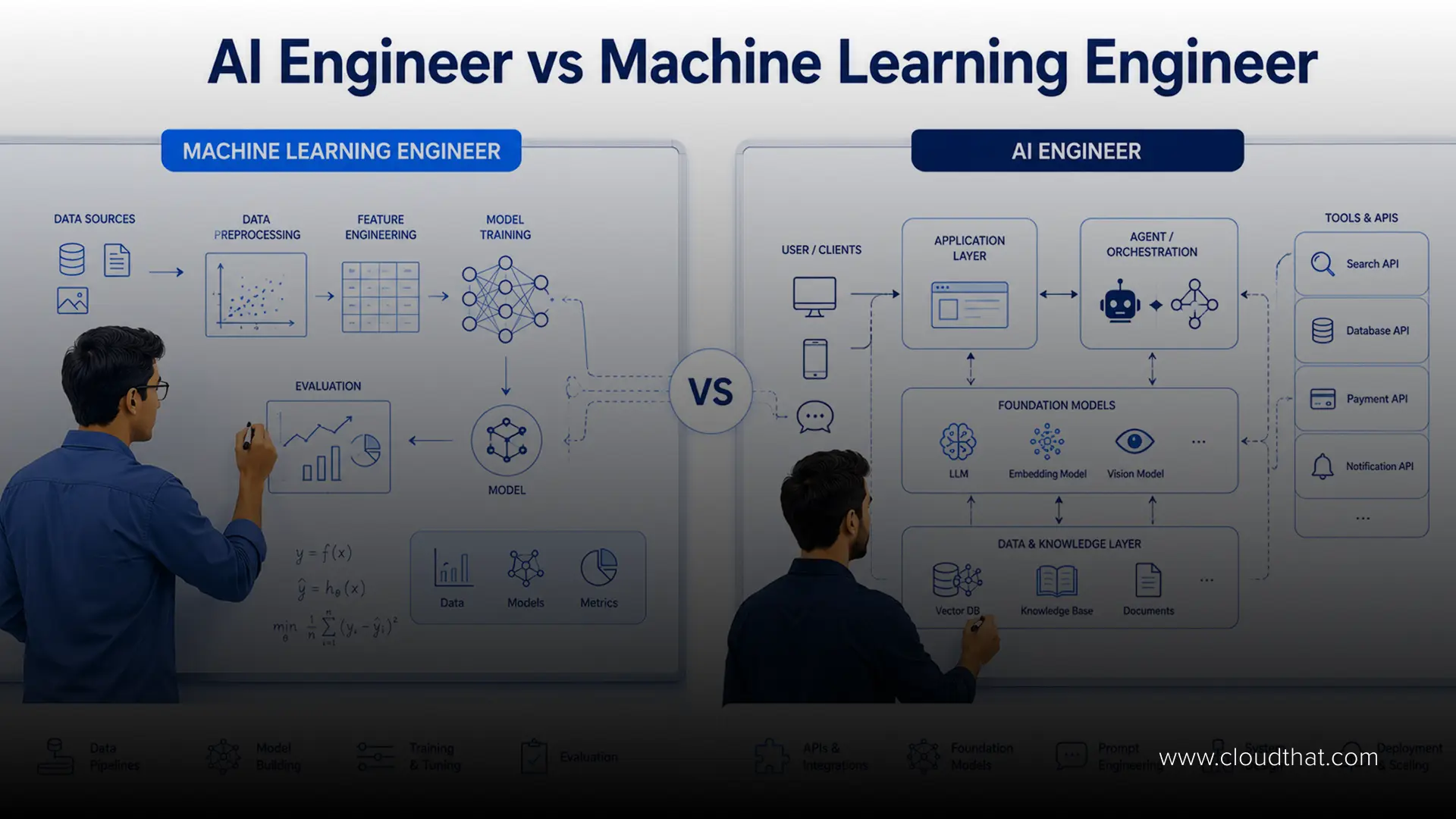
An AI Engineer and a Machine Learning Engineer are not the same thing, even though people use the terms interchangeably. An AI Engineer builds broader intelligent systems, including LLMs, agents, and production applications. A Machine Learning Engineer specializes in training models from data, handling features, pipelines, and optimization. ML Engineer roles are more established with higher salaries in many markets. AI Engineer roles are growing faster and offer frontier-level compensation. The career path you pick depends on whether you want to build from data (ML) or build with pre-trained models (AI). Both are learnable. Both are in demand. The right online course clarifies which one matches your strengths.
You’re sitting across from a hiring manager. They say, “We’re looking for a Machine Learning Engineer,” then two minutes later, “Actually, we also need an AI Engineer.” You nod like you understand. You don’t.
Later that week, you see a job posting for “Machine Learning Engineer” paying 18 LPA. The next day, another posting for “AI Engineer” pays 24 LPA. Same company. Different titles. Different expectations. Different skills.
This is the source of confusion that keeps people stuck in their career decisions. They don’t know which path to pick because they don’t know what the difference actually is.
Let’s clear it up. Not with corporate definitions that sound like they were written by the same person. But with what these roles actually do, day-to-day, in production systems.
Launch Your AI Career with AWS GenAI Training
- Interview Guarantee
- Up to 75% Money Back
- Real-World Learning
What’s the Actual Difference Between These Roles?
Here’s the clearest way to think about it.
A Machine Learning Engineer builds systems that learn from data. They collect datasets, engineer features (raw data into useful signals), train models, tune hyperparameters, evaluate performance, and deploy pipelines that improve over time as new data arrives. They answer questions like: “How do we predict customer churn?” or “Can we classify this image as fraud?” The model improves itself through exposure to more data.
An AI Engineer builds intelligent systems, often using foundation models that already know a lot. They design architectures, integrate APIs, build RAG systems, create agents, and solve complex application-level problems. They answer questions like: “How do we build a chatbot that understands our company’s data?” or “How do we make an autonomous system that can reason through multi-step tasks?” The intelligence comes from pre-trained models, and the engineering challenge is building the right system around them.
Different problems. Different skill sets. Different career trajectories.
Here’s what complicates things: The terms overlap. A good AI Engineer needs some ML knowledge. A sophisticated ML Engineer needs to understand LLMs. But the day-to-day work, the mindset, the problems they solve, they’re distinct enough that one path doesn’t lead naturally to the other.
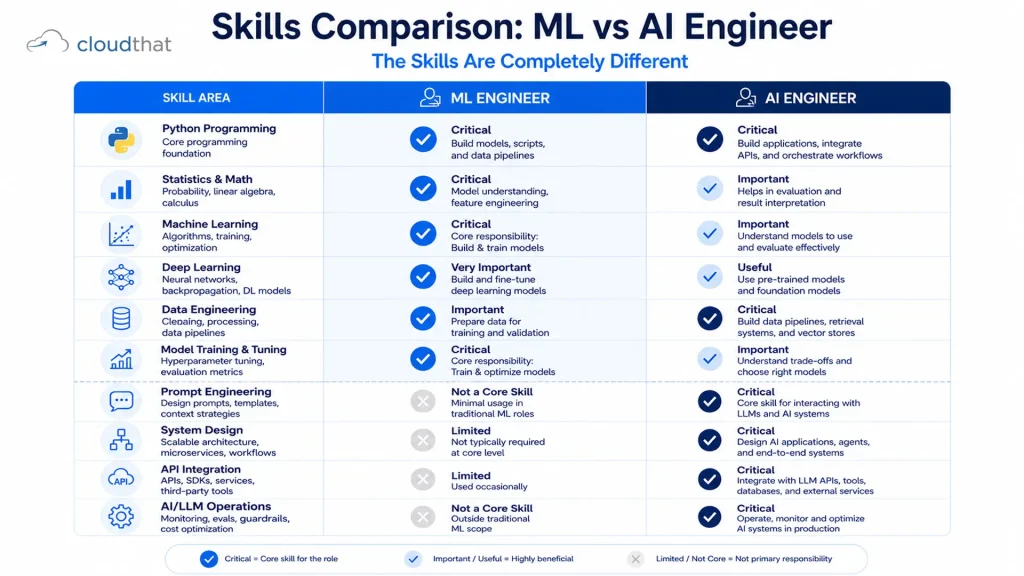
The Skills Are Completely Different
Let’s be specific about what you actually learn in each role.
Machine Learning Engineer
Data preparation: Feature engineering, data pipelines (ETL), handling missing values, imbalanced datasets, and data drift.
Mathematics & statistics: Probability, linear algebra, calculus, and optimization.
Model development: Model selection, training, and hyperparameter tuning.
Model evaluation: Precision, recall, F1 score, AUC, and other performance metrics beyond accuracy.
MLOps: Model and data versioning, experiment tracking, and reproducible workflows.
AI Engineer
Working with foundation models: Prompt engineering, few-shot learning, and API integration.
Building intelligent systems: Retrieval-Augmented Generation (RAG), AI agents, tool calling, and multi-step workflows.
Production deployment: Deploying, monitoring, and maintaining AI applications.
Performance optimization: Cost optimization, latency, and throughput.
System integration: Connecting AI models with databases, search systems, and external services.
The overlap? Both need Python. Both need to understand how models work conceptually. Both need deployment skills. But the depth and focus are completely different. An ML Engineer can spend a week tuning a single model. An AI Engineer is building a system that uses a pre-trained model in five different places.
The Job Market Reality Check
Here’s what you need to know about hiring demand.
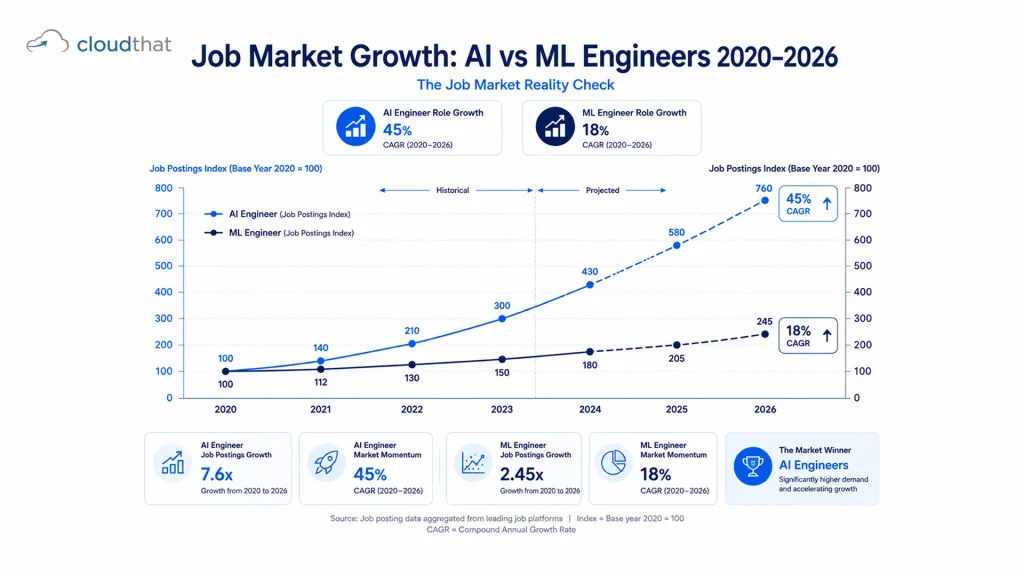
Machine Learning Engineer roles have been around longer. Companies have ML teams that need people who can build models from scratch. If you want to work at a financial services firm predicting market movements, or a fraud detection company building detection models, or a healthcare company diagnosing diseases from images, you need ML Engineers.
AI Engineer roles are the new frontier. Every company that moved fast during the GenAI wave realized it needed people who could build applications with foundation models. These roles are growing faster, attracting more venture capital, and creating new companies. Want to build an AI-powered SaaS product? That’s AI Engineer work. Want to create a customer service AI that handles your company’s specific workflows? AI Engineer. Want to build an autonomous system that takes actions? AI Engineer.
Job posting volume on LinkedIn shows that AI Engineer roles are growing 45% year-over-year. Machine Learning Engineer roles are growing at 18%. That’s not because ML is going away. It’s because AI and foundation models opened up a whole new category of things you can build without months of data collection and model training.
Geographically, there’s also a difference. India’s tech talent market is heavy with demand for ML engineers (banks, insurance, and fintech need models). But the global market is increasingly AI-heavy because every startup in the US and Europe is trying to build with LLMs.
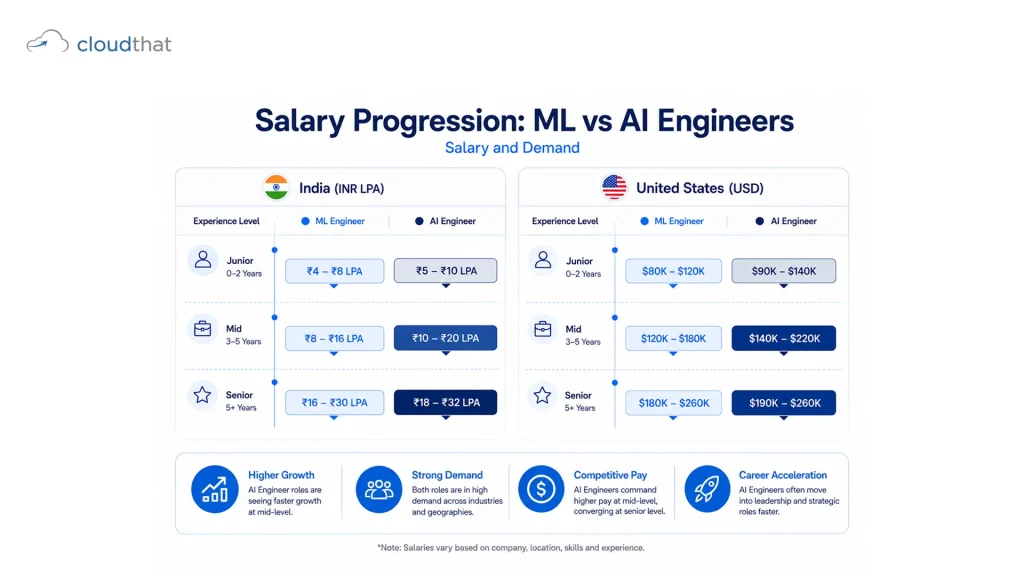
Salary and Demand: Where the Money Actually Is
Let’s talk numbers, because this is often what people care about.
In India, a junior Machine Learning Engineer starts around 10-14 LPA. Mid-level (2-5 years) reaches 16-22 LPA. Senior roles (5+ years) reach 25-35 LPA. The salary growth is steady but predictable.
An AI Engineer, especially one with prompt engineering and GenAI skills, starts at a higher level. Junior roles are 14-18 LPA. Mid-level (especially if you have Bedrock or LangChain experience) reaches 20-28 LPA. Senior AI Engineers in the US are commanding $200K-$300K+.
Why the difference? Supply and demand. ML Engineer is an established role with an established talent pool. AI Engineer is new enough that skilled people are still scarce. Foundation model companies are well-funded, so they can afford to pay more.
In the US market, the difference is even more dramatic. A mid-level ML Engineer averages $120K-$160K. An AI Engineer with GenAI expertise averages $160K-$220K. That’s not a small gap.
But here’s the thing: salary follows demand, and demand follows feasibility. A year ago, there were hundreds of ML Engineer jobs for every qualified candidate. Now, there are dozens of AI Engineer jobs for every person who actually knows how to build with foundation models.
Salary data from Levels.fyi clearly show these differences across companies and roles.
Which Path Fits Your Strengths?
This is the question that actually matters for your career.
Pick Machine Learning Engineer if: You enjoy mathematics and statistics. You’re comfortable spending weeks optimizing a model. You like working with data and finding patterns. You want a more established career path with clear progression. You’re interested in understanding how models learn in a fundamental way. You like working in teams where you’re the specialist in a specific ML problem.
Pick AI Engineer if you prefer building products over models. You’re excited about connecting systems together. You like working at a higher level of abstraction (using pre-trained models instead of training from scratch). You want to move faster and see results in weeks, not months. You’re interested in prompt engineering and autonomous systems. You want a frontier-level career with high upside. You like working on multiple problems quickly rather than deep-diving into one.
Here’s what’s honest: If you’re starting from zero, the path to AI Engineer is faster. You can learn the fundamentals, get proficient with Bedrock or OpenAI APIs, build projects with RAG and agents, and land a junior role in 4-6 months. An ML Engineer typically takes 6-12 months to become hireable because the foundational math and statistics take longer to build.
But if you have a background in mathematics or have spent time in data science, moving to an ML Engineer role is a natural next step. The skills transfer directly.
How CloudThat Trains for Both Paths
Here’s where the career decision becomes actionable.
CloudThat is an AWS Premier Tier Training Partner with actual production experience in both paths. The trainers aren’t people who learned from courses. They’re engineers who built production systems, made them work, and maintained them at scale.
For Machine Learning Engineer paths, CloudThat’s AWS Mastery Pass covers the ML specializations, plus hands-on labs where you build real ML pipelines, train models on actual datasets, and deploy them to production. The courses are structured so you’re working in live AWS environments, not simulations. You’re using SageMaker, understanding data preprocessing, and building models that work.
For AI Engineer paths, CloudThat’s GenAI-focused training programs and their GenAI Innovation Center cover prompt engineering, Bedrock integration, RAG architecture, and autonomous agents. The labs are project-based. You build a RAG system from scratch. You create an agent that can take actions. You deploy it on AWS. You see it work. You understand what breaks and how to fix it.
The Capability Development Framework ensures that, whether you choose ML or AI, you’re learning through hands-on work on real problems, not just watching someone else code. Pre-training skill assessments make sure you’re not wasting time on fundamentals you already know. Post-training support extends beyond the course, as learning doesn’t stop when it ends.
If you’re unsure which path fits, take the assessment labs first. Build a small ML model. Build a small AI application with Bedrock. See which one energizes you. That’s your signal.
Conclusion
You don’t have to choose between being an AI Engineer and a Machine Learning Engineer based on guesswork. You choose based on what energizes you, what matches your strengths, and what the market is actually hiring for right now.
If you want to build models that learn from data, optimize performance, and handle complex statistical problems, you’re an ML Engineer. If you want to build applications that use intelligence to solve business problems, integrate systems, and move fast, you’re an AI Engineer.
The good news? You can change course. But the earlier you pick the right path, the faster you accelerate. Start with an online machine learning engineer course or an AI/GenAI training program that uses real AWS environments and real projects. See which one clicks. Then go deep.
The market is hiring for both. The only wrong choice is staying confused.
Key Takeaways
- Machine Learning Engineers build systems that learn from data through training cycles and continuous improvement.
- AI Engineers build intelligent applications using pre-trained foundation models without retraining them from scratch.
- ML Engineers need a strong background in statistics and mathematics. AI Engineers need strong software architecture and system design.
- AI Engineer roles are growing 45% year-over-year, while ML Engineer roles are growing 18%, though ML is more established.
- In India, ML Engineer salaries range from 10-35 LPA depending on level. AI Engineers with GenAI skills command 14-28+ LPA.
- In the US, AI Engineers with foundation model expertise earn $160K-$220K, versus $120K-$160K for mid-level ML Engineers.
- The career path you pick should depend on whether you prefer optimizing models (ML) or building products (AI).
- An AI Engineer career path is faster to execute if you’re starting from zero, typically 4-6 months to hireable.
- An ML Engineer path requires a stronger mathematical foundation but offers a more stable, established career trajectory.
- Both paths are in high demand, but AI Engineer roles are growing significantly faster in the market right now.
- The right hands-on online training program matters more than the degree in both paths.
Become an AI Engineer with AWS GenAI Training
- Mock Interviews
- AWS Expert Trainers
- Career Support
About CloudThat
FAQs
1. Can I be both an ML Engineer and an AI Engineer?
ANS: – Absolutely. In fact, at senior levels, engineers often work on both. But starting out, it’s easier to pick one, get really good at it, then expand. Most people who go ML-first add AI skills later. Most AI-first engineers eventually understand ML enough to contribute meaningfully.
2. Is Machine Learning Engineering dying because of foundation models?
ANS: – No. Foundation models are for applications. The models themselves are trained and maintained by specialized ML Engineers at companies like Anthropic, Meta, and Google. If you want to work on the models themselves (not just applications), you need ML expertise.
3. Which path has better job security?
ANS: – ML Engineer roles are more established and therefore more stable. AI Engineer is growing faster, so there are more opportunities, but the roles are less defined. If job stability matters more than growth potential, ML. If growth potential matters more, AI.
4. What's a realistic timeline to become hireable in each path?
ANS: – ML Engineer: 6-12 months if you start from zero. 3-4 months if you have a quantitative background. AI Engineer: 4-6 months if you have software engineering experience. 6-9 months if you’re starting fresh.
5. Do I need a computer science degree for either path?
ANS: – No. Both roles hire based on demonstrated skills and portfolio projects. An online machine learning engineering course with real labs matters more than a degree.
6. Which pays better long-term?
ANS: – At mid-level, AI Engineer salaries are trending higher due to the role’s frontier nature. But at senior level and above, specialized ML Engineers at research companies or building core platforms command extremely high compensation. It’s not a clear answer.
7. Can I learn both simultaneously?
ANS: – You can, but it’s not efficient. Both require deep focus to get good. Learn one to a hireable level, then expand.

WRITTEN BY Himisha Raval
Himisha Raval is a Digital Marketing Manager at CloudThat with a strong command of search engine optimization, web analytics, link building, and content strategy. She brings a data-driven approach to digital marketing, helping IT companies strengthen their online presence, improve search rankings, and generate consistent leads across channels. Beyond execution, she plays an active role in ideation, campaign strategy, and website performance optimization. Outside of work, she balances her analytical side with a love for travel, nature painting, and dancing.


 PREV
PREV











Comments