

 Login
Login


 September 24, 2026
|
Voiced by Amazon Polly |
Introduction
The most prominent limitation of generative AI is that it can only process what is in its training dataset. Inquire anything recent from it, and you will receive nothing but either speculative or hesitating replies or even a misleading response with full confidence.
The concept of Retrieval-Augmented Generation (RAG) was developed specifically to address this problem by incorporating external sources. This process is rather difficult to perform without help, as it involves linking to a search engine, securing an API key, performing authentication, and keeping it all up to date.
However, AWS has addressed this issue as well. The general availability of the Web Search on Amazon Bedrock was launched in August 2026.
Ready to lead the future? Start your AI/ML journey today!
- In- depth knowledge and skill training
- Hands on labs
- Industry use cases
What Is Web Search on Amazon Bedrock?
This feature allows certain OpenAI GPT models running on Bedrock to perform real-time web searches while generating responses, rather than relying solely on their trained data. Developers use this feature by adding the web search option to an OpenAI Responses API request, allowing the GPT model to decide when to perform a search.
At present, this feature is supported by GPT 5.4, GPT 5.5, and the GPT 5.6 range (Sol, Terra, Luna). It is important to note that it is only supported as a server-side tool using the mantle endpoint and Responses API in Bedrock.
How Bedrock Web Search Works
More than just submitting a query to a search engine, AWS uses its own continuously updated index of tens of billions of web documents, along with its knowledge graph, which contains structured relationships among entities. Rather than whole pages, it uses semantic snippet extraction to deliver the relevant context. The citations appear as URLs linked to claims.
The process looks like this:
- The application submits a query to the foundation model.
- The model determines whether any external information is required.
- If yes, it calls Web Search using its index and knowledge graph.
- The observations (the title, URL, and snippet) are returned.
- The model makes reasoning based on those observations.
- It creates a response with citations.
Because retrieval occurs on the server side, developers don’t have to build their own search system.
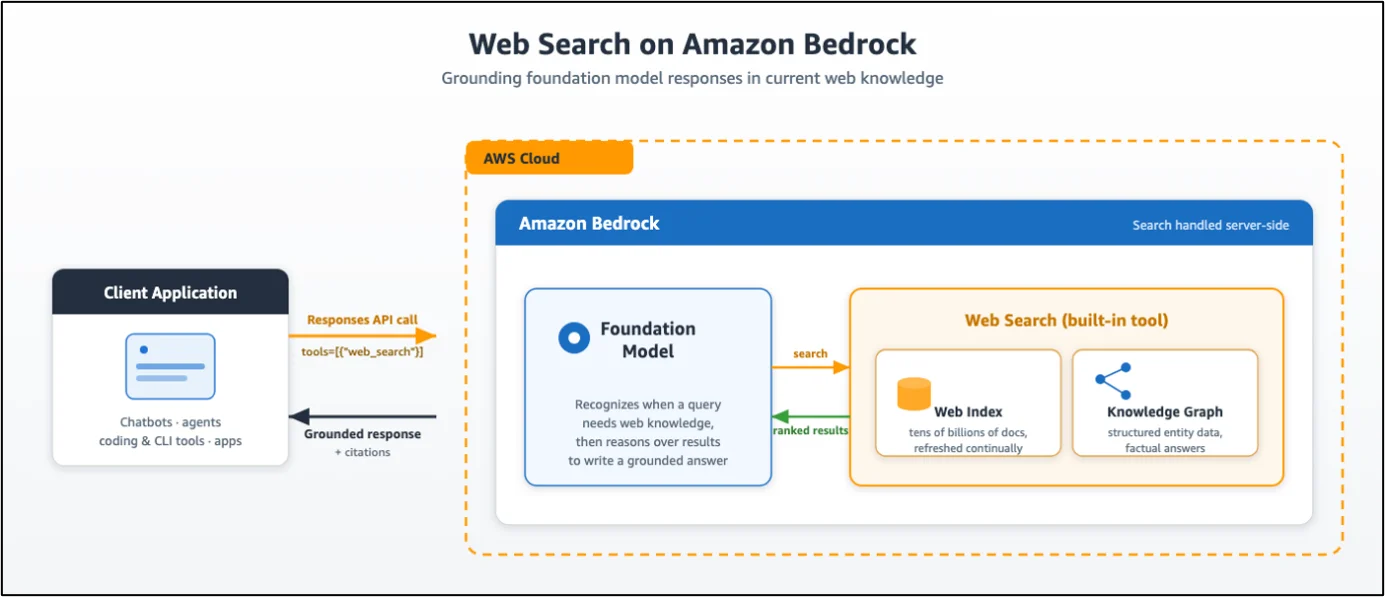
How Bedrock Web Search Works (Source: Introducing Web Search on Amazon Bedrock for foundation model grounding)
Why Real-Time Grounding Matters
Timing is critical for grounding when the impact on accuracy is significant, such as with a recently released product or new developments, like changes in documentation, pricing, rules, or news. The Web Search feature allows the model to augment its training knowledge with new data at query time. AWS also suggests it for specialised and long-tail queries.
Controlling Search Context
More retrieval isn’t always better, since extra context consumes tokens and raises costs. The Bedrock search_context_size property has 3 levels as follows:
- Low – up to 5 observations; for easy questions
- Medium – up to 11 observations; by default
- High – up to 25 observations; for difficult multi-step questions
This lets developers balance retrieval depth against token spend.
Data Governance and Security
The connection of an AI app to the internet raises governance issues, thus prompting Bedrock to provide developers with explicit control over this aspect. Specifying external_web_access as false ensures that any data is fetched within AWS and uses only the Bedrock index and cache. Live external web access will require explicit permission at both the request and IAM levels. Dedicated IAM actions let admins control who can search, fetch, or enable external access, and all activity is trackable through AWS CloudTrail.
Web Search vs. Knowledge Bases
While Web Search and Amazon Bedrock Knowledge Bases are commonly discussed together, they address very different use cases. Whereas the Knowledge Base ensures that your application is grounded in your organisation’s internal data, such as internal documentation, product manuals, and company policies, and addresses what your organisation’s data says, the Web Search goes much further. It looks at the external world to answer what it is saying now, including information not available in any internal document because it wasn’t available when the document was created.
For instance, if we consider the internal support assistant, questions about how to file an expense report or how to work from home fall into the category of Knowledge Base use cases, since all the required information is contained within the company’s documentation. However, questions such as “What new product did the competitor release?” or “What is the latest regulation?” are better addressed through Web Search.
Areas in Which This Could Be Implemented
Some examples include research assistants, developer tools with links to new documentation, market analysis applications, and user chatbots that provide time-sensitive answers with sources. Basically, any scenario where information changes faster than the model can be trained on it. The Web Search endpoint is currently available in-region in the US East (N. Virginia), US East (Ohio), US West (Oregon), and AWS GovCloud (US-West).
Conclusion
The key issue with generative AI is time, since the model is based on knowledge from the moment of training. Amazon Bedrock Web Search solves that problem by making real-time information retrieval an integral part of model inference, with citations, IAM controls, and configurable search depth.
Upskill Your Teams with Enterprise-Ready Tech Training Programs
- Team-wide Customizable Programs
- Measurable Business Outcomes
About CloudThat
FAQs
1. 1. Which models support Web Search on Bedrock?
ANS: – Currently, GPT 5.4, GPT 5.5, and the GPT 5.6 family (Sol, Terra, Luna).
2. 2. Does Web Search replace Knowledge Bases?
ANS: – No, Knowledge Bases ground answers in internal data; Web Search retrieves from the public web. They’re designed to work together.
3. 3. Can I restrict Web Search to AWS-only data?
ANS: – Yes, setting external_web_access to false keeps retrieval within the Bedrock web index and cached content, without reaching the live internet.

- AI citations
- AI Grounding
- AI Search
- Amazon Bedrock
- Amazon Bedrock Web Search
- AWS AI
- AWS bedrock
- AWS Generative AI
- Bedrock Knowledge Bases
- Bedrock Tools
- Claude
- Dynamic Knowledge
- Enterprise AI
- enterprise AI governance
- Foundation Models
- Generative AI
- GPT 5.6
- Knowledge Retrieval
- Live Data
- LLM
- RAG
- Real-Time AI
- real-time AI grounding
- Real-Time Knowledge
- Retrieval Augmented Generation
- Web Search

WRITTEN BY Sujay Adityan
Sujay works as a Research Associate in the Data & AIoT team at CloudThat, with a background in Data Science. He is skilled in data analytics, machine learning, cloud computing, Python programming, and working with large-scale databases and networks. Sujay has contributed to multiple AI/ML and Generative AI projects for both internal teams and clients. Passionate about continuous learning, he aspires to become a proficient software developer, creating meaningful, technology-driven solutions that make a real impact.


 PREV
PREV











Comments