

 Login
Login

 March 25, 2026
|
Voiced by Amazon Polly |
The DevOps ecosystem has evolved from basic CI/CD automation to intelligent, self-optimizing delivery platforms. Today, organizations are not just building pipelines; they are building AI-enhanced, self-healing, and predictive DevOps systems powered by open-source technologies.
In this blog, we’ll explore how open-source DevOps tools combined with Artificial Intelligence (AI) are transforming pipeline management, improving reliability, reducing costs, and accelerating software delivery.
Start Learning In-Demand Tech Skills with Expert-Led Training
- Industry-Authorized Curriculum
- Expert-led Training
Why AI in DevOps Pipelines?
Traditional CI/CD pipelines focus on automation; build, test, deploy, repeat. However, modern software systems are complex, distributed, and cloud native. Pipelines now handle microservices and containers, multi-cloud deployments, Kubernetes clusters, Infrastructure as Code (IaC), security and compliance scanning.
AI introduces intelligence into these pipelines by enabling predictive failure detection, automated root cause analysis, self-healing deployments, smart test case selection and resource optimization.
The combination of open-source DevOps tools + AI/ML is redefining Continuous Integration and Continuous Delivery.
Core Open-Source DevOps Tools Enhanced with AI
Jenkins
Jenkins remains one of the most widely used open-source automation servers. It supports thousands of plugins and integrates seamlessly with AI/ML systems.
AI Enhancements in Jenkins:
- Intelligent build failure prediction
- ML-based flaky test detection
- Auto-prioritized test execution
- Log anomaly detection using NLP
By integrating Jenkins with Python ML scripts or tools like TensorFlow, teams can analyse historical build data to predict failures before deployment
GitLab
GitLab offers an end-to-end DevOps lifecycle platform with integrated CI/CD, security, and monitoring.
AI Capabilities:
- AI-assisted code review
- Security vulnerability detection
- Smart merge conflict resolution
- Pipeline efficiency analytics
GitLab leverages AI for DevSecOps by automatically scanning dependencies and suggesting remediation steps.
Kubernetes
Kubernetes orchestrates containers at scale, but managing clusters manually is complex.
AI-Driven Enhancements:
- Predictive auto-scaling
- Intelligent pod scheduling
- Resource usage forecasting
- Self-healing clusters
When combined with monitoring tools such as Prometheus and AI-based anomaly detection systems, Kubernetes clusters can automatically respond to performance degradation.
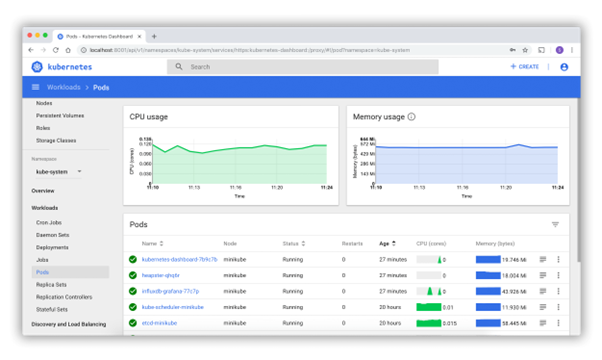
Fig 1: Kubernetes Dashboard
Argo CD
Argo CD is a GitOps-based continuous delivery tool for Kubernetes.
AI Integration:
- Drift detection using anomaly models
- Predictive deployment rollback
- Automated environment validation
- Smart release impact analysis
With AI-driven GitOps, organizations can ensure deployment consistency and prevent misconfigurations before they impact production.
Prometheus and Grafana
Monitoring is central to intelligent pipelines.
AI-Powered Observability:
- Anomaly detection in time-series metrics
- Forecasting resource consumption
- Automated alert prioritization
- Root cause correlation
By applying machine learning algorithms to Prometheus metrics, teams can detect abnormal patterns before incidents escalate.
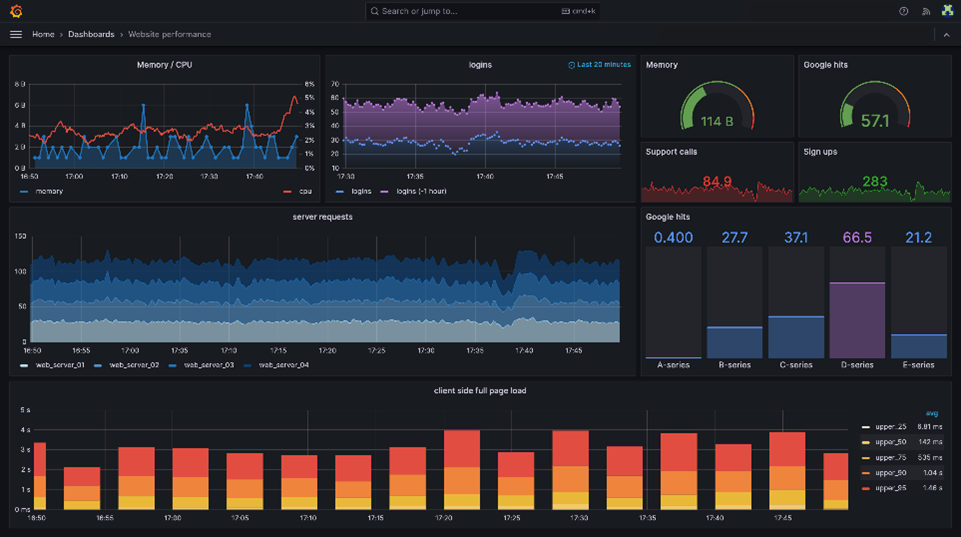
Fig 2: Prometheus Dashboard
AI Techniques Transforming DevOps Pipelines
AI in DevOps (often called AIOps) relies on several core technologies:
- Machine Learning
Used for:
- Build failure prediction
- Deployment risk scoring
- Resource utilization forecasting
- Natural Language Processing (NLP)
Applied to:
- Log analysis
- Incident report summarization
- ChatOps automation
- Reinforcement Learning
Used for:
- Intelligent scaling decisions
- Cost optimization
- Dynamic pipeline configuration
- Generative AI
Emerging use cases:
- Auto-generating pipeline YAML files
- Writing test cases
- Infrastructure as Code generation
- Automated documentation
AI-Enhanced Pipeline Architecture
A modern AI-powered DevOps pipeline typically includes:
- Code Commit → Git Repository
- AI Code Analysis
- Smart CI Build
- Intelligent Test Selection
- Security Scanning
- Deployment via GitOps
- AI Monitoring & Auto-Healing
The feedback loop continuously trains ML models using historical build logs, deployment success rates, incident reports, and performance metrics. This creates a self-improving DevOps ecosystem.
Benefits of AI-Driven Open-Source DevOps
- Faster Release Cycles
AI analyses previous builds and identifies which tests are actually impacted by code changes. Instead of running thousands of tests, it runs only relevant tests.
- Reduced Failure Rates
AI models analyse code changes, deployment history, and infrastructure metrics, then use predictive models to prevent risky deployments.
- Cost Optimization
AI analyzes cloud usage patterns and automatically recommends right-sizing of Instances, scaling resources, and eliminating unused infrastructure, thus improving cloud resource utilisation.
- Improved Security
AI improves DevSecOps by automatically detecting vulnerabilities and scanning code repositories, container images, and dependency libraries, ensuring Automated vulnerability detection and patch recommendations.
- Proactive Incident Management
AI enables predictive monitoring, analyses system telemetry data – CPU usage, memory usage, network traffic, and application logs, thus detecting anomalies before customer impact.
Challenges to Consider
Despite its advantages, Artificial Intelligence in DevOps introduces:
- Data quality requirements – AI systems are only as good as the data they are trained on. Old data may not represent the current system state. This leads to model degradation.
- Model training complexity – Training AI models for DevOps environments is not straightforward.
- Integration overhead – Integrating AI into existing open-source DevOps tools is rarely plug-and-play.
- Ethical and security concerns – AI in DevOps impacts production systems. Errors can cause major outages.
Organizations must ensure proper governance and model monitoring.
Intelligent Pipeline Automation
Open-source DevOps tools have long powered digital transformation. But the integration of AI is taking pipelines to the next level, transforming them from simple automation engines into intelligent, predictive, and autonomous systems.
By leveraging tools like Jenkins, GitLab, Kubernetes, Argo CD, and Prometheus, combined with AI techniques such as machine learning, NLP, and generative AI, organizations can build enhanced pipeline management systems that are:
Faster and smarter, ensuring more cost-efficient and secure. The future of DevOps is not just automation; it is intelligent automation.
Upskill Your Teams with Enterprise-Ready Tech Training Programs
- Team-wide Customizable Programs
- Measurable Business Outcomes
About CloudThat


WRITTEN BY Veeranna Gatate
Dr. Veeranna Gatate is a Subject Matter Expert on AWS and DevOps at CloudThat, specializing in cloud technologies, Java, DevOps, Python, and generative AI. With over 13+ years of extensive experience in training and mentoring, he has trained over 3,000 professionals to upskill in emerging technologies. Known for simplifying complex concepts through hands-on teaching and connecting theory with real-world applications, he brings deep technical knowledge and practical insights into every learning experience. His passion for empowering learners reflects in his unique approach to learning and development.


 PREV
PREV












Comments