

 Login
Login

 August 21, 2026
|
Voiced by Amazon Polly |
Introduction
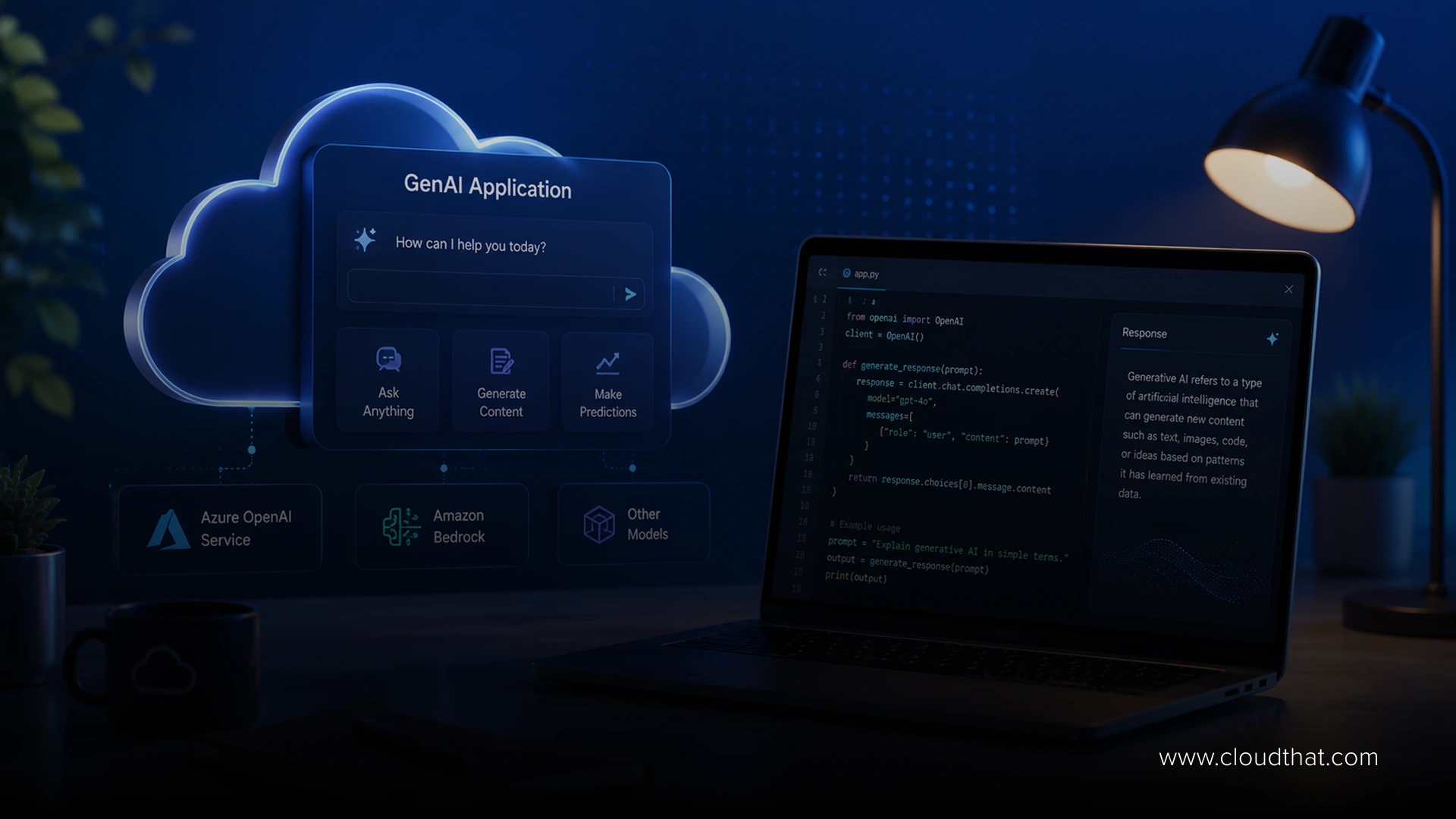
An AI course for developers should teach you to build GenAI applications that survive contact with real users, not just demo well once. A serious generative ai course for developers covers prompt engineering, retrieval-augmented generation, vector databases, agent orchestration, evaluation, and deployment, taught through actual builds rather than slides. It puts you inside a real stack, Azure OpenAI, Amazon Bedrock, or similar, and forces you to handle latency, cost control, and hallucination checks, because that is what separates a working prototype from something a company can ship. If your current program has no deployment module, it is only teaching you half the job.
Master Claude AI for Next-Gen Applications
- Prompt Engineering
- Claude API
- Secure AI Development
The Demo Worked. Production Broke It.
A developer builds a chatbot in a weekend. It answers questions beautifully in the demo. Everyone claps.
Three weeks later it is in production, and it is hallucinating pricing information to actual customers.
That gap between “worked in the demo” and “survives production” is exactly what a strong generative ai course for developers is supposed to close. Most GenAI tutorials online teach you to call an API and print the response. They rarely teach you what happens when that response is wrong, slow, or expensive at scale.
This blog breaks down what skills actually matter, what a strong program should cover, and why CloudThat structures its AI Technical Practitioner program the way it does. If you are already comfortable with core AI and ML courses foundations, this is the layer that turns that knowledge into shippable applications.
Who Actually Needs an AI Course for Developers
If you already write code for a living and keep getting handed GenAI features nobody trained you for, you need an AI course for developers.
This is not a beginner audience learning what a large language model is. Most candidates are backend or full stack developers who understand APIs, databases, and deployment pipelines, but have never built anything with an LLM in the loop. Product teams are shipping GenAI features faster than engineering teams can safely build them, and that gap is exactly where structured training earns its place.
If you are still writing your first “Hello World” script, start with core programming fundamentals first. This kind of training assumes you can already build and ship regular software.
What Makes a GenAI Application Production-Ready
Short answer: it handles the cases your demo conveniently skipped.
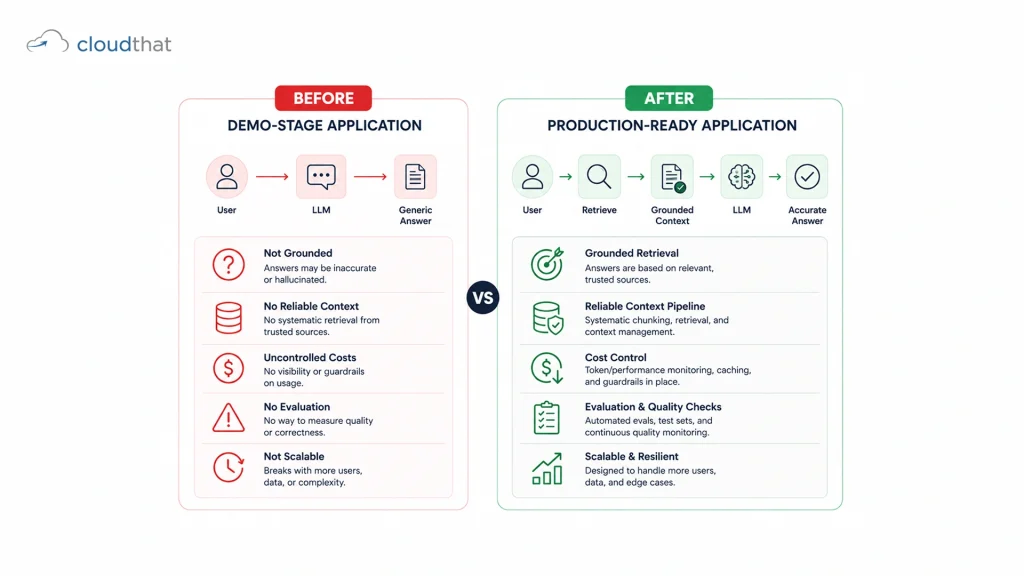
A demo answers the happy path question correctly once. A production application handles a user asking the same question three different ways, handles the model returning something slightly wrong, and handles ten thousand requests an hour without the API bill exploding.
Production-ready means retrieval is grounded in your actual data instead of the model’s guesswork, latency stays predictable under load, and there is a real evaluation process catching hallucinations before a customer does. This is the exact gap most free tutorials leave open, and it is why training built around real deployment scenarios matters more than training built around clever prompts alone.
Core Skills This Kind of Training Should Teach
Here is what actually separates a working GenAI engineer from someone who can call an API.
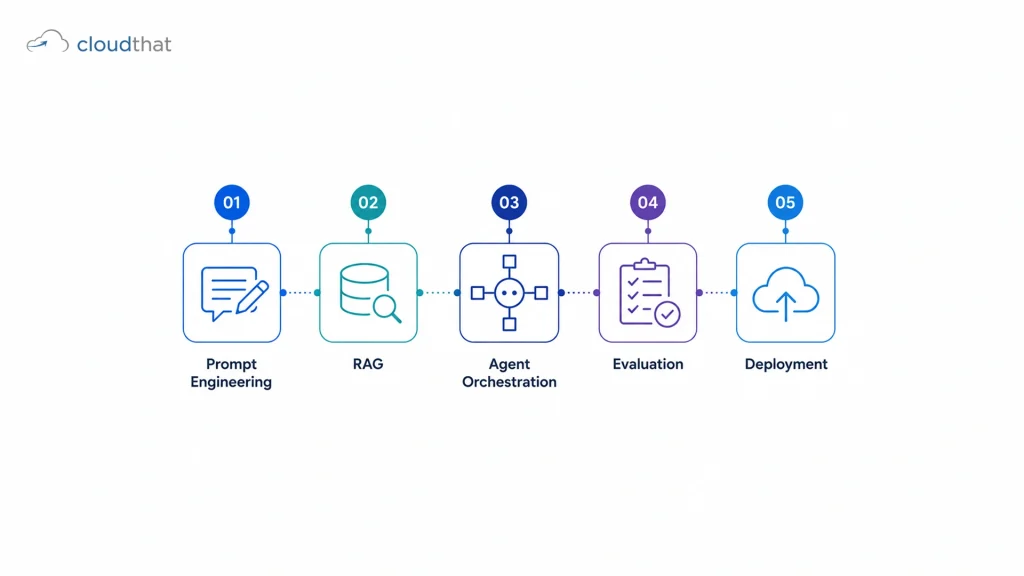
Prompt engineering that holds up under pressure. Not just writing a good prompt once, but structuring prompts that stay reliable as inputs vary. This connects directly to CloudThat’s Generative AI and Prompt Engineering course, which treats prompting as an engineering discipline, not guesswork.
Retrieval-augmented generation (RAG) and vector databases. Grounding model responses in your own data instead of letting it hallucinate. Any credible generative ai course for developers spends real time here, since most enterprise GenAI use cases are RAG problems in disguise.
Agent orchestration. Chaining multiple calls, tools, and decisions together instead of a single prompt-response loop. CloudThat’s Agentic AI training covers exactly this layer.
Evaluation and guardrails. Testing model output the way you would test regular code, with defined metrics for accuracy, relevance, and safety, not just eyeballing responses.
Deployment and cost management. Actually shipping the thing, monitoring token spend, and keeping latency inside acceptable limits once real traffic hits it.
Inside a Strong Program
This is where most online courses quietly fall apart.
A genuinely useful generative ai course for developers puts you inside a real cloud environment, building against Azure OpenAI, Amazon Bedrock, or a comparable production stack, not a sandboxed playground that disappears after the course ends. CloudThat’s AI-103 Develop AI Apps and Agents on Azure course, for example, has learners build and deploy actual agent-based applications, not just walk through slides describing what an agent theoretically does.
Developers working across multiple AI providers also benefit from exposure to AWS Generative AI Development and CloudThat’s Claude Certified Architect track, since production teams rarely lock into a single model provider forever.
AI Course for Developers vs Generic Coding Bootcamps
People often confuse a general coding bootcamp with an AI course for developers, assuming any technical program will teach the same GenAI skills.
| Aspect | Generic Coding Bootcamp | AI Course for Developers |
| Focus | General programming fundamentals | LLM integration, RAG, agents, evaluation |
| Hands-on depth | Basic projects | Production-grade builds in a live cloud environment |
| Prerequisites | Little to none | Existing coding and API experience expected |
| Outcome | General developer skills | GenAI engineer or AI application developer readiness |
A generic bootcamp teaches you to code. This kind of program teaches you to ship AI features that do not fall apart under real usage.
Building Production Skills With CloudThat
CloudThat’s AI Technical Practitioner track is built specifically for developers who already know how to code and need the GenAI layer added on top, not a beginner programming course wearing an AI label. Learners work inside actual cloud environments building retrieval pipelines, agent workflows, and deployment scripts, then walk out with applications that hold up outside a sandbox.
The AI-103 Develop AI Apps and Agents on Azure course anchors the core curriculum, paired with Generative AI and Prompt Engineering for the prompting foundation and Agentic AI training for multi-step orchestration. Developers building against OpenAI’s tooling specifically can move into the Codex Deployment Practitioner Program once the fundamentals are solid. For engineering teams instead of individuals, CloudThat’s corporate training arm runs cohorts through the same practical curriculum, and organisations needing GenAI capability built directly into their stack can work with the GenAI Innovation Center on the consulting side.
Conclusion
The right AI course for developers does not just teach you to call a model API. It teaches you to build something that survives real users, real traffic, and real edge cases. Get the retrieval, evaluation, and deployment pieces right, and the demo-to-production gap stops being a problem.
Key Takeaways
- An AI course for developers should teach production skills, not just how to call a model API.
- Prompt engineering, RAG, agent orchestration, evaluation, and deployment form the real GenAI engineering skill set.
- Production-ready applications handle edge cases, latency, and cost, not just the happy path a demo shows.
- A genuine generative ai course for developers uses a real cloud environment, not a disappearing sandbox.
- RAG and vector databases matter because most enterprise GenAI use cases are grounding problems in disguise.
- Agent orchestration skills separate simple chatbots from multi-step GenAI applications.
- Evaluation and guardrails catch hallucinations before customers do, and most tutorials skip this entirely.
- Existing coding and API experience is assumed before starting this kind of training.
- Hands-on deployment practice is what actually closes the gap between demo and production.
- Vendor flexibility matters, since production teams rarely stay locked into one model provider.
Ready to build GenAI applications that survive production, not just demos? Explore CloudThat’s AI-103 Develop AI Apps and Agents on Azure and start building on a real stack.
Advance Your Career with OpenAI Training
- Build AI Applications
- GPT-5 & OpenAI APIs
- Hands-on Projects
About CloudThat
FAQs
1. Do I need machine learning experience before starting?
ANS: – No, but you should already be comfortable coding, working with APIs, and deploying applications. Most programs assume software engineering skills, not ML theory.
2. What is the difference between this kind of program and a data science course?
ANS: – A generative ai course for developers focuses on building applications using existing LLMs. Data science programs focus more on model training, statistics, and analysis.
3. How long does a solid AI course for developers usually take?
ANS: – Most structured programs run several weeks to a few months depending on depth, with hands-on labs taking up the majority of that time.
4. Which cloud platform should I learn for GenAI development?
ANS: – Azure OpenAI and AWS Bedrock are both widely used in enterprises today. A good program exposes you to at least one production-grade platform rather than a generic playground.
5. Can this training help me switch from a general coding role into an AI-focused one?
ANS: – Yes, provided the course includes real deployment and evaluation practice, not just prompt writing exercises.
6. What is the hardest skill to learn in this kind of program?
ANS: – Most learners find evaluation and guardrails the hardest, since it requires thinking about failure cases instead of just getting a working demo.

WRITTEN BY Himisha Raval
Himisha Raval is a Digital Marketing Manager at CloudThat with a strong command of search engine optimization, web analytics, link building, and content strategy. She brings a data-driven approach to digital marketing, helping IT companies strengthen their online presence, improve search rankings, and generate consistent leads across channels. Beyond execution, she plays an active role in ideation, campaign strategy, and website performance optimization. Outside of work, she balances her analytical side with a love for travel, nature painting, and dancing.


 PREV
PREV






Comments