

 Login
Login

 September 25, 2026
|
Voiced by Amazon Polly |
Ask three people at the same company what “Claude” means, and you’ll get three different answers: a chatbot, a coding tool, an API line item. The Anthropic AI stack is five distinct layers: the models, how you access them, the applications built on top, the protocol that connects Claude to your tools, and where it all runs. Most training and procurement conversations only ever touch one of them. This guide walks through each layer, so you know which piece solves which problem before you buy another seat.
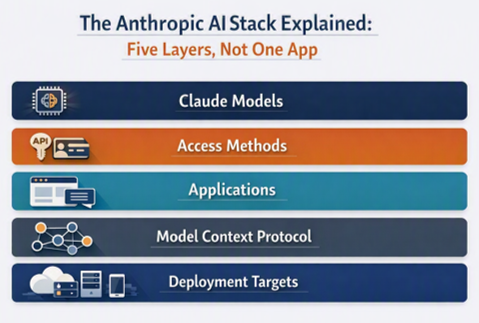
Fig 1: Five-layer view of the Anthropic AI stack, from deployment infrastructure to Claude models and user-facing applications.
Start Learning In-Demand Tech Skills with Expert-Led Training
- Industry-Authorized Curriculum
- Expert-led Training
What Is the Anthropic AI Stack?
The Anthropic AI stack is the full set of products and infrastructure layers that sit between a raw Claude model and the work someone actually does. Anthropic itself ships multiple surfaces sharing one underlying intelligence: Claude.ai for chat and Cowork, Claude Code for engineering, the Claude API for custom builds, and Claude Tag for Slack. Five layers matter when planning an enterprise rollout: the model, the access method, the application, the connective protocol, and the deployment target.
As organizations expand their use of AI assistants in enterprise workflows, understanding the strengths, limitations, and deployment considerations of different models becomes increasingly important. For professionals looking to build practical expertise with Claude and its ecosystem, structured learning paths can help bridge the gap between theory and real-world implementation. Resources such as the Anthropic Claude Courses provide broader coverage of Claude capabilities, while the Claude Certified Associate – Foundations program focuses on foundational concepts and skills that support effective adoption in business environments.
Confusing these layers is the most common rollout mistake. A team that buys Claude Pro seats gets chat, Cowork, and Claude Code for individuals, but a team that needs Claude wired into an internal ticketing system needs the API and the MCP layer instead, regardless of how many chat seats it already owns. The rest of this guide works through each layer in the order a rollout usually needs them.
Which Claude Model Should You Start With?
Anthropic’s current lineup runs four public tiers by intended job, not just size: Claude Haiku 4.5 for fast, low-cost tasks; Claude Sonnet 5 for most coding, agent, and enterprise workflows; Claude Opus 5 for complex agentic coding and high-stakes reasoning; and Claude Fable 5 at the top as Anthropic’s most generally capable model. Pricing scales with capability, from $1 input / $5 output per million tokens on Haiku 4.5 up to $10/$50 on Fable 5.
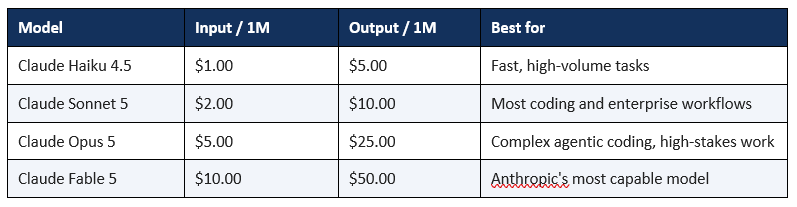
Table 1: Official API rates, per Anthropic’s Claude Platform pricing docs.
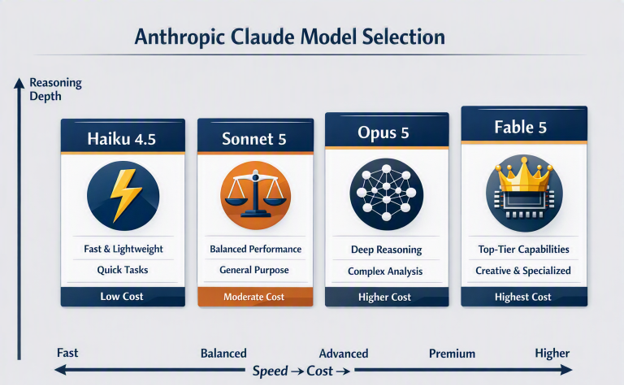
Fig 2: Claude model selection map showing how speed, cost, and reasoning capability increase from Haiku to Fable.
All models on Claude 4.6 and later, including Fable 5, ship with a 1-million-token context window as standard rather than an opt-in add-on. Above Fable 5 sits Claude Mythos 5, the same underlying model without Fable’s extra safety filtering for biology, cybersecurity, and LLM research, available only to approved partners doing defensive cybersecurity work. For most enterprise coding and workflow automation, Anthropic’s own guidance is straightforward: start on Sonnet 5, move to Opus 5 when a task’s stakes or complexity justify the extra cost, and reserve Haiku 4.5 for high-volume, low-complexity work like support-ticket triage.
How Do You Actually Get Claude into Your Hands?
Two separate paths lead to the same models. Claude.ai subscription plans: Free, Pro, Max, Team, and Enterprise, billed by seat and covering chat, Claude Code, and Claude Cowork for people working inside Anthropic’s own apps. The Claude Platform, or API, bills by token instead and is for engineering teams building custom software, with two ways to build: the raw Messages API, or Claude Managed Agents, a hosted agent harness (the tool-and-execution loop wrapped around the model) that Anthropic runs for you.
On the subscription side, Pro runs roughly $20 a month (about $17 billed annually) and is the entry point that includes Claude Code and Cowork; Max adds 5x or 20x the usage headroom at $100 or $200 a month for heavy individual users; Team starts around $20 to $25 per standard seat with a five-seat minimum, with premium seats near $100 to $125 adding Claude Code; and Enterprise layers on SSO (single sign-on), SCIM (automated user provisioning), and compliance controls at custom pricing. On the API side, the Messages API is stateless (it holds no memory of earlier turns unless you resend them) and you own the agent loop yourself, while Claude Managed Agents, in public beta since April 2026, handles sandboxing (isolated execution), state persistence, and error recovery for you at $0.08 per session-runtime hour plus standard token costs, with early adopters including Notion and Asana.
What Can Claude Code and Claude Cowork Each Do?
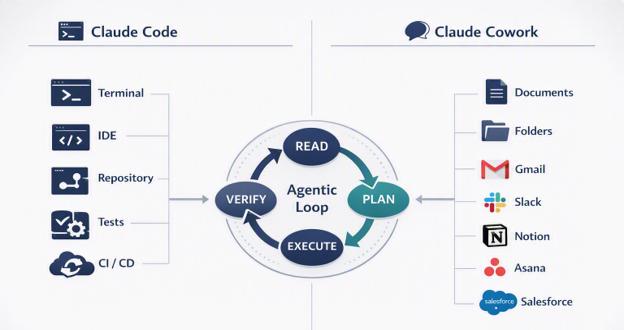
Fig 3: Claude Code and Claude Cowork apply the same read-plan-execute agentic loop to engineering and knowledge-work workflows.
Claude Code and Claude Cowork run on the same underlying agentic architecture but serve different purposes: Claude Code targets software engineering, writing, debugging, testing, and shipping code, while Cowork applies that same read-plan-execute loop to non-coding knowledge work such as research, file organization, and document production. Claude Code reaches you through the terminal, a desktop app, VS Code, and JetBrains extensions, the web, and Slack; Cowork lives inside the Claude Desktop app.
Cowork launched as a macOS-only, Max-subscriber research preview in January 2026 and reached general availability across paid plans on both macOS and Windows within a few months, with web and mobile access rolling out in beta. It works by granting folder-level access and reaching for connectors, Gmail, Slack, Notion, Asana, Salesforce, and hundreds more, before falling back to direct computer use only when no connector or browser path exists. Two more purpose-built surfaces round out the application layer: Claude in Chrome for browser automation, and Claude in Excel and Claude in PowerPoint for spreadsheet and slide work directly inside Microsoft Office.
What Does MCP Add to the Stack?
MCP, the Model Context Protocol, is the open standard that Anthropic introduced and open-sourced in November 2024 for connecting any AI application to any external tool or data source through a single shared interface, rather than a custom integration for each pairing. It turns what used to be an M×N integration problem, M applications each needing a custom connector for N tools, into an M+N problem: a tool builder ships one MCP server, and any MCP-compatible application can use it.
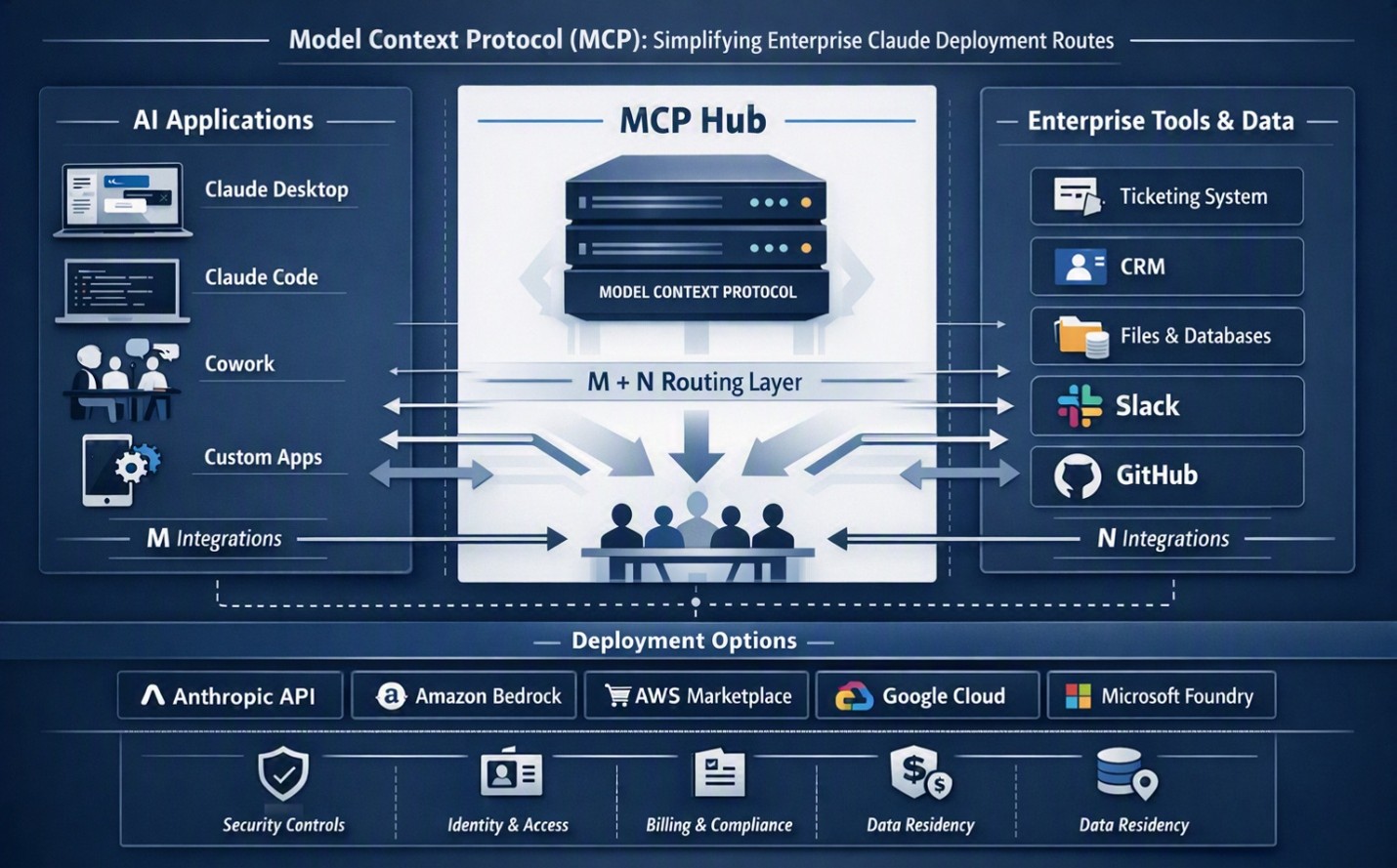
Fig 4: MCP reduces custom integrations by connecting multiple Claude applications to enterprise tools through a shared protocol layer.
MCP is what lets Claude Code, Claude Cowork, Claude Desktop chat, and custom Agent SDK builds all reach the same connector catalog instead of needing four separate integrations. Every Claude.ai plan supports connecting MCP servers to Claude Desktop, and OpenAI, Microsoft, and Google DeepMind have all adopted the same protocol since Anthropic released it. That matters for procurement, since an MCP server your team builds for one AI product is very likely to work with others later. For teams that need something the packaged apps don’t offer, the Agent SDK sits one layer below Claude Code and Cowork, giving developers the same harness, tool ecosystem, and MCP connectivity to build a fully custom agent from scratch.
Which Cloud Should Run Claude for Your Enterprise?
The same Claude models are available via five deployment routes: Anthropic’s own Claude API, Amazon Bedrock, Claude Platform on AWS (billed through AWS Marketplace), Google Cloud, and Microsoft Foundry. Enterprises already standardized on one hyperscaler generally route Claude through that provider, so spend, identity, and network policy inherit controls the security team already trusts, rather than adding a sixth vendor relationship.
The trade-off is timing: first-party API features occasionally reach Anthropic’s own endpoint before reaching a cloud marketplace route, so a team evaluating a brand-new capability should check availability by provider rather than assume parity. For regulated data specifically, the API layer offers Zero Data Retention routing and a data-residency parameter that pins inference to a specific geography, both independent of the underlying cloud, which is worth confirming with Anthropic or your cloud account team before committing a regulated workload to any single route.
Before adding another Claude line item to next quarter’s budget, map every team currently using or requesting Claude against these five layers: which ones just need a chat seat, which need Claude Code or Cowork specifically, and which need a custom Agent SDK build talking to internal systems over MCP. That map, not the subscription tier, is the actual adoption plan; the plan you buy is just how you pay for it.
Upskill Your Teams with Enterprise-Ready Tech Training Programs
- Team-wide Customizable Programs
- Measurable Business Outcomes
About CloudThat
FAQs
1. What's the difference between Claude Code and Claude Cowork?
ANS: – Claude Code targets software engineering, reading, writing, and testing code in a repository. Claude Cowork applies the same agentic loop to non-coding knowledge work, like organizing files, producing documents, and synthesizing research, inside the Claude Desktop app.
2. Do I need the API if my team already has Claude.ai seats?
ANS: – Only if you’re building custom software that calls Claude programmatically or wiring it into an internal system. Claude.ai seats cover chat, Claude Code, and Cowork for people working directly in Anthropic’s apps; the API is a separate, token-billed product for engineering teams.
3. What is MCP, and do I need to build my own MCP server?
ANS: – MCP is the open standard that lets Claude connect to external tools and data through one shared interface. Most teams don’t need to build a server at all , they connect to an existing one from Anthropic’s or a third party’s catalog; building your own only makes sense for a genuinely internal system with no existing connector.
4. Can I run Claude on AWS or Google Cloud instead of Anthropic's API?
ANS: – Yes. The same models are available through Amazon Bedrock, Claude Platform on AWS, Google Cloud, and Microsoft Foundry, in addition to Anthropic’s first-party API, so teams already standardized on one cloud can keep billing and identity management inside that provider.
5. What's the difference between Claude Opus 5 and Claude Fable 5?
ANS: – Opus 5 costs $5/$25 per million tokens and targets complex agentic coding and enterprise work. Fable 5 sits above it as Anthropic’s most generally capable model at $10/$50 per million tokens; Anthropic offers that same underlying model separately, without Fable’s extra safety filtering, as Mythos 5, with limited availability for approved defensive-cybersecurity partners.


WRITTEN BY Pramod Sunagar
Dr. Pramod Sunagar is a Subject Matter Expert and Microsoft Certified Trainer at CloudThat, specializing in Microsoft Azure, DevOps, and GitHub Copilot. With over 12 years of experience in academics and corporate training, he has upskilled more than 2,500 learners through immersive, hands-on sessions. Dr. Sunagar is widely recognized for simplifying complex cloud and DevOps concepts through real-world examples, guided labs and a highly interactive delivery style. His approach blends academic depth with practical application, enabling professionals to confidently apply skills in real-world projects. Backed by a Ph.D. in Text Analytics and multiple Azure certifications, he delivers training across a wide range of roles—from beginners to advanced developers—focusing on certifications such as AZ-400, AZ-204, AZ-900, AI-102, GitHub Copilot, AI-900, DP-900 and SC-900. His passion for teaching, combined with a commitment to learner success, makes him a highly trusted mentor in the cloud and DevOps learning space.


 PREV
PREV









Comments