

 Login
Login


 September 25, 2026
|
Voiced by Amazon Polly |
The Claude Certification Program now includes four paid, proctored credentials for different Claude roles: Associate, Developer, Architect Foundations, and Architect Professional. If you use Claude for business productivity, the Associate exam is the best fit. If you build Claude-powered applications, choose Developer. If you design Claude systems, choose Architect Foundations. If you own enterprise-scale delivery, governance, and stakeholder outcomes, choose Architect Professional. The right choice is not the “hardest” exam; it is the credential that matches the work you already do.
Start Learning In-Demand Tech Skills with Expert-Led Training
- Industry-Authorized Curriculum
- Expert-led Training
What are the four Claude certifications in 2026?
Anthropic Partner Academy lists four Claude credentials, each mapped to a specific role and level. The page groups the credentials into Associate, Developer, and Architect roles and lists prices of $99, $125, $125, and $175 USD.
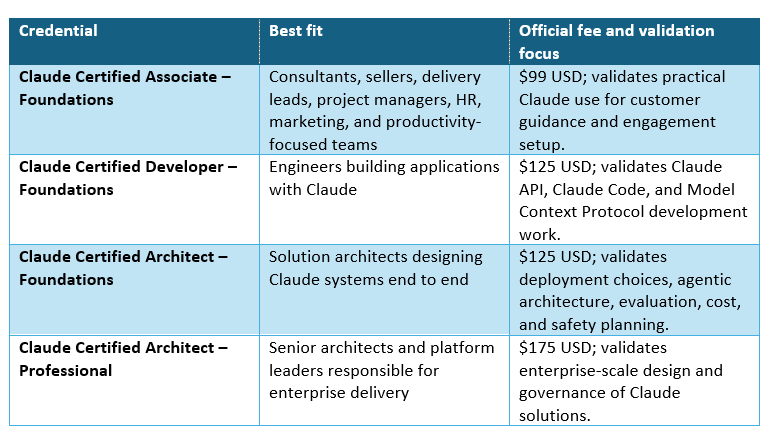
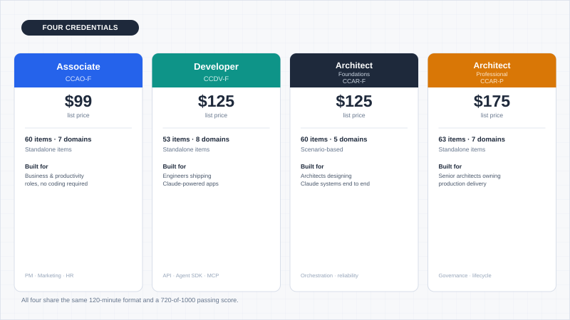
Fig 1: The four Claude certifications and their career-focused learning paths.
All four credentials share a 120-minute format and a 720-of-1000 passing score.
What do all Claude certification exams have in common?
Pearson VUE delivers Claude certification exams and states that the program validates skills for advising, designing, and building Claude solutions. Pearson VUE also names Credly as the digital badge provider for successful candidates.
Pearson VUE states that candidates can retake a Claude exam 14 days after the first unsuccessful attempt, 30 days after the second, and 90 days after the third. Pearson VUE allows up to four attempts per exam within any rolling 12-month period. Teams should schedule exam-readiness reviews before the first test date so that retake windows do not delay partner-readiness goals.
Which Claude certification should you choose for your role?
Choose the Claude certification by role because Anthropic maps each credential to the work candidates already perform.
- Choose Associate if you use Claude for writing, summarizing, reviewing, researching, and business productivity.
- Choose Developer if you build applications with Claude APIs, Claude Code, tools, agents, or integration workflows.
- Choose Architect Foundations if you design solution architecture, plan evaluation, manage cost, and define safety controls.
- Choose Architect Professional if you own enterprise rollout, governance, risk review, stakeholder communication, and long-term adoption.
Anthropic Partner Academy provides free preparation courses for partner candidates. The certification FAQ states that the four paid exams cost $99, $125, $125, and $175 USD before partner-tier discounts. A prep course helps candidates study; a certification confirms that the candidate passed a role-specific proctored exam.
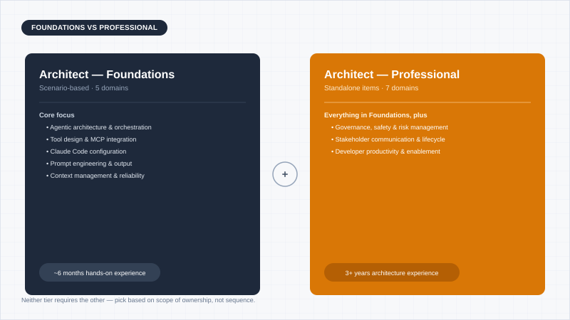
Fig 2: Choose the right Claude certification based on your role, skills, and responsibilities
Professional keeps everything. Foundations tests and adds governance, stakeholder, and enablement domains on top.
How are Claude Architect Foundations and Architect Professional different?
Claude Architect Foundations fits partners who design Claude solutions end-to-end, choose deployment platforms, shape agentic architectures, and plan for evaluation, cost, and safety. In this article, agentic architecture means a Claude-based system that can use tools, follow multi-step workflows, and complete a defined business task with human-approved controls.
Anthropic’s certification FAQ says Architect Foundations and Architect Professional are separate exams. The FAQ describes Foundations as proof that an architect can build with Claude, and Professional as proof that an architect can design and govern Claude solutions at enterprise scale. In this article, governance means the policies, review steps, risk controls, and ownership model that guide how a team uses Claude in production.
Choose the Claude credential that matches your daily work
Choose the credential that matches your daily Claude responsibilities. Associate fits business users; Developer fits builders; Architect Foundations fits solution designers; and Architect Professional fits enterprise owners.
- For business enablement teams, start with Associate because the exam focuses on practical Claude use and customer guidance.
- For engineering teams, start with Developer because the exam focuses on Claude API work, Claude Code, Model Context Protocol, and production agents.
- For solution architecture teams, start with Architect Foundations because the exam focuses on platform choices, agent design, evaluation, cost, and safety.
- For enterprise AI leaders, choose the Architect Professional exam because it focuses on governance, stakeholder alignment, rollout ownership, and lifecycle management.
To prepare teams before the exam, use Generative AI and Prompt Engineering Course Guide, OpenAI and Prompt Engineering training portfolio, and AI and ML certification courses. These internal resources help teams practice prompt design, agent workflows, responsible AI, and production deployment before they choose a Claude certification path.
How should you prepare for the Claude certification?
Start with the official Anthropic Partner Academy page because it links each credential to prep courses, exam guides, and registration. Build your preparation around the role you plan to certify for, not around a generic Claude study plan. A business user needs prompt quality, use-case framing, and customer guidance practice, while a developer needs hands-on work with APIs, Claude Code, and tool-connected workflows.
- Week 1: Read the exam guide, list the domains, and map each domain to one work example from your current projects.
- Week 2: Practice role-specific tasks, such as writing reliable prompts for Associate, building API workflows for Developer, or designing evaluation criteria for Architect.
- Week 3: Review weak areas through scenarios, especially safety, cost planning, tool use, and stakeholder communication.
- Week 4: Run a timed readiness check, review incorrect answers, and schedule the exam only after you can explain every major domain in your own words.
What should teams check before scheduling a Claude exam?
Teams should confirm eligibility, role fit, study readiness, and retake risk before scheduling the exam. This avoids wasted exam fees and prevents certification timelines from slipping when a candidate needs a second attempt.
- Eligibility: Confirm that the candidate uses a partner organization email address, as Anthropic’s FAQ states that certification registration requires a recognized partner company domain.
- Role alignment: Match the candidate to the exam that reflects current work responsibilities rather than future aspirations.
- Exam readiness: Ask the candidate to explain the credential’s exam domains, not just complete a prep course.
- Retake planning: Reserve buffer time because Pearson VUE lists waiting periods of 14, 30, and 90 days after unsuccessful attempts.
- Business outcome: Decide whether the certification supports delivery, sales enablement, solution architecture, or partner-network goals.
Before scheduling your exam, review the official Claude certification paths and prep resources, confirm delivery details on the Pearson VUE exam registration page, and check the certification FAQ for fees, retakes, and validity rules.
How can you choose between Associate, Developer, and Architect?
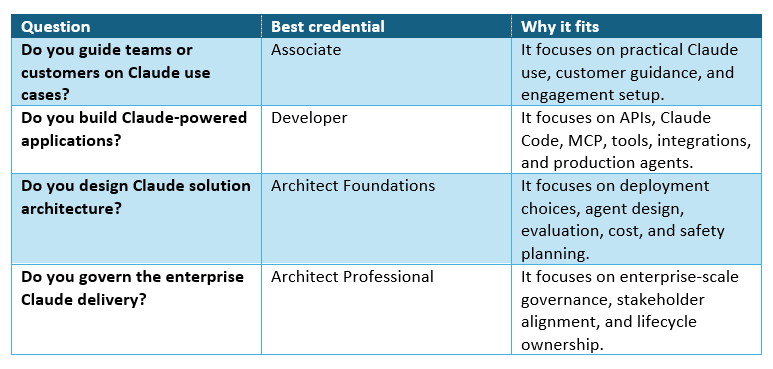
Use daily responsibility as the main decision rule. If a person primarily uses Claude to improve business workflows, the Associate offers the clearest fit. If a person builds software or automates workflows with Claude, the Developer gives the clearest fit. If a person decides how Claude systems run in production, Architect Foundations or Architect Professional gives the clearest fit.
What mistakes should candidates avoid before the Claude exam?
Candidates should avoid choosing the most advanced credential only because it sounds more valuable. The better credential is the one that aligns with daily work and allows the candidate to answer scenario-based questions drawn from real experience.
- Do not skip the exam guide: It tells candidates what the credential measures, so use it as the study blueprint.
- Do not confuse prep courses with certification: A prep course supports learning, while the certification requires passing a proctored exam.
- Do not ignore retake windows: A failed attempt can add 14, 30, or 90 days to the plan, depending on the attempt number.
- Do not overgeneralize Claude’s skills: Prompting, API development, solution design, and enterprise governance require different preparation tasks.
- Do not schedule without a use case: Tie the credential to a customer scenario, an internal delivery goal, or a partner-readiness target.
Choose Your Claude Certification
For most learners, the best Claude certification in 2026 is the one that matches their daily role. Choose Claude Certified Associate – Foundations if you use Claude for business productivity, customer guidance, or enablement. Choose Claude Certified Developer- Foundations if you build Claude-powered applications, APIs, agents, or tool-connected workflows. Go for Claude Certified Architect – Foundations if you design Claude solutions, evaluate deployment options, and plan for cost, safety, and architecture.
You can pick Claude Certified Architect- Professional if you lead enterprise-scale Claude adoption, governance, stakeholder alignment, and lifecycle management. In short, start with your responsibility, study the official exam guide, practice role-based scenarios, and schedule the exam only when you can explain how Claude creates measurable business value in real use cases.
Upskill Your Teams with Enterprise-Ready Tech Training Programs
- Team-wide Customizable Programs
- Measurable Business Outcomes
About CloudThat
FAQs
1. Is Claude's certification official?
ANS: – Yes. Claude certifications are official Anthropic Partner credentials listed on Anthropic Partner Academy. Pearson VUE also lists the Claude Certification Program as an exam program for validating skills in Claude solutions.
2. Which Claude certification is best for non-developers?
ANS: – Claude Certified Associate – Foundations is the best fit for non-developers because Anthropic describes the Associate role as suitable for consultants, sellers, and delivery leads who guide customers toward Claude use cases.
3. Which Claude certification is best for developers?
ANS: – Claude Certified Developer – Foundations is the best fit for developers because Anthropic describes the Developer role as suitable for engineers who build with the Claude API, Claude Code, and Model Context Protocol. Model Context Protocol, or MCP, connects Claude to external tools and data sources.
4. Is an Architect Professional required after Architect Foundations?
ANS: – No. Anthropic’s certification FAQ states that Architect Foundations and Architect Professional are separate certifications with distinct exams, and that there is no formal prerequisite for Professional. Choose Architect Foundations if you design Claude solutions; choose Architect Professional if you own enterprise-grade rollout, governance, lifecycle, and stakeholder responsibilities.


WRITTEN BY Akshay K S
Akshay is a Tech Lead at CloudThat, specializing in Azure Integrations and DevOps. With 10+ years of experience in consulting and training, He have trained over 10000+ professionals/students to upskill in Azure, AWS, GCP, GitHub, DevOps and Copilot technologies. Known for simplifying complex concepts, hands-on teaching, industry insights, he brings deep technical knowledge and practical application into every learning experience. His areas of expertise include Cloud, DevOps, DevSecOps, GitHub etc. Akshay's passion for teaching and learning reflects in his unique approach to learning and development.


 PREV
PREV












Comments